Article
What should buyers know first?
Short answer: Review textile-to-textile recycled fabrics by feedstock, composition, quality, colour consistency, traceability and repeat-order requirements.
Textile-to-textile recycled fabrics use recovered textile inputs to make new textile materials. Buyers need to identify the feedstock, processing route, finished composition and evidence connecting the delivered fabric to the claimed source. Then they need to check the fabric in the intended garment. A credible source story and an acceptable product sample are separate approvals.
Yinshan Fashion works with buyers on custom and private-label bulk programmes rather than unrestricted ready-stock wholesale. For a small fashion brand, the useful question is whether an identified material can support the first order and the next one. This guide explains how to structure that enquiry without assuming every recycled fabric follows the same route.
Define Textile-to-Textile Recycled Fabrics in the Actual Order
Begin by asking what the term refers to in the supplier's proposal. Does the recovered input come from cutting remnants, unused textile stock or garments that have been worn? What processing happens before it becomes yarn or fabric? Which part of the finished fabric contains the resulting material? A clear answer should describe a material flow that the buyer can connect to the offered fabric reference.
Do not let a photograph of textile waste stand in for that explanation. The picture may illustrate a general process, a development trial or material belonging to a different customer. Request a written description of the proposed route and ask how the sample is identified. If the supplier cannot yet connect the sample to a specific source category, record that as information still needed rather than filling the gap with marketing language.
The word textile also needs a practical boundary. A collection project might receive garments, but sorting may remove trims, contamination or unsuitable components before processing. The weight collected at the beginning is therefore not automatically the weight incorporated into new fabric. If the brand wants to communicate a quantity or percentage, identify the stage and denominator to which it belongs.
For product development, record three separate references: the recovered input category, the intermediate material where applicable and the finished fabric code. A finished fabric may use a mixture of recycled and other fibres to meet a construction requirement. That does not make the input story unimportant, but it changes how the buyer must describe the final product.
Use the established recycled-fabric guide for the broader material categories. This article focuses on the purchasing consequences of a textile feedstock: what must be controlled, what can vary and what the supplier needs to document before the buyer commits a style to that route.
Separate Pre-Consumer and Post-Consumer Sources
A factory cutting remnant and a garment returned after use have different histories. A remnant may have a known fabric reference and colour batch. A used garment may carry information from an older label, include repairs or have an uncertain care history. Those differences affect the questions the processor needs to answer before accepting the material.
Ask the supplier to identify the claimed source category and the definition used for any certification or public statement. Do not assume every scrap generated inside a factory qualifies for the same recycled-content claim. Material that is routinely returned to the same process may be treated differently under the applicable framework. The buyer should obtain the relevant interpretation from the responsible supplier or certifier.
For a controlled cutting-waste project, discuss how material is kept identifiable before collection. Useful questions concern collection containers, separation by material or colour, contamination control and transfer records. A beautifully organised final spreadsheet cannot reconstruct a source distinction that was lost when different waste streams were mixed together without records.
For a post-consumer route, ask how the collected material is sorted and what happens to unsuitable items. Clarify whether the fabric proposal relates to a dedicated collection programme or a broader input pool. If the brand's own returns are being discussed, define how their contribution is recorded. Avoid an implied one-for-one return loop unless the actual project supports that account.
A practical brief can allow more than one source category while still demanding clarity. For example, a hypothetical casualwear brand could accept either verified cutting-waste content or an approved post-consumer route, provided the source is disclosed before sampling. The brand would then compare the resulting fabric and documentation rather than insist that two different processes be described with the same story.
Keep that distinction in communications with photographers and copywriters. A photograph of worn clothing should not accompany a cutting-remnant claim in a way that suggests otherwise. The material record should give the commercial team enough context to choose accurate imagery and wording.
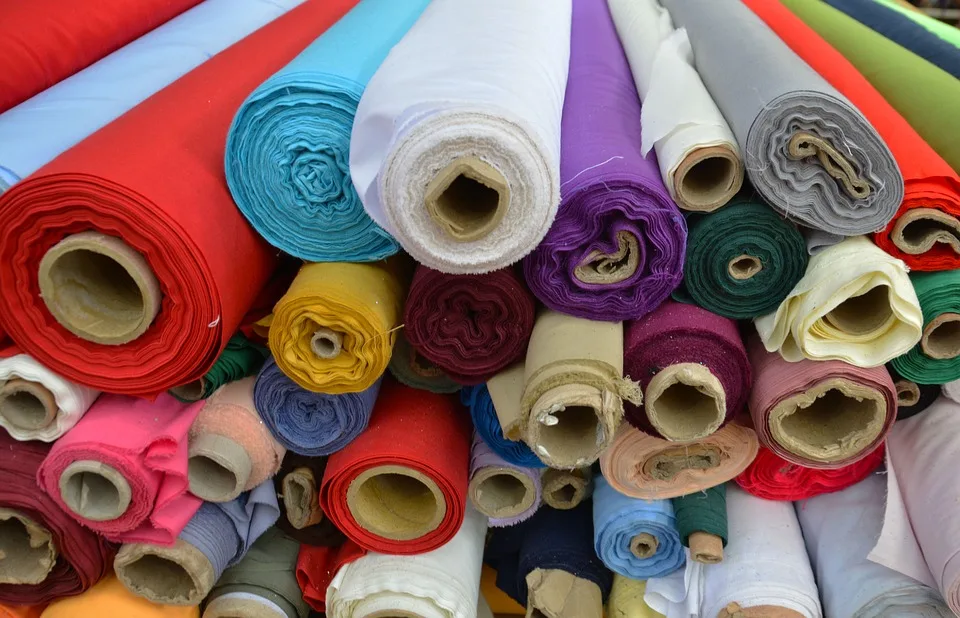
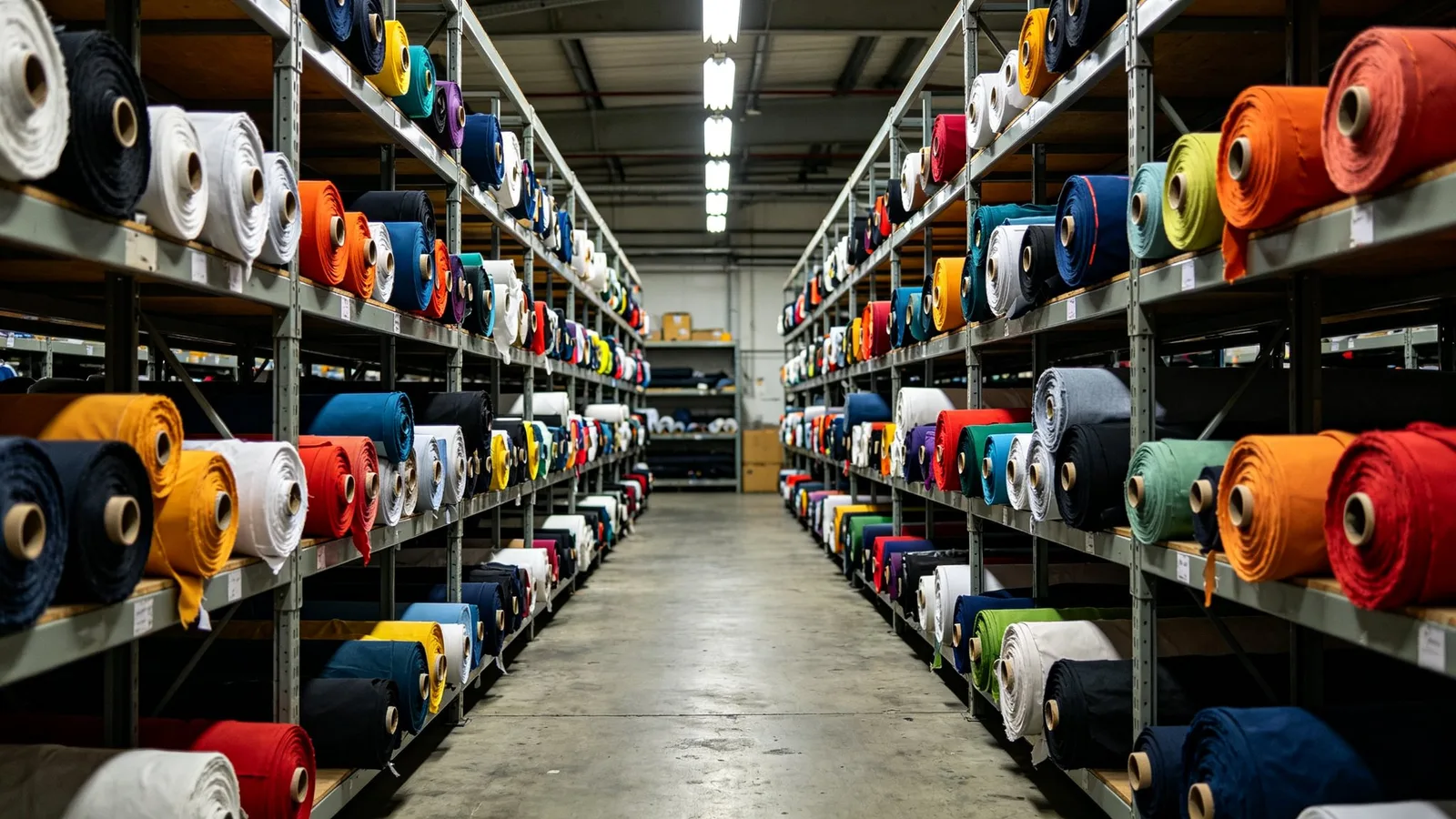
Image references: the stored rolls and fabric assortment illustrate material identification. They do not show textile recycling or establish recycled content, feedstock origin, lot ownership or a particular supplier relationship.
Compare Textile Inputs with Bottle-Based Inputs Fairly
A recycled polyester fabric can be associated with different input streams. The generic fibre name does not tell a buyer whether the recovered source was textile material or another product category. If textile-to-textile sourcing is a requirement, write it explicitly and ask what evidence distinguishes the proposed route from other recycled polyester offers.
Do not infer an overall environmental ranking from the input category alone. A comparison would need a defined product, processing boundary and suitable evidence. For an initial sourcing decision, it is more practical to separate the brand's source preference from the garment performance and commercial requirements. That allows the supplier to explain where an offer meets the brief and where it does not.
Consider an illustrative buyer comparing two lightweight fabrics for the same outer layer. One has a documented textile input route but is only offered in a limited construction. The other meets the desired handle and colour requirements but uses a different recovered input. The correct decision depends on the buyer's fixed priorities. Neither should be relabelled to make the comparison appear simpler.
If the source route is non-negotiable, the design team may need to revise the construction, colour plan or launch scope. If garment performance is fixed and the source requirement is flexible, the team may proceed with a different material while using narrower wording. Both outcomes should be documented before labels or campaign assets are ordered.
The existing recycled-polyester sourcing article can support the fibre-specific discussion. Ask the supplier to provide separate fields for fibre composition, recovered source and evidence method. Combining them into a single description such as “recycled sustainable polyester” makes it harder to identify which part of the claim has actually been supported.
Also consider what the comparison will mean on a repeat order. If one fabric is a one-off lot and the other is a continuing specification, that difference belongs in the decision. The buying team needs to understand whether it is selecting a replenishable product or a finite collection opportunity.
Understand the Processor's Acceptance Rules
A recycler's ability to process one material does not establish its ability to process every garment that contains that material. The processor may need information about blends, coatings, attachments and contamination. Obtain its current acceptance guidance for the proposed input rather than relying on a general description of recycling technology.
Kurabo's L∞PLUS is a specific example. Its published guidance lists restrictions, including certain laminated materials and compositions, and explains that the resulting appearance is affected by the recovered input. These are conditions of that system. They should not be copied into a universal rule for other processors or represented as Yinshan Fashion's own acceptance policy. L∞PLUS technical and FAQ information provides the original context.
The buyer can turn an acceptance discussion into a short material submission. Identify the textile, its known composition, the form in which it will arrive and any coatings or attachments. Include clear photographs where helpful, but keep documentary uncertainty visible. If a component cannot be identified, ask whether a sample or additional analysis is needed.
Ask what preparation the source organisation must perform. Separate removal, sorting or cleaning work can affect whether a programme is practical. Clarify who is responsible, what happens if a delivery does not meet the agreed condition and whether rejected material has an identified destination. Those questions prevent a collection commitment from becoming a storage problem.
Then distinguish a successful trial from a confirmed production arrangement. A small experiment may show that a particular input can be processed, but the proposed commercial route still needs to address availability, consistency, scheduling and documentation. The buyer should receive a clear statement of which stage has been demonstrated and what remains subject to agreement.
For a small-batch garment programme, discuss the mismatch that can occur between garment quantities and material-processing quantities. Do not assume that a low garment order automatically supports a dedicated recycling run. Ask whether an existing material route, a shared fabric or a staged development is appropriate, with the actual conditions confirmed for the project.
Specify Fibre Composition and Recycled Share Separately
The fabric's fibre composition and its recycled share answer different questions. A fabric description might identify cotton and polyester, while a separate statement identifies how much of one component is recycled. Ask for both pieces of information in a form that allows the buyer to understand the whole fabric rather than a selected ingredient.
Use a simple hypothetical calculation to expose ambiguity. Suppose a fabric is 60% cotton and 40% polyester by fibre weight, and one quarter of the cotton component is documented as recycled. Under those stated assumptions, the recycled cotton represents 15% of the total fibre weight, calculated as 60% multiplied by 25%. This example is arithmetic for a development record, not a label recommendation or a claim about an offered fabric.
The example becomes misleading if the denominator changes. A shell-fabric percentage is not automatically a whole-garment percentage. A garment also includes other parts, and a material programme may use a particular accounting or certification method. Ask the responsible supplier to explain the basis before the buyer writes a consumer-facing number.
Put the proposed specification into a material sheet with separate fields for component, fibre composition, recycled-content statement, source category and supporting evidence. Link it to the fabric code and relevant order. If the buyer wants a minimum share, state that requirement clearly and ask how it will be demonstrated for the supplied material.
Changes during sampling need the same discipline. A revised blend might improve handle or sewing behaviour while altering the source statement. Do not carry the old percentage into the revised sample file simply because the colour and style remain unchanged. Reopen the affected material and wording approvals.
For casualwear collection development, the resulting record should help a designer and buyer understand what is being approved without requiring them to interpret a chain of disconnected supplier messages. A concise, accurate specification is more useful than a long list of broadly favourable material descriptions.
Review the Fabric in the Intended Garment
An acceptable fibre source cannot tell the buyer how a neckline, pocket or hem will behave. Start with the actual garment and identify where the proposed fabric will be stressed, folded, rubbed or stretched. Use those locations to plan construction samples and the first complete prototype.
For a blouse, review the placket, cuffs, armholes and any gathered areas. A fabric with an attractive surface may need a different support or seam treatment at a button opening. The blouse collection is a useful reference for describing the garment type, without implying that any displayed style contains the proposed recycled material.
For a dress, review the silhouette, coverage and seam appearance in the intended colour. A material that suits a loose overshirt may be unsuitable for a close-fitting bodice. Use the dress collection to establish the product context, then evaluate the candidate fabric against the specific pattern and lining arrangement.
Agree on the review conditions before comparing samples. Record whether the material has been washed, pressed or otherwise treated. Identify which measurements and appearance observations matter for the intended use. If formal testing is needed, agree on the method, sample and acceptance criteria with the relevant parties rather than importing a universal threshold from an unrelated garment.
Keep a record of changes made to accommodate the material. A revised seam, a different interfacing or a slightly fuller pattern can alter cost, appearance and care. Include those changes when assessing the proposal. The buyer should be comparing complete development options rather than choosing a fabric on one metric while ignoring the work needed to make it function.
When a sample does not meet the brief, ask whether the problem can be addressed through construction, material selection or a revised product requirement. Record the decision and the evidence. Do not translate one failed sample into a claim that all recycled textiles have the same weakness.
Plan Colour Consistency Before the First Order
Colour is an approval system, not just a swatch. Establish whether the brand needs a precise shade, a controlled range of shades or a deliberately varied appearance. That choice affects how the supplier can propose recovered inputs and how the buyer should assess future lots.
Request an explanation of how colour is achieved in the offered fabric. The route might involve selected input colours, subsequent colour processing or another defined approach. Avoid assuming that recovered-colour material is undyed throughout its history. The supplier should describe the actual process and any statement the buyer may wish to make about it.
Create a physical approval reference that the parties can retain. Where variation is expected, a single ideal swatch may be less useful than an agreed acceptable range. Make clear whether the range applies within one garment, across garments in a lot or between separate orders. Those are different commercial expectations.
A matching set deserves an additional review. A top and skirt sold together may expose shade differences that are less noticeable when each is sold separately. Specify whether components must be cut from the same approved lot and how the factory will maintain that identification through production. Confirm what is practical for the actual fabric and order.
The buyer should also decide how photography will represent the product. An image selected from the palest sample may not fairly show a varied bulk lot. Use representative products and accurate descriptions, with the visual standard approved before the launch assets become fixed.
For repeat orders, request a new lot sample early enough to make a decision. If the new offer differs, the buyer may accept a new colour designation, adjust the collection or decline the material. These choices are easier when they are anticipated in the first order rather than treated as a last-minute quality dispute.
Build a Feedstock-to-Fabric Evidence File
Organise the evidence around the delivered fabric, with a path back to the claimed input. The file should identify the material reference, supplier, relevant order or lot, source description, composition statement and the documents used to support the claim. Keep dates and versions visible so a later reviewer can tell which information was current at approval.
Different documents answer different questions. A supplier declaration may describe the proposed source. A certification record may cover a particular organisation or process. A transaction record may relate to specified material moving through a supply chain. Ask the responsible party to explain the document's scope instead of assuming that any certificate covers every product the company sells.
Use the fabric traceability checklist to organise references that need to remain connected. The goal is a usable project file, not a collection of attachments that nobody can match to the material received. Label records with the fabric code and retain the sample approval alongside them.
When the supplier proposes a substitution, ask what changes in the evidence file. A similar-looking fabric from another route may require a new source statement, composition review and product test. The old approval should remain available as history, but it should not be used to authorise the replacement automatically.
Include the limits of the available evidence. If a document supports the shell fabric but not the lining, say so. If a claim is based on a particular accounting method, retain that explanation. If the source is known only at a broad category level, do not make it more specific in the finished product story.
Finally, assign an owner for keeping the file current. The buyer may own the final claim decision while suppliers provide supporting information. The factory needs the approved specification and substitution rules. A clear division of responsibility makes the record useful during production instead of leaving it as a research document disconnected from the order.
Manage Repeat Orders and Material Changes
A repeat order should start by comparing the new offer with the approved material record. Check the fabric reference, composition, recovered source, construction, finish, shade and relevant evidence. A matching commercial description is not enough if one of those underlying details has changed.
Ask which parts of the specification the supplier expects to hold stable and which may vary. A limited recovered-material lot may be appropriate for a capsule with no replenishment promise. A continuing style needs a more deliberate conversation about material availability and approval timing. State the commercial expectation before the first order is booked.
Retain fabric and garment samples in a condition suitable for comparison. Record their identity and approval date. When a new lot arrives, compare it under the agreed conditions rather than against a faded image or an unlabelled sample. Differences should be assessed against the approved range, not a memory of how the first delivery looked.
If a change is proposed, identify the decisions it affects. A construction change may require new sample work. A composition change may affect labels. A source change may affect marketing evidence. A finish change may require renewed care and appearance review. The team should not assume that one approval covers all these consequences.
Consider a hypothetical second order where the fabric remains visually similar but the recovered source category changes. The garment may still meet the product brief, while a source-specific campaign statement no longer fits. The buyer can approve the product and revise the wording, or reject the substitution if the source requirement is essential. The decision should be explicit.
Build time for those choices into the reorder conversation. Programme-specific availability and processing conditions can change. A clear request for new lot evidence and sample approval gives the buyer more control than treating the first order as a permanent guarantee of identical future material.
Send a Sampling Brief with the Open Questions Included
A good sampling brief describes the intended product and the material requirement together. Include the silhouette, size range, target market, colours, quantities, care expectations and any fixed composition or recovered-source requirement. Add the planned public statement only as a requirement to verify, not as a conclusion already reached.
List the questions the first sample should answer. For a casual blouse, those might concern surface appearance, seam behaviour and colour consistency. For a dress, they might concern coverage, lining and movement. Keep the review focused enough that the sample comments can lead to a specific decision.
Send the material evidence request at the same time. Identify which source category, percentage basis and supplier records matter to the brand. If a named recycling system is required, state that separately and ask whether the proposed route is actually available. An article describing a system does not establish that Yinshan Fashion purchases from it.
Use the fabrics and trims enquiry to discuss candidate materials and the manufacturing overview to define the handover from sample to production. Commercial terms, testing arrangements and development timing need to be confirmed for the actual project.
The final sample meeting should produce a material decision, a garment decision and a list of unresolved evidence questions. Proceed only with the approvals appropriate to the current stage. That approach lets a brand investigate textile-to-textile options seriously while keeping the order specification, source story and product quality connected.
Material development checklist
Three actions before sampling
Connect the material identity, sample decision and supporting evidence to the actual garment brief.
Draw the Material Flow
Write the input category, processing route and finished fabric reference on one page. Mark every connection that still needs evidence.
Define the Colour Agreement
Choose exact matching, a controlled range or deliberate variation. State where each is acceptable.
Prepare the Repeat-Order File
Save the material sheet, approved samples, evidence and substitution rules before the first bulk order.
Buyer and factory checklist
Confirm these inputs for the material and garment being considered.
| Decision area | What the buyer should prepare | What to ask the factory |
|---|---|---|
| Source requirement | Accepted feedstock category | Proposed route and current availability |
| Composition | Required fibre blend and content basis | Complete specification and evidence scope |
| Product behaviour | Use, construction and care expectations | Sample and appropriate review plan |
| Colour | Standard and acceptable variation | Lot-control and approval approach |
| Replenishment | Repeat quantities and continuity needs | Conditions for new lots and substitutions |
Continue the production conversation
Feedstock and Sourcing Decision Table
| Proposal | What to establish | Product review | Evidence focus | Decision |
|---|---|---|---|---|
| Identified cutting remnants | Collection and separation method | Construction and surface | Source category and fabric reference | Sample if the route matches the brief |
| Post-consumer input | Sorting and acceptance conditions | Proposed finished fabric | Collection-to-material connection | Confirm the claimed source before wording |
| Mixed input pool | What is known about each category | Lot consistency | Limits of source attribution | Use only the supported level of detail |
| Limited recovered-colour lot | Available quantity and variation | Complete garment and matching set | Lot identity and retained standards | Plan as a finite capsule if appropriate |
| Repeatable fabric offer | Stable specification and change rules | New lot against approved sample | Current source and order records | Reapprove affected changes |
Buyer FAQs
What are textile-to-textile recycled fabrics?
They are new textile materials made using recovered textile inputs. The buyer should confirm the actual feedstock, route and share in the finished fabric.
How do pre-consumer and post-consumer materials differ?
Their source histories differ. The supplier should identify the category and the definition used for the relevant claim or certification rather than treating every waste stream as equivalent.
Can recycled content vary between fabrics?
Yes. Different fabric specifications can contain different components and shares. Confirm the percentage basis and the material to which it applies.
How should buyers manage colour differences?
Agree on a physical standard or acceptable range, identify the lot and define whether variation is acceptable within garments, across a delivery or between orders.
What evidence is needed for repeat orders?
Compare the new fabric specification, source information and supporting records with the previous approval. Retain samples and reopen any approval affected by a material change.