
Article
What should buyers know first?
Short answer: A B2B guide for fashion brands choosing recycled, organic, cellulosic, and lower-waste material routes, with a practical method for checking fibre claims, documentation, sampling, labels, and repeat-order records before bulk production.
Sustainable fabrics for fashion brands should be selected as part of a product specification, not as a decorative claim added after a collection is designed. Before a buyer approves a recycled, organic, cellulosic, or lower-waste material route, the team should confirm the claimed fibre content, supporting documents, sample behaviour, color route, label wording, and commercial plan.
That is because a material can have a credible sourcing story and still be wrong for the garment. A light knit may not provide enough coverage in a pale color. A recycled performance fabric may need a different stretch and recovery review from a conventional base. A soft cellulosic blend may need careful shrinkage and seam testing. An organic raw-material claim does not automatically confirm the composition, processing route, or final label for every order.
This guide is for fashion brands, product developers, private-label teams, and buyers sourcing in China. Yinshan Fashion supports custom and private-label bulk programmes rather than unrestricted ready-stock wholesale, so a material direction has to become a sample and production record for one real garment. The guide explains how to compare sustainable fabric options without greenwashing, what to request before sampling, and how to keep records that remain useful when a style moves into bulk production or repeat orders.
How should buyers start with the garment decision, not an environmental label?
The first question is not “which fabric is most sustainable?” There is no useful one-word answer. The right route depends on the garment, wearer, market, price direction, order quantity, care expectation, and available evidence. A draped blouse, heavy streetwear sweatshirt, lounge set, active layer, and woven overshirt all put different demands on the material.
Write those demands in the product brief before asking a supplier for sustainable fabric options. Describe the silhouette, target handfeel, weight, opacity, stretch, surface, color palette, intended care, logo method, labels, packing, destination market, quantity by style and color, and launch timing. State what is fixed and what is open to factory advice.
For example, a brand may be fixed on an opaque cream jersey for a soft lounge top, but flexible on the exact fibre blend. Another may be fixed on a recycled-content requirement for a lightweight outer layer, but open to the knit construction and finish. This distinction lets the sourcing team look for a workable route rather than promising a material before it has been tested in the style.
The same discipline applies to small-batch programs. A first order that combines custom material, many colors, special trims, and certification requirements may be possible, but each choice affects MOQ, lead time, and approval steps. Shared materials, a focused color plan, and a clear documentation requirement usually create a more useful first sampling conversation.
What should buyers check about separate a fibre claim from a certification claim?
Words such as recycled, organic, responsible, renewable, low impact, biodegradable, and sustainable are not interchangeable. They describe different things, and each needs different evidence. A website or label should never imply more than the buyer can substantiate for the actual product and order.
If a brief calls for recycled content, establish what the claimed material is, what percentage is claimed, which component it applies to, and which supply-chain document supports it. Do not assume that a recycled yarn or fabric discussion means the completed garment can automatically be marketed as certified. The eligibility of a claim depends on the specific certification scope, chain of custody, transaction documentation, and final product configuration.
If a brief calls for organic cotton, confirm the material and documentation route before the buyer writes “organic” into hangtags, web copy, or care-label files. A chain-of-custody standard can verify organic material through the supply chain, but it does not automatically answer every question about chemical inputs, dyeing, labour practice, garment quality, or packaging. The buyer should keep the claim narrow and factual.
The same care is required for wood-based cellulosic materials. The generic fibre name, supplier information, claimed source information, sample behaviour, and label wording should be reviewed separately. A material derived from a plant source should not be described with a simpler or more favourable name if the finished fibre and its legal label name are different. This is particularly important for bamboo-derived rayon or viscose in markets with specific labelling and advertising guidance.
The practical rule is simple: name the material, state the relevant verified fact, retain the supporting record, and avoid broad conclusions. “Contains X% recycled polyester, supported by the applicable supplier documentation” is more useful than “an eco-friendly fabric.” The final wording must always match the approved product and the buyer’s market requirements.
What should buyers check about request four records before a material moves beyond the first sample?
Material sourcing becomes easier when the buyer and factory agree on a shared file rather than exchanging isolated photos and claims. Before approving a fabric for a private-label fashion program, request four types of information.
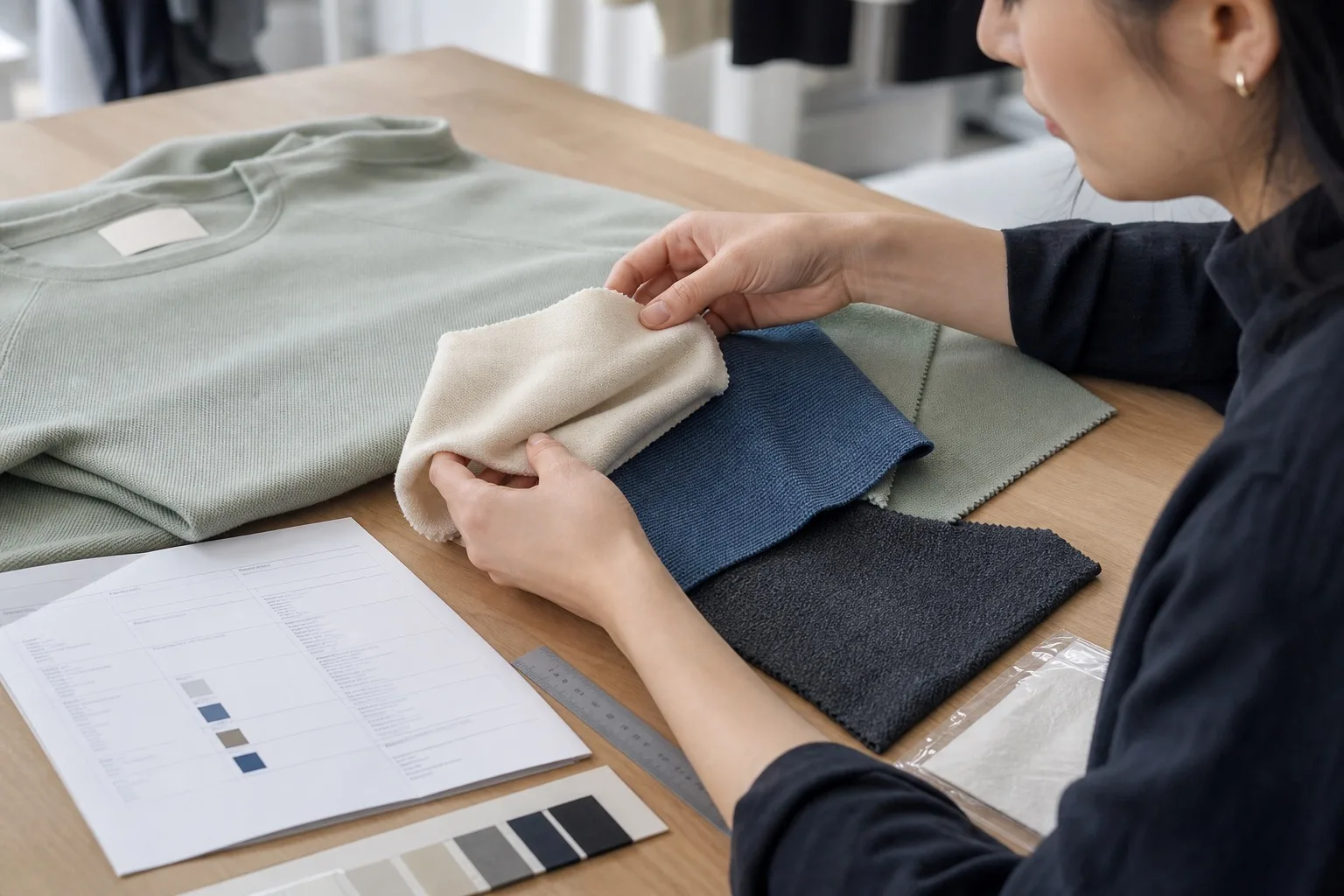
First, keep a material identification record. It should include the supplier or mill reference, fibre composition, construction, weight where relevant, width, color reference, surface description, and the intended use in the style. A material header or swatch should be tied to the exact sample rather than labelled only “soft blue knit” or “recycled fabric.”
Second, keep a claim-support record. This may include a supplier declaration, certification reference, transaction or chain-of-custody document, and any order-specific conditions required by the buyer. The factory can help coordinate the material discussion, but the buyer should define which documents are required and who is responsible for approving the final claim language.
Third, keep a sample and performance record. It should show the approved header, color or lab dip, pattern version, trim route, wash or care review, measurements, construction notes, and identified risk points. There is no responsible way to declare a material suitable for a style until it has been checked in that style.
Fourth, keep a label and packing record. Fibre composition, care wording, country-of-origin logic, size information, hangtags, barcode placement, individual packing, carton marks, and customer-specific instructions need to agree with the approved material and final product. Late label changes can create rework even if the fabric itself is correct.
How should buyers review the material in the garment, not only as a swatch?
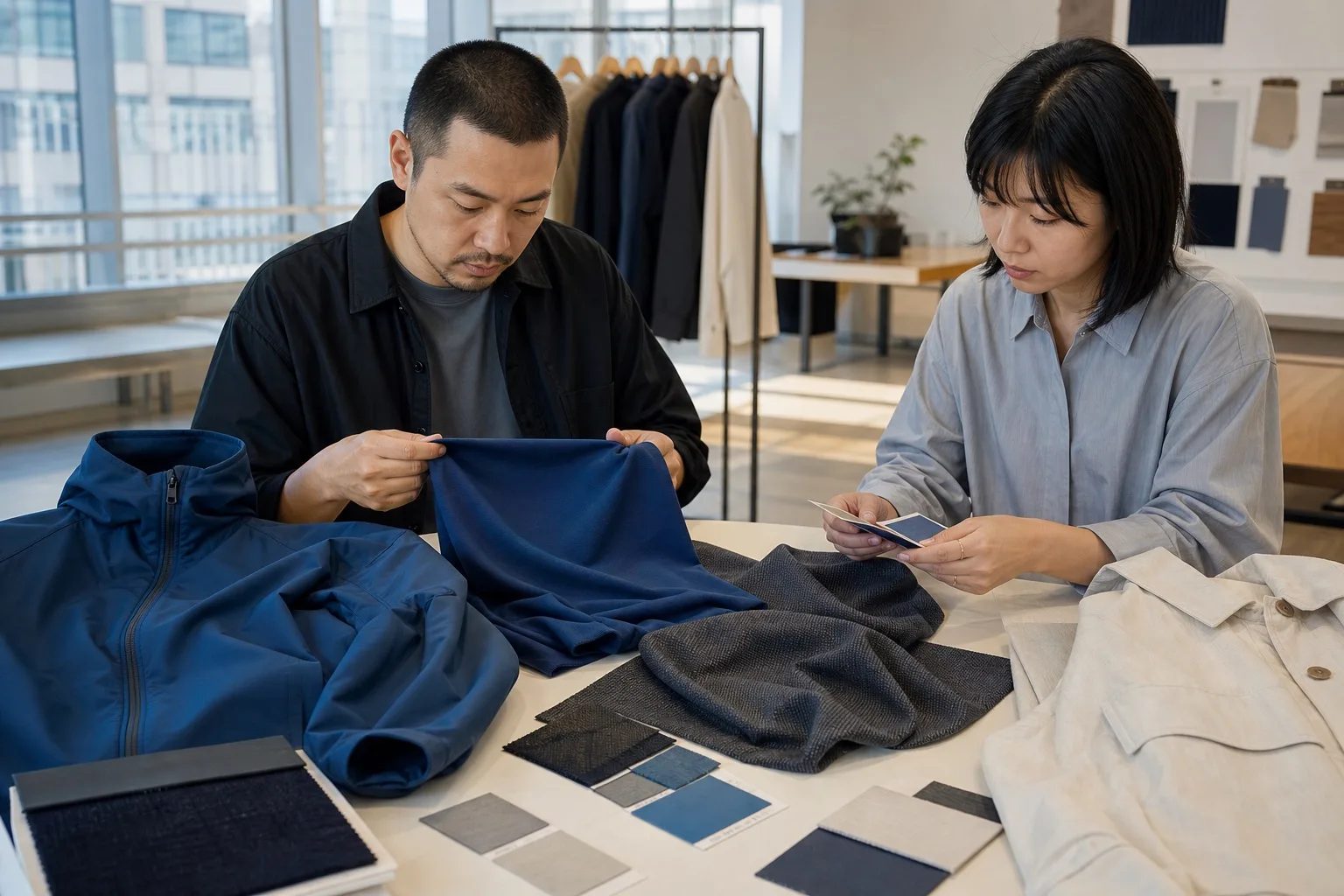
A fabric header can show surface and initial handfeel. It cannot show how the fabric behaves at a neckline, waistband, shoulder seam, pocket, placket, hem, or body area that stretches in wear. For sustainable fabric sourcing, the first sample is where the material story meets the product.
Review the sample in the intended color and garment shape. Pale colors may need an opacity check. Stretch materials need recovery checked at the bust, seat, knees, elbows, and waistband. Woven materials need to be reviewed for seam puckering, drape, button support, and lining compatibility. Brushed or textured fabrics need to be checked for surface change, bulk, and comfort after the intended care route.
Care is part of the material decision, not a final label task. If the garment will be washed, pressed, garment-dyed, printed, embroidered, or otherwise finished, the buyer and factory should assess whether the approved appearance, measurements, and handfeel remain stable after the relevant process. The exact test plan depends on the product and market; it should be agreed against the approved sample and buyer requirements rather than assumed from a material name.
Durability belongs in the same review. Pilling, shrinkage, twisting, color change, seam strength, elastic recovery, print appearance, and trim compatibility can all affect the product life. A garment that loses shape or fails after a small number of wears does not become a stronger product because it carries a preferred-material claim.
How should buyers compare common material routes without assuming that one is always better?
Recycled polyester and recycled nylon may be considered for fashion programs that need lightness, strength, stretch blends, or a performance-oriented surface. The buyer should still ask what input material is claimed, which documents are available, how the base handles color and finishing, and how it performs in the final sample. Do not describe the material as closed-loop textile recycling unless the actual source and claim support that conclusion.
Organic cotton can be considered for selected casual, lounge, sleepwear, and soft basics programs when the material route, composition, documents, and label requirements fit the order. The sample still needs to confirm fabric weight, opacity, shrinkage, pilling, color route, neckline recovery, and how the material works with trims and packing.
Recycled cotton or blended cotton routes can be useful where the product brief allows the resulting surface, handfeel, and strength. The factory should compare actual headers, not only composition descriptions, because yarn quality, construction, and finishing affect the final garment. Batch consistency and color review are also important for any repeat-order plan.
Lyocell, viscose, modal, and other cellulosic-blend directions may suit products that need drape, a smooth surface, or a soft handfeel. They should be reviewed for care, shrinkage, pilling, seam stability, color response, and correct fibre naming. Material-source claims must be tied to supplier documentation, not inferred from a commercial name.
Available stock or shared fabric families can be a lower-complexity route for first collections and small-batch development. This is not a universal environmental claim; it is a practical sourcing decision that may help a buyer reduce the number of custom developments, colors, and trim packages. The value comes from a clear order plan, not from attaching a broad “low impact” label to stock material.
What should buyers check about write marketing and label language after verification?
Environmental wording should be approved after the material, documents, sample, and market requirements are known. Starting with a campaign phrase and trying to make the supply chain fit it is a common source of risk.
Avoid broad statements such as “green fabric,” “zero-impact collection,” “chemical-free,” or “100% sustainable” unless the buyer has a defined, defensible basis for the full statement. A specific claim should identify the feature it refers to and should not suggest unrelated benefits. If a material has recycled content, say what component is covered and make sure the percentage and documentation match. If a package has reduced material, identify the comparison basis and confirm it is meaningful.
For EU or U.S.-bound product, fibre composition and product information should be reviewed with the buyer’s compliance or legal team. The factory can support the production files and material records, but it should not replace the buyer’s final market review. Correctly named fibres, clear composition information, care direction, and country-specific label requirements are part of product readiness.
How should buyers build a repeat-order material file from the first order?
The best time to create traceability is when the first sample and bulk order are being approved. Save the approved header, fabric reference, composition, color standard, supplier documentation, sample photos, wash results, trim codes, label files, packing instructions, QC notes, and buyer comments together. This record supports a more consistent restock, a new colorway, or a related style in the next collection.
It also makes communication more practical. A buyer asking to repeat “the blue recycled fabric from last year” may receive an uncertain answer. A buyer who can identify the approved material reference, color record, order date, style, and documentation requirement gives the factory a clear starting point. A repeat order still requires a current availability and quality review, but it does not need to begin from memory.
What to send before discussing sustainable fabric sourcing?
Send a reference style, tech pack or clear images, intended product category, target market, quantity by style and color, price direction, launch timing, preferred handfeel, fabric-performance requirements, color plan, label and packing direction, and any material-documentation or certification requirement. If the brief is incomplete, state which points are open for sourcing advice.
Yinshan Fashion can help buyers connect a material brief with fabric sourcing, sample development, trims, labels, packing, quality control, and repeat-order records. For a sustainable material discussion, the useful starting point is not a generic request for an eco fabric. It is a clear product decision, a defined claim requirement, and a sample route that can verify whether the material works for the finished garment.
How should fashion brands compare sustainable fabrics before sampling?
Fashion brands should compare sustainable fabrics against the same product brief, not against a generic expectation that one fibre will solve every design, commercial, or claim question. Put two or three realistic fabric headers beside the reference garment and ask the same questions of each: what is the exact composition, what is the construction, what documents support the stated feature, what colour and finish are being proposed, what will the material need to do in wear, and what has to stay consistent for a repeat order?
The comparison should include the conventional alternative where that is commercially relevant. A recycled polyester jersey and a virgin polyester jersey may differ in supplier route, available documentation, yarn, knit, finish, handfeel, opacity, recovery, colour response, and cost direction. A recycled cotton blend and a conventional cotton fabric can differ in surface, strength, colour consistency, and the way the style should be constructed. These are not reasons to reject a preferred-material route. They are reasons to test the actual header in the actual garment rather than treating the fibre name as the product specification.
Ask the mill or supplier to identify the exact reference for every option. The buyer should capture fibre composition, claimed component, construction, weight, width, colour, finish, available evidence, and any known sample considerations in one comparison record. A short, honest comparison is more useful than a large sustainability scorecard built from assumptions.
How should buyers compare evidence, garment behaviour, and commercial fit separately?
A buyer can make a clearer decision by separating three questions that are often mixed together. First is evidence: what can the supply chain document for this material and this order? Second is garment behaviour: does the fabric deliver the intended handfeel, coverage, drape, recovery, seam stability, colour, care, and trim compatibility? Third is commercial fit: can the available route support the style count, colour plan, quantity, packaging, and repeat expectation without creating unapproved substitutions?
One option may have a stronger record for the buyer’s requested material feature but require a different development route. Another may be the best physical base for the garment but need a narrower claim. A third may be practical for an initial range because it has an available colour family and simpler sampling path. These can all be valid outcomes when the buyer is explicit about which requirement is fixed and which requirement is open to advice.
Do not reduce this comparison to a ranking such as “best sustainable fabric.” A shirt, soft dress, active layer, workwear overshirt, lining, knit lounge set, and accessories programme have different product jobs. The point is to select a defensible material route for the one garment being developed.
What the first sample must answer?
Before bulk booking, the first sample should answer questions that a swatch and supplier document cannot. Review the garment on a body form or wearer where appropriate. Check whether the intended silhouette holds, whether pale colours need a lining or construction change, whether stretch areas recover, and whether seams, pockets, neckbands, elastic, buttons, zippers, prints, or embroidery change the material result.
For wovens, inspect drape, body, seam appearance, placket support, button area stability, lining interaction, and care-related change. For knits, inspect coverage, stretch, recovery, neck or waistband return, surface change, and pilling risk appropriate to the proposed use. For any route, confirm the actual colour, wash or finishing process, label composition, and packing details against the approved header. A material choice becomes production-ready only when these decisions agree.
Record the buyer’s comments as an approval decision, not only as a photo folder. State the material reference, sample version, colour reference, construction updates, label language awaiting approval, and the open risks. That record allows the team to distinguish a deliberate change from an unplanned substitution when bulk or a later repeat is discussed.
What should buyers check about a practical decision table for a first collection?
For an early private-label collection, complexity is often the risk to manage. A buyer can start with a small group of styles that shares one or two fabric families, a controlled colour plan, and compatible trims. This does not mean every collection should use stock materials or avoid custom development. It means the material decision should match the capacity of the product brief, evidence route, sampling calendar, and approval process.
Use a simple decision table in the development meeting. In the first column, list the non-negotiable garment needs. In the second, list the requested material feature and evidence. In the third, record the sample checks. In the fourth, note the bulk-control record that will prevent ambiguity later. The factory can then advise on alternative constructions or available routes without losing the buyer’s claim, fit, or design intent.
Yinshan Fashion can coordinate this comparison with the relevant fabric, pattern, sample, trim, and production inputs. The practical value is not a generic environmental promise. It is a buyer-ready route that makes the material, the garment, the documentation, and the eventual production files agree.
How should buyers keep label wording until the evidence and product are approved?
The final material statement should be the last step in the decision, not the first. Keep working copy in the product brief as a requirement to be verified, then confirm the final wording after the buyer has approved the material reference, the evidence route, the garment sample, and the destination-market label requirements. This protects the brand from a mismatch between a hangtag, a web claim, and the fabric actually used in production.
For example, if the approved fabric contains a stated recycled component, the product file should identify the relevant component and record the supporting supplier information. It should not turn that one fact into a broader statement about every stage of the garment’s impact. If a supplier route changes, the buyer should reopen the claim and sample review rather than transferring the previous wording by default.
How should buyers build a repeat-order check into the first bulk approval?
An approved first order gives the buyer a baseline, not a permanent guarantee that every later batch will be identical. For a repeat order, compare the new material offer with the original approved record: material reference, composition, colour standard, construction, finish, documents where required, trims, label language, measurements, care route, packing, and relevant QC notes. Any change should be visible before material or labels are booked.
This disciplined record is especially useful when the collection adds a new colourway, changes a print, moves to a different garment category, or needs an alternative material route. It allows the buyer to decide whether the change is acceptable for the product rather than discovering it after production. A sustainable-fabric programme becomes repeatable when its claim and product controls are stored together.
Material-claim review
Four checks before a material claim reaches the collection
A preferred-material direction becomes useful only when the product team can connect the actual fabric to a claim, a sample, the required documents, and final label wording. These checks make that conversation specific before bulk production starts.
Define the claim
State exactly what is being claimed: fibre type, recycled-content direction, organic-material route, material source, or a lower-complexity first-order plan.
Check the evidence
Match the material reference with available supplier documents, relevant transaction or chain-of-custody records, and the final component where the claim applies.
Approve the garment
Review the actual sample for colour, opacity, handfeel, shrinkage, recovery, seam stability, trims, care, labels, and packing before bulk is booked.
Sustainable fabric brief checklist
This checklist helps a buyer and manufacturer turn a material preference into a traceable product-development route. It does not replace the buyer’s compliance or legal review for the final market claim.
| Decision area | What the buyer should prepare | What to ask the factory |
|---|---|---|
| Product and wearer outcome | Share the style, intended fit, product category, market, retail position, expected care, and the handfeel, weight, opacity, stretch, or drape that matter to the wearer. | Which material directions suit this actual garment rather than only the preferred fibre story? |
| Material and claim definition | Name the material feature the brand intends to claim and state whether composition, recycled content, organic content, source information, or certification documents are required. | Which supplier records, certification scope, or order documents are available for this material route? |
| Sampling and performance review | Confirm the target colour, trim route, logo method, care process, risk points, and sample size before the material is approved for bulk. | What should be checked on the first sample for shrinkage, pilling, coverage, recovery, seam stability, colour, and finishing? |
| Labels and packing | Provide fibre, care, label, hangtag, barcode, individual packing, carton, and destination-market requirements early in the development process. | Which product files and packing details need to match the approved material and final claim wording? |
| First order and repeat route | Share quantity by style and colour, target price direction, launch timing, and whether the material must be kept for a future restock or new colourway. | Can material, colour, trims, and records be organised for a practical first order and a controlled repeat order? |
Continue the production conversation
Material-claim checklist before fashion sampling
| Claim in the brief | What the buyer should request | What the first sample must prove |
|---|---|---|
| Recycled content | Material reference, claimed component and percentage, supplier documentation, and any order-specific chain-of-custody requirement. | The fabric works for the intended colour, handfeel, construction, care route, and label wording. |
| Organic material | Actual fibre composition, applicable organic-content documentation, label requirement, and destination-market review. | Weight, opacity, shrinkage, pilling, colour response, and trim compatibility suit the approved garment. |
| Cellulosic material source | Correct generic fibre name, supplier information, claimed source documents where required, and market-specific label direction. | Drape, seam stability, surface change, wash behaviour, and care route work in the finished style. |
| Lower-waste first-order route | Available fabric options, shared colour and trim plan, quantity by style, packing requirement, and repeat-order expectation. | The collection can use a practical sample and bulk route without undermining the design or material record. |
Buyer FAQs
What should fashion brands check before selecting sustainable fabrics?
Ask for the material reference, fibre composition, the exact feature being claimed, supporting supplier or chain-of-custody documents where required, the sample route, and the final label wording. The claim should be checked against the actual approved style and destination market.
Can a garment be marketed as recycled because its fabric supplier offers recycled yarn?
Not automatically. The brand needs to confirm the claimed component, percentage, certification scope or order documents where applicable, and whether the final garment and its marketing language meet the relevant claim requirements.
Does organic cotton guarantee that a fashion product is sustainable?
No. Organic-material verification addresses a specific material claim and supply-chain route. The finished product still needs suitable fabric behaviour, construction, care, labels, packing, and evidence for any other environmental or social statement.
Why should sustainable fabric be tested in the sample before bulk production?
A swatch cannot show opacity, recovery, shrinkage, pilling, seam stability, colour response, or trim compatibility in the finished garment. The first sample confirms whether the material route works for the actual style.