
Article
What should buyers know first?
Short answer: A loungewear fabric guide for B2B buyers developing private-label pajama sets, robes, lounge separates, and travel-comfort collections, covering handfeel, drape, coverage, recovery, care, sampling, and repeat-order records.
A loungewear fabric guide should start with the garment a customer will actually wear, not a list of fibre names. A rib top that is meant to be worn at home, a draped pajama set for travel, a robe sold as a gift, and a relaxed lounge co-ord can all be called comfortable. They do not need the same material route.
For a private-label loungewear program, fabric controls the first impression in the buyer's hand, the way a set falls on the body, the care message, the sample route, and the chance of a stable repeat order. A material that feels soft as a small swatch may become too sheer in a pale color, lose its shape at a neckline, pill after wear, or sit heavily at the waistband. Those questions should be tested in the garment before bulk fabric is booked.
This B2B guide is for brands, buyers, and product teams developing pajama sets, lounge separates, robes, travel-comfort pieces, and soft private-label collections. It explains what to decide before sampling, what to review on the sample, and what a loungewear manufacturer needs to know before making a useful fabric recommendation.
Yinshan Fashion supports custom and private-label bulk programmes rather than unrestricted ready-stock wholesale. For a lounge product, that means the useful work begins by defining the garment, the desired wearer experience, and the decisions that a sample needs to prove. It does not begin with a generic promise that one fabric is right for every sleeper, climate, or retail channel.
What should a lounge garment be expected to do?
The first material question is not whether a fabric is cotton, modal, viscose, polyester, or a blend. It is what the garment needs to do. A lightweight sleep shirt may need airflow, low bulk at the seams, and a surface that stays comfortable against skin. A relaxed jogger may need more recovery at the waistband and knees. A robe may need enough body to hold its belt and pockets without becoming stiff. A travel set may need to pack well, recover after sitting, and keep a clean appearance after care.
Write the product use in the factory brief. State whether the piece is intended mainly for sleep, home wear, resort travel, a gift set, an airport look, or a soft everyday basic. Then describe the customer and retail position. A premium lounge set can justify different handfeel, construction, and packaging choices from a value-focused pajama program. This context helps the factory narrow the relevant fabrics instead of sending a large and unhelpful swatch library.
The silhouette belongs in the same decision. Loose styles can look refined when the fabric has controlled drape, but a fabric that is too fluid may pull at a neck binding, reveal pocket bags, or make a drawstring waist look uneven. A close-fitting rib set needs a different conversation about coverage, stretch recovery, seam allowance, and size grading. A good loungewear manufacturer will assess the fabric in the intended pattern, not only as a roll or a hand-sized header.
How should buyers compare fabric routes by behaviour rather than marketing names?
Several material directions can suit loungewear. The right option depends on the product and the approved sample; no fibre name guarantees comfort or quality on its own.
Cotton jersey is familiar and versatile for sleep tees, easy pajama sets, and casual lounge basics. The buyer still needs to check weight, surface, shrinkage route, color response, and whether the neckline and hems remain clean after care. A light jersey can feel soft but require an opacity review in cream, white, or pale seasonal colors. A more compact jersey may give a neater product but feel warmer or less fluid.
Fine rib can create a close, tactile, modern lounge look. It is useful for fitted tops, soft leggings, tanks, cuffs, and coordinated sets, but the rib direction must be sampled at the correct stretch. Check whether the fabric recovers after being worn over the bust, seat, knees, elbows, and waistband. Check as well whether stripe direction, seam alignment, and label placement remain neat. A rib fabric that looks beautiful flat can show distortion when the garment is graded across a size range.
Modal or other cellulosic-blend knits can be selected when the brief calls for fluid drape and a smooth handfeel. In practice, the factory should still review the surface stability, pilling tendency, color route, seam treatment, and how the garment behaves after the intended care process. A draped lounge trouser and a body-skimming sleep top may need different weights or constructions even when they share a similar fibre story.
Brushed knit, interlock, waffle, French terry, and soft fleece may work for cooler-season lounge programs, travel sets, robes, or more structured separates. Their main questions are bulk, warmth, surface change, seam thickness, and whether the inside surface stays comfortable after washing. For a first order, do not assume that a warm handfeel automatically means a premium result. Ask to see the fabric sewn into a collar, waistband, cuff, pocket, and hem.
Woven materials can also be appropriate for pajama shirts, light robes, sleep shorts, and gift-led sets. They can bring a crisp or fluid appearance that knit fabrics do not always provide. The sample must show how the woven material moves at the shoulder, seat, and side seam; whether it needs lining; how it behaves in a light color; and whether piping, buttons, or a belt change the drape.
How should buyers review handfeel, weight, and drape on a real sample?
Handfeel is important in loungewear, but terms such as buttery, breathable, premium, soft, or cool are not enough for a sample room. Translate them into checks. Should the material feel dry or silky? Should it fall away from the body or stay close? Does it need to feel substantial in the hand, or should it be light for warm climates? Is a lightly brushed surface desired, or would it create excess warmth and lint?
Ask to assess fabric in at least four conditions: flat on the table, draped over a form, lightly stretched where relevant, and sewn into the first sample. A fabric header cannot show whether a V-neck rolls, whether a rib hem waves, whether a shirt placket pulls, or whether a loose trouser pockets show through. The best time to identify those issues is before several colors, trims, and labels are committed.
Weight should be discussed together with structure. Two fabrics at a similar GSM can behave very differently because yarn, knit construction, finishing, and fibre blend change density and movement. Rather than requesting a single number without context, give the factory a wearer outcome: enough coverage for a pale lounge top; an easy drape for a wide-leg pant; a stable neckline for a sleep shirt; or a warmer but not bulky travel layer. The factory can then propose a focused set of headers to compare.
How should buyers consider breathability, warmth, and care together?
Loungewear is often sold on comfort, so buyers may ask for breathable, temperature-friendly, easy-care, or travel-ready material. These are product requirements to review, not claims to copy into marketing without evidence. Breathability, thermal comfort, moisture handling, and drying behaviour depend on the actual fibre, construction, weight, finish, garment fit, and user conditions.
Start with the market and season. A pajama collection for a warm climate may need lighter weight, looser construction, and an airflow review. A cold-season lounge set may need warmth, a soft interior, and a check that seams, cuffs, and waist construction do not become too bulky. A year-round capsule may work better with separate weight options than with one fabric expected to suit every climate.
Care instructions should be considered before the sample is signed off. Confirm the intended wash route and any buyer or market-specific label requirements. Then inspect the sample after the relevant care process for shrinkage, torque, color change, surface change, seam puckering, shape retention, and print or embroidery appearance where used. A manufacturer can prepare samples and records; the final care wording and market compliance should be confirmed by the buyer's responsible team.
Which risk points need coverage, recovery, and construction checks?
Loungewear can fail at quiet details. A pale jersey can become transparent around the seat. A waistband elastic can twist. A soft cuff can stretch out. A brushed inside can shed or change after washing. A sewn-in label can irritate the wearer. These are not reasons to avoid a soft material; they are reasons to choose the right construction and sample checks.
For fitted lounge pieces, review opacity and recovery at the body areas that stretch in wear. For relaxed pieces, review how the fabric hangs at side seams, pockets, drawstrings, and hems. For robes, check belt loops, belt pull, pocket weight, and the way a collar or shawl edge sits. For pajama shirts, review button spacing, placket stability, piping bulk, and whether a woven or knit base supports the desired finish.
Construction should not be an afterthought. Neck bindings, seam finishes, elastic widths, drawcord exits, piping, labels, hangtags, and folding all change the finished product. Share the brand package early. A private-label loungewear collection may use a woven neck label, heat-transfer care information, a soft printed label, a hangtag, tissue, a gift box, or a poly bag. Each choice should be reviewed for skin comfort, material compatibility, packing method, and order planning.
How should buyers plan fabric and colour for a workable first order?
A first loungewear collection becomes difficult when each style needs a unique fabric, custom color, special trim, and separate packaging route. That can be appropriate for a developed brand, but it should be a deliberate commercial choice. For a new private-label program, a shared fabric family can reduce development complexity while still giving the collection a clear point of view.
For example, one soft jersey direction may support a tee and short, while a coordinating rib can provide a tank or cuff detail. One woven base may support a pajama shirt and short. Shared materials can make color review, trim selection, sampling, and repeat-order records easier. The products do not need to look identical; they need a visible material relationship.
Color should be approved on the actual base fabric. Cream, oatmeal, pale blue, soft sage, and blush may look different on rib, compact jersey, brushed knit, waffle, and woven fabric. A buyer who wants a coordinated set should review the main fabric, rib, thread, piping, elastic, labels, and printed artwork together. If a color is central to the collection or intended for repeat orders, keep the approved header, color standard, and bulk approval record with the style file.
MOQ, price, and timeline remain subject to the approved material, color count, trims, packing, and order plan. The useful factory conversation is not “what is your MOQ for loungewear?” in isolation. It is “which material and color route makes this first collection realistic, and what should we simplify before sampling?”
What should buyers send a loungewear manufacturer before sampling?
The first message does not need to be a perfect tech pack. It should make the important open decisions visible. Send the product category, reference images or sample, intended fit, target customer, fabric behaviour, planned colors, size range, logo and label direction, quantity by style and color, destination market, target price direction, and launch timing.
For fabric, describe what the customer should notice: light and cool, softly brushed, compact and opaque, fluid and draped, textured, warm, or easy to layer. Mention what is fixed and what is flexible. A buyer may be fixed on an opaque pale lounge top but open to the exact fibre blend. Another may be fixed on a smooth handfeel but open to the garment weight. Those priorities let the factory suggest meaningful alternatives before a sample revision becomes necessary.
Yinshan Fashion supports loungewear development from material review and sample making through private-label details, production planning, QC, packing, and export preparation. The strongest starting point is a product brief that connects the desired comfort with a real silhouette, fabric route, color plan, commercial target, and repeat-order intention. That gives the team enough information to propose a practical sample path rather than a generic fabric list.
How can a loungewear fabric guide turn comfort into a sample plan?
Words such as soft, cooling, elevated, cosy, breathable, and easy-care can be useful commercial intentions. They are not yet factory instructions. A buyer should translate each word into a physical question that can be answered on a sample. “Soft” might mean a smooth face with no irritating neck label, a brushed inside, a low-bulk seam, or a fluid fabric that does not stand away from the body. “Cool” might mean a lighter garment, an open construction, less surface finish, a looser silhouette, or simply a product designed for a warmer retail season. The brief should say which outcome matters and which parts are open for supplier advice.
Set the sample objective before material is cut. A first version can be asked to prove silhouette and key measurements; a later version can be asked to confirm the selected material, colour, elastic, piping, label, and packing route. When fabric behaviour determines the product, however, the target fabric belongs in the earliest meaningful sample. A fluid trouser cannot be evaluated in a stiff substitute. A close-fitting rib top cannot be approved from an oversized jersey test. The point is not to insist on one sample sequence. It is to make the decision each sample is expected to close visible to the buyer and factory.
How should buyers define the garment category and wearer use?
Loungewear is a wide category. A sleep tee, matching pajama set, kimono robe, recovery-oriented travel layer, soft short set, and elevated home co-ord may all use comfortable materials. They do not need the same balance of coverage, weight, drape, recovery, or construction. Start the brief by naming the garment category, expected use, climate or season direction, target customer, retail channel, and fit profile. A factory cannot choose a meaningful material route from a photo alone when the photo does not explain how the product is intended to be worn.
For instance, an evening pajama shirt may need a woven fabric with controlled drape, button support, and a clean placket. A lounge jogger may need a waistband construction that remains comfortable and stable after wear and care. A simple travel set may need the top and bottom to look cohesive when folded into a bag, while still managing stretch or bagging at the knee. A robe may need sufficient body at the collar, belt loops, pockets, and hem. The buyer does not need to decide every technical answer before starting. The buyer does need to identify the features that define the product and the areas where a recommendation is welcome.
Why should buyers separate fibre content from fabric behaviour?
Fibre content is an important product and label input, but it is not a complete description of performance or appearance. Yarn type, knit or weave construction, weight, density, surface finish, mechanical stretch, recovery, colour, and garment construction all affect the final result. Two cotton jerseys can differ sharply in coverage, handfeel, neck recovery, drape, and surface appearance. Two cellulosic-blend knits can feel similarly soft as headers but perform differently after stitching, washing, or wearing over a fitted body area.
Ask a supplier or manufacturer to compare the fabric against the actual garment decision. Does the neckline need to stay flat? Does the trouser need a fluid leg without revealing pocket bags? Does a pale colour need added coverage? Does the product need to stretch around the body and recover at the cuff, knee, or waistband? Does the inside surface stay comfortable against skin after the intended care route? These are product questions, not a request for a particular marketing name. They also make a quote more comparable because each party is responding to the same garment requirements.
How should buyers review handfeel with the customer experience in mind?
Handfeel should be assessed in context. A customer notices more than whether a fabric header feels pleasant between two fingers. They feel the neckline, side seam, waistband, label, inside surface, and the way a garment moves after sitting or sleeping. A soft fabric can still create a less comfortable product if the seam is bulky, an elastic twists, a care label rubs, or a component pulls against a lightweight body fabric.
Ask the factory to show the material flat, draped, lightly stretched where relevant, and sewn into the actual style. Compare at least the garment areas that carry the most risk: neck opening, armhole, waistband, pocket opening, side seam, hem, cuffs, button placket, or belt loop. Record the review in direct language. “Reduce the collar bulk at the back neck” is an actionable comment. “Make it more premium” is not. Buyers who retain the approved fabric reference and sample comments can move more confidently into a second colourway or a restock conversation later.
How should buyers judge drape, coverage, and weight together?
Drape is the way a fabric hangs and responds to movement. Coverage is the degree to which the garment remains appropriate in the intended colour and fit. Weight influences both, but a GSM number does not make the decision on its own. A fabric with a similar weight can fall differently because of knit construction, yarn, finishing, or density. Use a desired outcome to guide the discussion: a wide-leg lounge trouser that moves but does not cling; a pale top that gives enough coverage; a robe that holds its belt and pockets; a close-fitting rib tank that recovers cleanly; or a short set that feels light without becoming flimsy.
Review each material in the colours and size directions that create risk. Pale shades, larger size grading, bias-related movement, and close body contact can change the result. A buyer who approves a dark sample without a light-colour review may not have approved the material route for the full range. Similarly, a roomy sample can conceal a coverage or recovery issue that becomes visible in a smaller, closer fit. The factory can identify likely risk points, but the buyer should make the intended market and acceptance standard clear.
Why should buyers check stretch and recovery separately?
Stretch is how far a material can extend. Recovery is how well it returns after that extension. The distinction matters in lounge ribs, leggings, cuffs, waistbands, neck bindings, and any piece that is expected to remain neat after repeated wear. A fabric can stretch enough to make fitting easy and still lose its shape at the elbows, knees, hem, neck, or seat. Conversely, a very stable fabric can limit comfort if the pattern does not provide the necessary ease.
Check the zones that will actually extend in use. For a ribbed top, that may include bust, armhole, sleeve, neckline, and hem. For a lounge trouser, consider the waistband, seat, knee, cuff, and drawcord exit. For a fitted set, review whether the top and bottom respond consistently across the planned size range. Record whether an issue is a fabric question, a pattern question, an elastic or trim question, or a combination. This prevents a later bulk decision from treating one sample observation as an unexplained quality standard.
How should buyers build care review into material approval?
Care is not a line to add after product development. The proposed care route can change handfeel, measurements, surface appearance, recovery, colour, seam behavior, and the way trims sit on the garment. The exact method and any testing requirement depend on the product, buyer requirements, and destination market. The practical sequence is to agree the intended care route, review the relevant sample after that route, and then decide whether the material, construction, label wording, or product positioning still needs adjustment.
Check for visible change at the features that define the style. A soft rib can ripple at a hem. A jersey can twist or shrink in a way that shifts side seams. A brushed surface can look or feel different after care. A printed, embroidered, piped, or contrast detail can behave differently from the main body. Yinshan Fashion can coordinate the sample and production records, but the buyer remains responsible for confirming its market-specific compliance, care wording, and product claims. Keeping that distinction clear avoids treating general material advice as legal or performance certification.
Why should labels, trims, and packing join the fabric decision?
Private-label details can change the comfort and commercial readiness of loungewear. A woven neck label, printed care information, heat transfer, size tab, hangtag, drawcord, elastic, button, piping, tissue, poly bag, or gift box should not be chosen separately from the garment. A label that is acceptable on a structured outer layer may feel intrusive on a sleep top. A plush fabric may need a different folding approach from a smooth jersey. A gift-led robe may require a packing review that a basic pajama set does not.
Ask what needs an applied proof before bulk. The proof might be a label on the sample, a trim attachment, a fold test, a packing mock-up, or a colour comparison. Document the relationship between the approved style, label copy, component code, packing instruction, and quantity plan. That is what allows a supplier, manufacturer, and factory team to work from one product version rather than separate files that have drifted apart.
How should buyers plan a small collection around a disciplined material family?
A small private-label range does not need every style to use a completely different fabric. Sharing a main jersey, rib, woven, or trim direction can simplify sample review, colour approval, private-label components, packing, and repeat-order records. This does not mean forcing one material into incompatible products. A structured robe, close rib tank, and fluid trouser may require separate routes. It means asking whether the collection has a coherent material system before creating unnecessary development variables.
Write a simple style-colour-material matrix. For each style, show the intended fabric route, proposed colour, supporting component, sample purpose, and the issue that must be approved. Then look across the matrix for duplication or hidden complexity. A first order becomes more difficult when every style introduces an untested base, a special trim, a new colour route, and unique packing. The right commercial plan depends on the programme, so no fixed minimum, price, or schedule belongs in a generic guide. A focused material system simply gives the buyer a clearer basis for the conversation.
How should sample review become a production standard?
An approved sample should not be the only record that survives. Connect it with the material reference, colour approval, pattern and measurement version, component list, construction notes, label and packing files, quality priorities, and buyer comments. If a comment changes the garment, state which version it applies to and whether it has been confirmed on the next sample. This is especially useful when the buyer, supplier, product developer, and production factory are not in the same room.
Yinshan Fashion combines design and product-development coordination with long-term cooperative factory resources and more than 30 years of garment production experience. The value for a B2B buyer is a traceable route from fabric direction to sample feedback and bulk handover. That does not remove the need to review each exact fabric, colour, component, order quantity, market requirement, and approval. It helps keep those decisions visible and connected as the programme moves forward.
What should a buyer send for a useful fabric recommendation?
Send the strongest available inputs rather than waiting for a perfect technical pack. Useful starting materials include reference images or a retained garment, product category, intended customer, fit direction, desired handfeel and behaviour, key colours, planned size range, private-label requirements, packing direction, quantity by style and colour, target market, commercial position, and the intended launch window. Mark what is fixed and what is open for advice. If there is an existing sample, add the observations that must change or remain the same.
A useful request asks a specific question. For example: Which fabric routes could give an opaque, light-colour lounge top with a soft handfeel? Which rib options should be checked for recovery in a fitted pajama set? How should a robe’s belt, pocket, and collar be tested in the selected base? Those questions give the manufacturer a way to propose a sample route. They also give the buyer a way to compare recommendations without reducing the decision to a generic swatch catalogue.
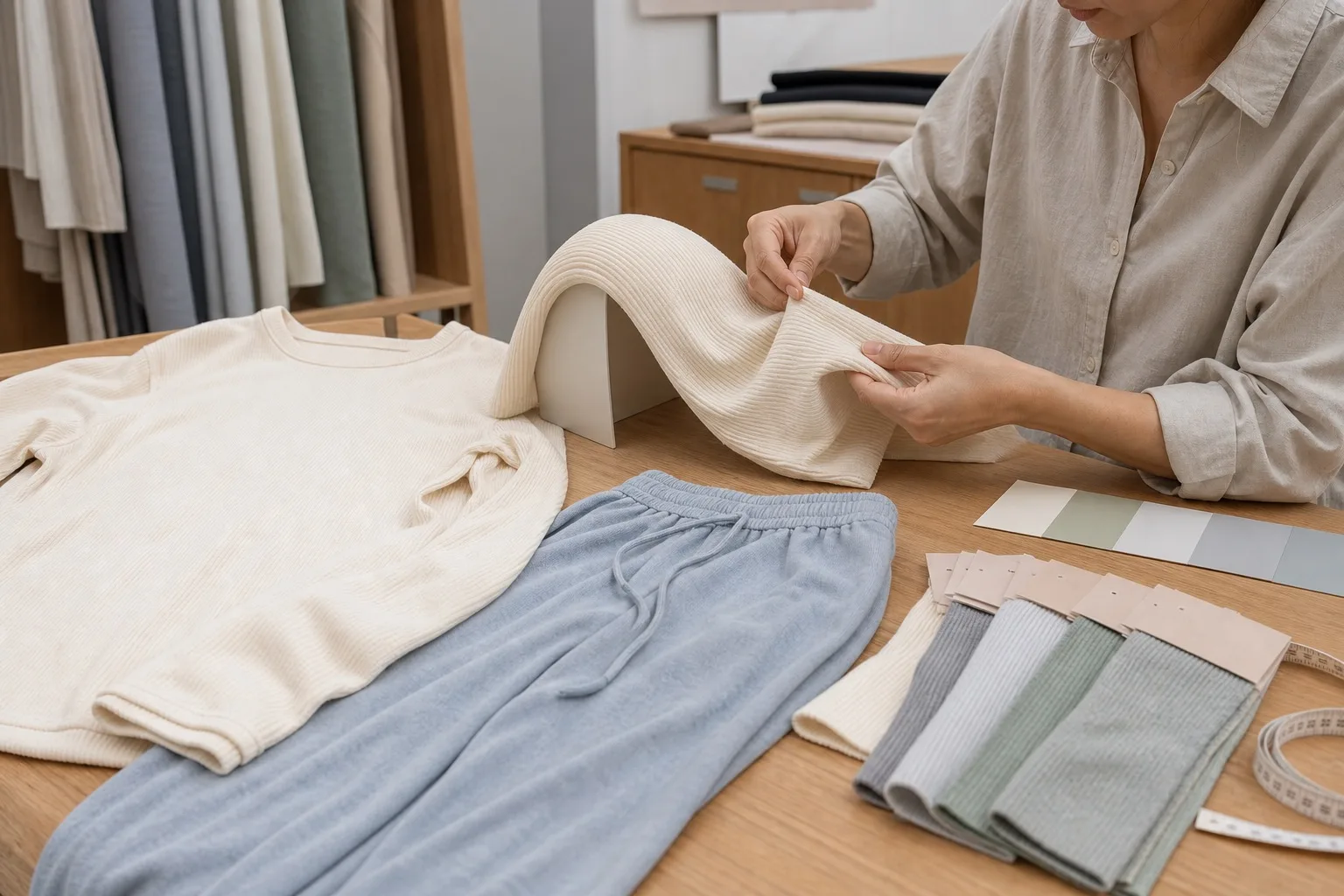
Loungewear material review
The three material decisions that shape a lounge collection
For pajama sets, robes, lounge separates, and travel-comfort pieces, fabric should be reviewed as part of the garment: how it falls, covers, recovers, washes, and works with the intended neckline, waistband, trims, and packing route.
Wearer outcome
Name whether the piece is for sleep, home wear, travel, gifting, or an easy everyday layer. That decision changes the material, fit, and care conversation.
Fabric behaviour
Review coverage, drape, warmth, recovery, surface, and shrinkage in the actual style. A soft header cannot answer how a waistband or pale color will perform.
Repeatable records
Keep the approved header, color standard, trim information, sample notes, packing direction, and care route with the style file for later reorders.
Loungewear fabric handover checklist
This checklist gives a loungewear manufacturer the information needed to suggest fabric options and plan a useful first sample. Any market-specific testing, label, or compliance requirement should be confirmed by the buyer before bulk production.
| Decision area | What the buyer should prepare | What to ask the factory |
|---|---|---|
| Product use and fit | State whether the style is a pajama set, lounge top, trouser, robe, travel layer, or gift-led item; describe the intended silhouette and level of coverage. | Which material structure and sample checks suit this product use, fit, and target customer? |
| Handfeel and fabric behaviour | Describe the desired feel and result: fluid, soft, brushed, compact, airy, opaque, warm, textured, close-fitting, or loose and draped. | Which available headers should be compared in the actual garment, and what risks should be checked before approval? |
| Color and sample route | Provide core colors, print or piping direction, light-color requirements, target sample size, and whether colors need to repeat across styles. | How should color be reviewed on the actual fabric base, and when are lab dips, headers, or a revised sample needed? |
| Trims, labels, and packing | Show labels, care copy, elastic, drawcord, buttons, piping, hangtag, individual packing, and any gift-box or retailer requirement. | Which component changes skin comfort, seam bulk, MOQ, production timing, or the first-order packing route? |
| Commercial plan | Share quantity by style and color, destination market, target price direction, launch date, and expected repeat-order plan. | Can fabrics, colors, or trim packages be shared to make the first loungewear collection more practical to sample and repeat? |
Continue the production conversation
Loungewear fabric review: what to check before sample approval
| Material direction | Suitable product use | What to review on the first sample |
|---|---|---|
| Cotton or compact jersey | Sleep tees, easy pajama sets, relaxed lounge basics | Opacity in pale colors, neckline recovery, shrinkage route, hem behaviour, and surface after care. |
| Fine rib knit | Fitted tops, tanks, close lounge sets, cuffs | Stretch and recovery at body areas, coverage, seam alignment, grade across sizes, and label comfort. |
| Fluid cellulosic-blend knit | Draped sleep tops, lounge trousers, soft coordinated sets | Drape, pilling risk, seam stability, color response, and shape after the intended care process. |
| Waffle, brushed knit, interlock, or soft fleece | Cooler-season lounge sets, travel layers, robes | Warmth, seam bulk, inside-surface comfort, cuff recovery, surface change, and packing bulk. |
| Soft woven fabric | Pajama shirts, robes, sleep shorts, gift-led sets | Drape at the shoulder and seat, show-through, placket and piping stability, button support, and belt behaviour. |
Buyer FAQs
What fabric is best for a private-label loungewear collection?
There is no single best fabric. The right direction depends on whether the product is a fitted rib set, a light pajama, a draped lounge trouser, a robe, or a warmer travel layer. Review the chosen material in the actual sample for handfeel, coverage, drape, care, and construction compatibility before bulk fabric is confirmed.
What should a loungewear fabric guide help a buyer decide before sampling?
A loungewear fabric guide should turn general comfort goals into garment-specific decisions: intended wearer and use, silhouette, handfeel, coverage, drape, stretch and recovery, care route, colour, trims, labels, packing, sample objective, and the records needed for bulk or a repeat order. It should not treat a fibre name as a complete product specification.
How should buyers check whether a loungewear fabric is too sheer?
Review the fabric on the actual garment in the intended light colors and at the body areas that stretch or sit close to the wearer. A header alone cannot show transparency at the seat, pocket, neckline, or across a fitted rib construction.
Can one fabric be shared across several pajama or lounge styles?
Often, yes. A shared fabric family can simplify color planning, sampling, MOQ discussion, and repeat-order records. It still needs to suit each garment’s structure: a draped trouser, a stable neckline, and a fitted rib top may require different materials or supporting components.
What should a buyer send before asking for a loungewear sample?
Send reference images or a sample, product type, intended fit, fabric behaviour, color plan, size range, label and packing direction, quantity by style and color, destination market, price direction, and required launch timing. Open decisions can remain open as long as they are visible.