
Article
What should buyers know first?
Short answer: A buyer guide to comparing fashion manufacturer, supplier, and factory quotes by aligning product scope, fabric, fit, construction, samples, labels, packing, quantities, quality priorities, and commercial assumptions.
Why the lowest fashion manufacturer quote may not be the lowest cost route?
When two fashion manufacturer quotes show different unit prices, the difference is not automatically a sign that one supplier is expensive and the other is efficient. It may mean that the manufacturers are pricing different fabrics, construction routes, sample scope, labels, packing, quantities, delivery basis, or unresolved assumptions. A lower number can be useful, but only after a buyer understands exactly what product it represents and what work or risk remains outside the quote.
For a fashion buyer, the goal is not to force every factory into one identical price format. The goal is to make the scope comparable. That means checking whether each manufacturer has understood the same product category, target wearer, fit, fabric behaviour, colour or print, construction, components, private-label requirements, sample route, quantity split, target market, quality priorities, and packing route. A reliable comparison is a decision tool, not a spreadsheet contest.
Yinshan Fashion supports custom and private-label bulk programmes as a fashion supplier, manufacturer, and factory-coordination partner, rather than unrestricted ready-stock wholesale. It can help buyers make quote assumptions visible across design references, fabric and fit advice, sampling, labels, packing, and production communication. Its long-term cooperative factories are supported by more than 30 years of production experience. Actual materials, quantities, pricing, testing, timing, and commercial terms are confirmed for each programme rather than promised from a generic comparison.
What should buyers check about begin with one common product brief?
The most important quote-comparison step happens before any quote arrives. Send every potential supplier the same core brief. Include the product category, style reference, target customer, intended sales market, product use, silhouette, key measurements or fit direction, material information, colours or prints, construction features, components, label package, packing route, quantity plan, sample purpose, and the decision you want the quote to support. If something is not decided, state that it is open and ask the manufacturer to identify its assumption.
For a dress, that may include neckline, waist position, skirt volume, lining, zipper, hem, print placement, fit intent, size range, and packaging. For a blouse, it may include collar, body length, sleeve volume, fabric handfeel, opacity, button type, placket, wash, and label placement. For nightwear, it may include softness, coverage, stretch, trim comfort, size range, and folding route. For a girls’ top, the product brief may need a different discussion of proportions, comfort, finishing, labels, and target market requirements. The garment category alone is not enough to compare prices.
The fashion apparel RFQ template can help structure this first request. It is better to disclose an open fabric or construction question than to hide it inside a vague image. A supplier can then quote a provisional route or recommend a next decision, while the buyer can see exactly what later choice may change the price.
How should buyers check what fabric route each quote actually assumes?
Fabric is often one of the largest variables in a fashion quote, but comparing fabric by a short name is rarely enough. “Cotton,” “satin,” “jersey,” “woven,” or “polyester blend” may describe many material routes with different fibre content, construction, weight, width, surface, drape, opacity, stretch, recovery, wash, print response, and sourcing conditions. A quote should state what is known and make unknown points visible.
Ask each manufacturer to identify the fabric assumption behind its price: fibre direction if known, weave or knit construction, approximate weight or handfeel direction, finish, colour or print route, lining relationship, and any particular behaviour required by the garment. One factory may have priced an available material that creates a relaxed casual result while another has allowed for a more structured surface that holds a tailored shape. Neither answer is comparable until the buyer sees the difference.
Put fabric references beside the garment purpose. A fluid dress may need drape and coverage. A fashion shirt may need body, clean collar behaviour, and a particular surface. A sleepwear set may need soft handfeel and a comfortable movement route. A printed girls’ top may need a fabric base that carries the print and creates the intended feel. The fabrics and trims page provides a starting point for turning aesthetic language into material questions before a quote becomes a bulk decision.
If a fabric is buyer-nominated, state whether it is already secured, merely a reference, or still subject to availability and review. If a factory proposes an alternative, ask it to explain the product effect as well as the cost direction. A substitute may affect silhouette, opacity, seam appearance, shrinkage behaviour, print, colour, care, or the need for lining. The buyer needs a route that matches the intended product, not simply a material name that matches a budget line.
How should buyers compare fit, pattern, and construction scope—not just fabric and labour?
Two garments can use similar-looking fabric while requiring different pattern work and construction attention. A close-fitting bodice, gathered dress, asymmetric hem, lined wrap, shaped collar, puff sleeve, concealed zipper, contrast topstitching, embroidery, wash effect, or decorative trim can change the development and manufacturing route. The quote should reflect the features that define the garment rather than assuming a basic version.
Ask whether the manufacturer has priced from a usable pattern or tech pack, from a reference image, from an existing sample, or from a verbal description. These starting points do not carry the same certainty. A quote based on a photo may be a preliminary estimate until the buyer and development team settle the measurements, fabric route, construction details, and sample outcome. An estimate is not a failure; it is useful when the assumptions and next proof are visible.
Fit needs to be part of the conversation. A supplier might price a simple size chart while the buyer expects a specific shoulder balance, waist position, neckline stability, sleeve movement, or size-range review. The dress sample fit checklist explains how an attractive garment reference becomes fit and sample evidence. Before comparing quotes, identify whether each quote includes the same pattern, grading, fit review, and revision assumptions. Otherwise the buyer may be comparing a basic garment with a more developed one.
What should buyers check about separate samples from bulk pricing?
Sample work and bulk production answer different questions. A development sample, fit sample, sales sample, photo sample, colour or material proof, and pre-production sample may require different materials, labour, timing, and private-label inputs. A transparent quote states which sample is being priced, how many versions are in scope, whether branding and final materials are included, and what decision the sample is expected to support.
For Yinshan Fashion programmes, sample garments are normally quoted at two to three times the corresponding bulk garment price. Under the usual sample-charge policy for the same style, bulk orders of 100 pieces may receive a 10% sample-charge refund, 300 pieces 30%, 500 pieces 50%, and 1,000 pieces 100%. The actual sample quote, applicable conditions, order scope, materials, construction, and commercial terms must still be confirmed for the programme. Buyers should compare this sample policy with the full development route rather than treating it as an unconditional price promise.
When comparing a supplier’s sample quote, ask what it includes: source pattern or adaptation, fabric and component assumptions, labels, printing or decoration, revisions, courier, fit review, and the final handover record. A low sample number may exclude a critical material or component. A higher number may include the evidence that prevents a costly bulk misunderstanding. The buyer should decide which sample question has the greatest commercial risk and compare scope against that purpose.
What should buyers check about put trims, labels, and decoration on the quote sheet?
Small components can be highly visible and can also affect the final price. Buttons, zippers, elastic, drawcords, thread, lining, interlining, tapes, lace, patches, heat transfers, embroidery, prints, hangtags, main labels, size labels, care information, barcode stickers, and individual protection should be listed when they are relevant. Do not assume that a garment quote automatically includes every private-label component.
Ask each factory to identify whether a component is included, buyer-supplied, provisional, or excluded. If the buyer has an approved trim or label, attach the correct reference and version. If the component is open, describe what it must do: invisible or decorative closure, soft or structured label, washable transfer, high-density embroidery, contrast topstitching, or retail-ready hangtag. The result may change the product experience as much as the cost direction.
Decoration needs the same clarity. State the location, number of placements, approximate size, colour count or technique direction, exposure, and whether the file is ready. A print or embroidery quote can differ because one supplier has priced a simple placement while another has assumed multiple positions, a different size, or a different process. The buyer should compare the product outcome and proof route, not merely the name of the technique.
What should buyers check about treat packing as a product decision with a cost line?
Packing is often left until late, then treated as a small operational detail. It can affect garment presentation, warehouse handling, carton planning, damage prevention, final inspection, and cost. A delicate dress may need a hanging or protective route that avoids crushed trim or a marked hem. A fashion blouse may need a fold that protects the collar and front placket. A nightwear set may require coordinated folding and size identification. A girls’ top may need an individual presentation route and correct size sticker placement.
For every quote, state whether goods are folded, hung, bagged, boxed, bundled, or packed in another way. Include individual bags or protective layers, tissue, inserts, hangers, barcodes, size stickers, carton marks, assortment, carton type, and any retailer or e-commerce requirement that is known. Ask the supplier to show which elements are included and which require buyer confirmation. One quote may include basic individual packing while another includes none; this is a scope difference, not simply a price difference.
Yinshan Fashion can organise private-label and packing inputs alongside the current style version, but the buyer should keep final artwork, text, market requirements, and presentation priorities under review. This prevents a quote from being accepted as “complete” when the route to sell, store, and deliver the garment has not yet been defined.
How should buyers compare quantities, colour splits, and size mixes in the same way?
Quantity is not one number when it is divided across multiple styles, colours, sizes, materials, labels, or packing assortments. A quote for 500 pieces of one style in one colour is different from a quote for 500 pieces split across five colours, a wide size range, multiple label sets, and assorted cartons. The buyer should state total quantity, quantity by style, colour, and size if known, and request comparable scenarios where the order plan is still open.
Useful scenarios can include a first bulk order, a planned repeat, and a larger option. The manufacturer can then explain what changes with each route: material planning, colour treatment, decoration setup, label or packing quantities, sampling, cutting efficiency, and price direction. Do not assume a quote at one volume can be divided or multiplied without changing the underlying conditions.
Keep the sample quantity separate from bulk quantity. Also distinguish a total collection quantity from a per-style or per-colour quantity. These facts help a supplier and factory decide what can realistically be grouped together and what must be considered separately. They make the comparison more honest before the buyer tries to negotiate the final number.
How should buyers ask what is included, excluded, provisional, and conditional?
Every quote should make its boundaries clear. Build four fields into the comparison sheet: included, excluded, provisional assumption, and buyer decision needed. Included means the supplier has allowed for the stated element. Excluded means the buyer must arrange or approve it elsewhere. Provisional means the factory has priced a route that may change when a fabric, component, print, label, packing, or construction point is confirmed. Buyer decision needed identifies what will turn the estimate into a more final price.
This framework prevents false precision. A quote can be valuable even if it is not final, provided the buyer understands why. For example, a factory could reasonably provide a working garment price using an available fabric assumption while awaiting a print artwork file or final label details. The comparison becomes dangerous only when an early estimate is treated as though it includes every unknown future input.
Ask about the commercial basis as well. Does the quote identify currency, tax treatment if relevant, shipping or freight responsibility if requested, sampling courier, payment terms, quote validity, and the version of the brief used? These are commercial questions to confirm directly with each supplier. They should not be inferred from the unit price or from another programme’s arrangements.
How should buyers compare the supplier’s questions and working response?
The quality of a quote is also visible in the questions that arrive with it. A useful fashion supplier, manufacturer, or factory will ask about the product points that affect the proposed route: fabric behaviour, target fit, construction, colour or print, components, label package, packing, quantity split, sample objective, and target market. A response that identifies unknowns gives the buyer a chance to make a decision before an assumption becomes a production issue.
Record how each supplier communicates. Did it refer to the correct style version? Did it distinguish a working estimate from a confirmed production price? Did it explain why a material or component option changes the route? Did it name the evidence it needs before sampling? Did it show who will coordinate the buyer’s design information with material sourcing, sample review, and factory handover? These observations do not replace commercial comparison, but they are relevant to the reliability of a custom apparel programme.
Avoid rewarding a vague reply simply because it is fast. A fast initial estimate may be useful for a preliminary business case, but a buyer should mark the parts that still need confirmation. Similarly, do not penalise a manufacturer merely for asking clarifying questions. The better question is whether those questions are focused on the garment the buyer intends to sell and whether the answer can be carried into a clear next step.
What should buyers check about preserve price logic when the product changes?
Quotes are tied to a version of the product. If the buyer changes the fabric base, colour count, print, lining, trim, silhouette, size range, label artwork, packing route, quantity split, or requested sample after receiving a quote, the team should check which cost assumptions remain valid. A change can be small visually but meaningful in the production route. For example, a new lining can alter drape and sewing; a revised print can change placement or material work; a change from folded to hanging presentation can affect packing and cartons.
Use a simple change record: current style version, proposed change, reason, affected quote section, supplier response needed, buyer owner, and decision. This is especially helpful when several buyers, designers, or merchandising colleagues contribute to a project. It prevents someone from comparing an old quote with a new garment without realising that the scope has moved.
For repeat orders, start with a difference list. Check fabric availability, current colour or print version, material finish, pattern revision, components, labels, packing, size mix, destination, quality priorities, and any learning from the first production. The prior quote is a valuable reference, but it is not automatic approval for a changed repeat route. A difference list lets the buyer retain relevant commercial history while asking the supplier to price the actual current programme.
How should buyers use quote scenarios to support a buying decision?
When the order plan is not final, ask for clearly named scenarios instead of trying to derive them by dividing one unit price. A buyer might request a first bulk option, a planned reorder option, and a higher-volume option for the same defined style. If colour or size splits are central, show them in every scenario. The manufacturer can then explain the reason for any change in material planning, production efficiency, label or packing quantities, sample-charge treatment, decoration setup, or another route-specific factor.
Do not turn scenario comparison into a promise that every later order will have the same result. Availability, materials, components, buyer requirements, and production conditions can change. The purpose is to make the buyer’s current decision more informed: which programme size supports the intended product, presentation, commercial direction, and development evidence? A scenario table is valuable because it distinguishes a genuine choice from an assumption hidden inside a single number.
What should buyers check about include quality priorities and the decision path for exceptions?
A price comparison is incomplete if it ignores what the buyer expects to protect. State the visible and functional priorities for the product: measurements and fit, fabric appearance, shade or print, seam quality, component placement, decoration, label accuracy, folding, packing, and presentation. The correct inspection or testing route depends on the product, market, buyer requirements, and project-specific agreement. A factory quote alone does not prove compliance or final product quality.
Ask how the supplier will carry the approved sample, material, components, and buyer comments into the factory record. If an issue appears during sampling or bulk production, there should be a clear path to record the style, version, observation, reference, proposed action, and decision owner. This is more useful than a generic quality claim because it tells the buyer how an exception will be handled.
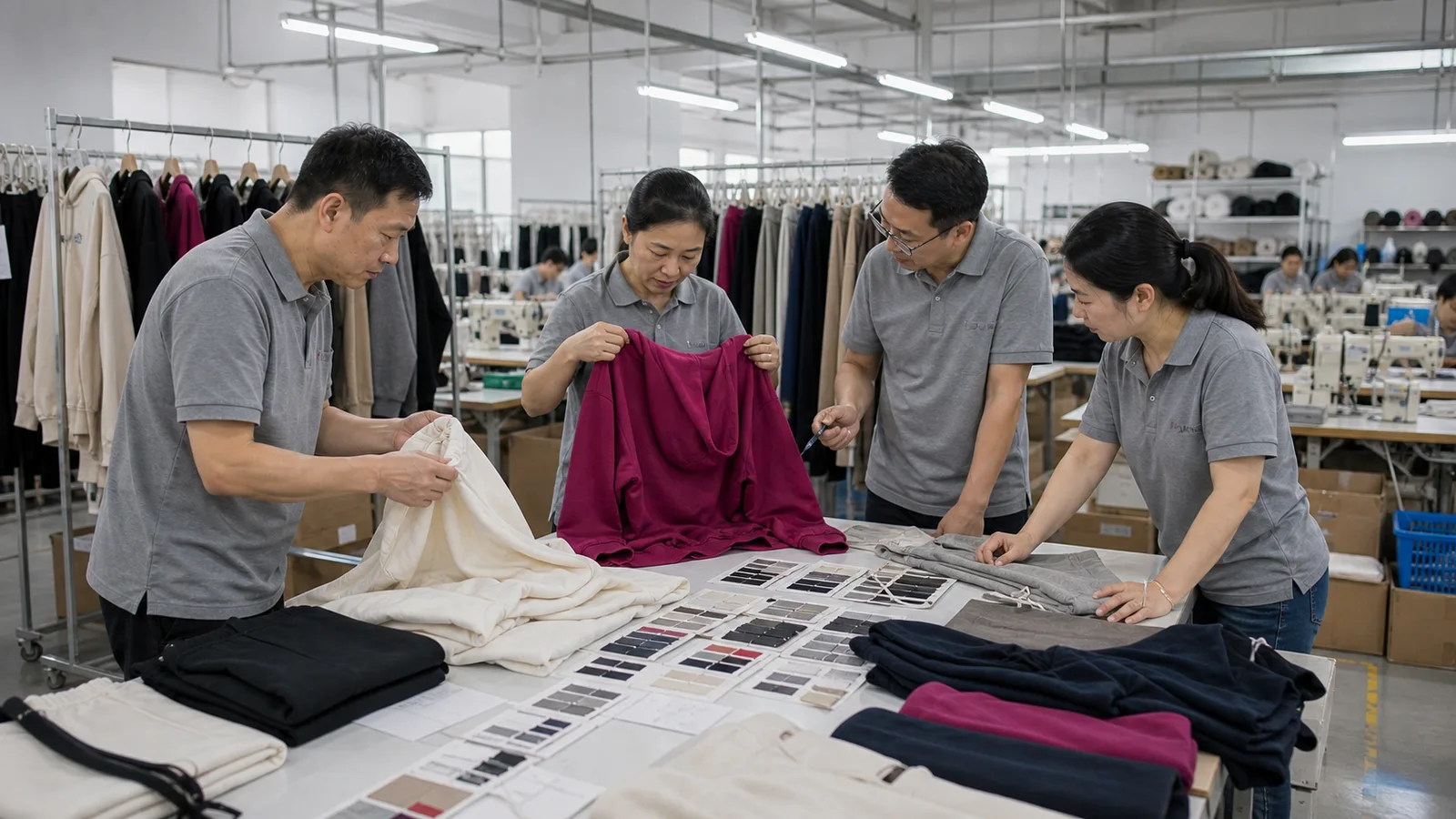
The supporting image in this article shows a sample-review scene with garments, swatches, and a factory team. It is an existing Yinshan Fashion development image used to illustrate review and comparison; it is not a customer order, quote, or guarantee of a specific outcome. The hero image is a user-provided fashion reference with no visible watermark. It represents the analytical buyer process, not an actual pricing record or a promised price.
What should buyers check about score comparable routes before negotiating price?
Once scope is aligned, create a comparison sheet for each supplier. Use the same rows for product reference, fabric, fit and pattern, construction, colours and prints, components, labels, packing, quantity split, samples, quality priorities, commercial basis, included items, exclusions, provisional points, decision needed, and next proof. Then flag where the answers differ.
Only after this review should the buying team compare price direction. A lower quote may be the right commercial route when it represents the required product scope and the buyer accepts the stated assumptions. A higher quote may be justified if it includes materials, development, components, presentation, or risk control that another supplier leaves open. The decision should combine product result, clarity, development capability, factory communication, evidence, and the buyer’s business priorities—not a single number isolated from the garment.
Yinshan Fashion can help buyers structure this comparison for custom dresses, fashion blouses, nightwear, girls’ tops, and related private-label apparel programmes. Share the current brief, reference images, fabrics or open material questions, construction, labels, packing, quantities, target market, and the quotes already received. The aim is not to make every factory quote identical. It is to give the buyer a clear, fair basis for selecting the supplier, manufacturer, and production route that best fits the intended fashion product.
Quote comparison kit
Three controls that make fashion manufacturer quotes genuinely comparable
A useful quote comparison starts with one shared product brief, makes every material and presentation assumption visible, and records which buyer decision turns an estimate into a bulk-ready route.
Align the product scope
Give every supplier the same style version, fit direction, fabrics, construction, components, labels, packing, quantity split, sample purpose, and target-market inputs.
Expose every assumption
Separate included and excluded items from provisional fabric, pattern, decoration, packing, commercial, and buyer-decision points before treating unit prices as comparable.
Choose the complete route
Compare product result, sample evidence, factory communication, quality priorities, presentation, risk, and commercial basis alongside the price direction.
Buyer actions and supplier questions before choosing a fashion manufacturer quote
Use the same comparison sheet for every supplier so the buyer can see product, fabric, fit, construction, components, labels, packing, quantities, samples, quality priorities, commercial terms, and open decisions in one place. Exact costs and conditions remain programme-specific.
| Decision area | What the buyer should prepare | What to ask the factory |
|---|---|---|
| Shared product brief | Provide the current style version, category, target customer, silhouette, measurements or fit, construction, colours, prints, target market, quantity plan, and sample purpose. | Which product information was used for the quote, and which unresolved design, fit, pattern, or construction point is still an assumption? |
| Fabric and material route | State known fibre, construction, handfeel, weight or behaviour, opacity, stretch, finish, colour or print, wash, lining, and product requirements. | Which fabric route is priced, and how would an alternative affect the silhouette, surface, fit, material proof, or price direction? |
| Components and branding | List trims, decoration, labels, care information, hangtags, barcodes, protective materials, and status as approved, buyer-supplied, open, or not applicable. | Which items are included, excluded, provisional, or dependent on final artwork, source, placement, or technique? |
| Packing and quantity structure | Give style, colour, and size splits plus folding, hanging, bagging, carton, assortment, retail, or e-commerce presentation requirements. | What quantity and packing route are included, and which split, packing, or presentation change would alter the quote? |
| Samples and quality priorities | Name the sample type, quantity, question it must answer, buyer approvals, quality priorities, accepted exceptions, and change-control expectation. | What does the sample quote include, what evidence will it produce, and how will the approved version transfer to bulk production? |
| Commercial comparison | Record quote date, currency, validity, payment, freight scope if requested, taxes if relevant, inclusions, exclusions, conditions, owner, and next action. | Which exact buyer decision or source confirmation is needed before the provisional price becomes a confirmed production route? |
Continue the production conversation
Fashion manufacturer quote comparison sheet
| Comparison area | Buyer needs to align | What to ask each supplier | Decision record |
|---|---|---|---|
| Product and fit | Style version, target user, silhouette, measurements, size range, construction, and sample purpose | What starting information was priced, and which fit, pattern, grading, or construction points are provisional? | Shared product brief and versioned assumptions |
| Fabric and components | Material behaviour, colour or print, lining, trims, decoration, labels, and visible finishing | Which fabric, component, and decoration routes are included, buyer-supplied, provisional, or excluded? | Reference list, proof objective, and open decisions |
| Quantities and packing | Total and split quantities, colours, sizes, folding or hanging route, individual protection, and cartons | What quantities and presentation route are priced, and what changes if the split or packing requirements change? | Scenario table and packing specification |
| Samples and bulk release | Sample type, version, revision scope, sample-charge route, quality priorities, and change controls | What evidence does each sample produce, and what inputs or later changes require a new price or review? | Sample record and bulk production brief |
| Commercial basis | Currency, quote date, validity, payment, freight scope if requested, taxes if relevant, and exclusions | What is included, excluded, conditional, and awaiting a buyer decision? | Comparable quote sheet with decision owner and next action |
Buyer FAQs
How should buyers compare fashion manufacturer quotes?
Compare the same product brief first: style version, fit, fabric, colour or print, construction, components, labels, packing, quantities, sample scope, quality priorities, commercial basis, inclusions, exclusions, assumptions, and open decisions. Only then compare price direction.
Why can two clothing factory quotes have very different prices?
They may use different fabric routes, fit or pattern assumptions, construction, components, decoration, labels, packing, quantity splits, sample scope, or commercial basis. A lower price is not comparable until the buyer knows what product and responsibilities it includes.
Should fabric be specified before requesting a fashion quote?
State as much as is known: desired fibre direction, construction, handfeel, weight or behaviour, opacity, stretch, finish, colour or print, wash, lining relationship, and target product outcome. If material is still open, ask the supplier to state its provisional assumption and any decision needed for a confirmed price.
What should a fashion sample quote include?
It should identify the sample purpose, quantity, product version, material and component assumptions, branding scope, revisions if agreed, courier or other separately priced items, and the decision the sample is intended to support. Compare sample scope with the development risk it is meant to reduce.
How does Yinshan Fashion normally handle sample charges?
Sample garments are normally quoted at two to three times the related bulk garment price. For the same style, usual sample-charge refunds are 10% at 100 pieces, 30% at 300, 50% at 500, and 100% at 1,000 pieces. The exact quote, conditions, product scope, and order terms must be confirmed for the programme.