Article
What should buyers know first?
Short answer: A B2B quality-control guide for fashion brands, boutiques, and retail buyers checking product identity, measurements, workmanship, labels, barcodes, packing, cartons, and release records before a wholesale bulk order reaches the warehouse.
Wholesale fashion quality control should confirm that the bulk order matches the buyer's approved product and can be received, identified, stored, and sold without avoidable correction. The review should connect garment appearance and measurements with style-colour-size identity, labels, barcodes, individual packing, carton assortments, and release records. A final inspection is useful only when the buyer and factory share the same written standard.
Yinshan Fashion focuses on custom and private-label bulk programmes rather than unrestricted ready-stock wholesale. The product, materials, colours, quantities, size ratios, labels, packing, destination market, sample approvals, quality plan, and delivery objective must be confirmed for each order. This guide does not promise a universal inspection level, acceptance rule, production result, or delivery time. It explains the decisions a fashion buyer should make with the factory before the goods reach a warehouse.
Direct answer: Build wholesale fashion quality control from the approved product record and the warehouse receiving requirement. Check the right garment, colour, size, measurements, workmanship, labels, barcode, folding, individual pack, carton quantity, carton mark, and evidence of any correction. Do not release an order from a generic “passed” message; release the identified order version against agreed checks.
What does warehouse-ready wholesale fashion quality control mean?
Warehouse-ready quality is broader than whether a garment looks acceptable on an inspection table. A warehouse receives SKUs, not only clothing. Each unit needs to be the correct style, colour, size, label version, barcode, pack, and carton assortment. The physical garment and the data surrounding it must agree. A well-sewn blouse with the wrong size sticker can be misallocated. A correct dress in the wrong carton ratio can delay receiving. A clean carton with an outdated style code can create inventory errors before the product reaches the sales floor.
The buyer should therefore define quality in three connected layers. The first is product conformity: silhouette, measurements, material, colour, construction, trims, decoration, appearance, and function match the approved direction. The second is retail presentation: main labels, size labels, care information, hangtags, price or barcode labels, folding, tissue, individual bags, and other approved presentation details are correct for the product and market. The third is logistics identity: unit, inner pack, carton, packing list, and purchase-order records describe the same assortment.
These layers are relevant across casual fashion, active fashion, streetwear, and loungewear, although the detailed checks change by product. A draped dress may depend on lining, hem balance, closure, pressing, and length. A blouse may need attention to transparency, placket alignment, collar shape, buttons, and seam puckering. A heavyweight streetwear top may need checks on wash appearance, print placement, rib recovery, hardware, and surface damage. A lounge set may depend on handfeel, shade, elastic comfort, matching top-and-bottom identification, and folding.
Use a real product direction early in the conversation. The Casual Fashion collection can help a buyer identify whether the quality plan must cover shirts, blouses, dresses, T-shirts, trousers, or coordinated daywear. Collection pages are development references, not proof of ready inventory or a fixed inspection route. The final standard still comes from the buyer's product file, approved sample, order structure, and receiving requirements.
How should buyers start the quality plan from one approved order record?
Quality control becomes unreliable when production, merchandising, packing, and inspection teams use different versions. Before bulk release, create one order index that identifies the purchase order, style code, product name, colour names or codes, size range, unit allocation, current measurement chart, material and trim references, artwork versions, label files, packing instructions, and carton marks. Every supporting document should show a date or revision so an older file cannot quietly return to the process.
Name the product reference that controls the review. Depending on the project, this may be a pre-production sample, sealed sample, approved size set, current tech pack, measurement chart, fabric header, colour standard, trim card, print or embroidery approval, label artwork, and packing master. One object rarely proves every point. The approved sample may show silhouette and workmanship, while the measurement chart controls dimensions and the packing master controls the retail presentation.
Record what the reference does not prove. A sample made in substitute fabric cannot approve final handfeel, shade, shrinkage, or opacity. A sample with temporary labels cannot approve care copy, barcode data, or packing. A digital artwork placement does not confirm the physical result on the selected fabric. These limitations are not failures when they are visible. They become risks when a team treats a partial reference as complete approval.
The order index should also identify open decisions and their owners. The buyer may need to confirm a barcode file, language version, size ratio, colour name, or retailer mark. The factory may need to verify bulk material, a component, a construction adjustment, or packing feasibility. Do not release production or shipment by assuming an unanswered message means approval. Close the point in writing and update the linked document.
A useful manufacturing workflow connects product approvals with material checks, cutting, sewing, in-line review, finishing, packing, and final preparation. The buyer does not need to manage every factory operation. It should, however, be able to see how its approved standard reaches the people who make and check the order.
How should buyers check bulk fabric, colour, and components before defects are multiplied?
Final inspection happens too late to solve many material decisions. Bulk fabric and components should be reviewed before they are cut or consumed across the order. Confirm the material identity, surface, handfeel, weight or structure where specified, colour direction, shade relationship, print or wash appearance, lining, elastic, buttons, zippers, thread, labels, and other trims against the current product record.
Material checks should follow the garment. Pale blouse and dress fabrics may need an opacity review in the actual construction. A printed item may need scale, placement, repeat, panel relationship, and colour review. Stretch products may need recovery and coverage checks at the relevant pattern areas. Washed or brushed products may need a controlled appearance standard because normal variation can be interpreted differently by a buyer, production team, and final inspector.
Shade management matters at both garment and assortment level. The factory should identify material lots and avoid creating unintended panel or set differences. The buyer should state whether top-and-bottom pieces, body-and-sleeve panels, lining, rib, binding, or trims need a close colour relationship. A general colour name such as black, cream, or sage is not enough when several materials are involved.
Components should be connected to the correct style and market. A button can be the right shape but wrong colour. A zip can function but have the wrong puller. A care label can be cleanly sewn but contain an outdated product version. A barcode can scan but identify another size. Quality control needs to check identity and application together rather than treating the presence of a component as proof that it is correct.
When an alternative is proposed, record whether it is a temporary sampling option, a buyer-approved replacement, or a production correction. Note which styles, colours, sizes, labels, packing items, and quotation assumptions are affected. A substitution should never enter the order only through a photograph in a message thread.
How should buyers use in-line checks to control construction and measurements?
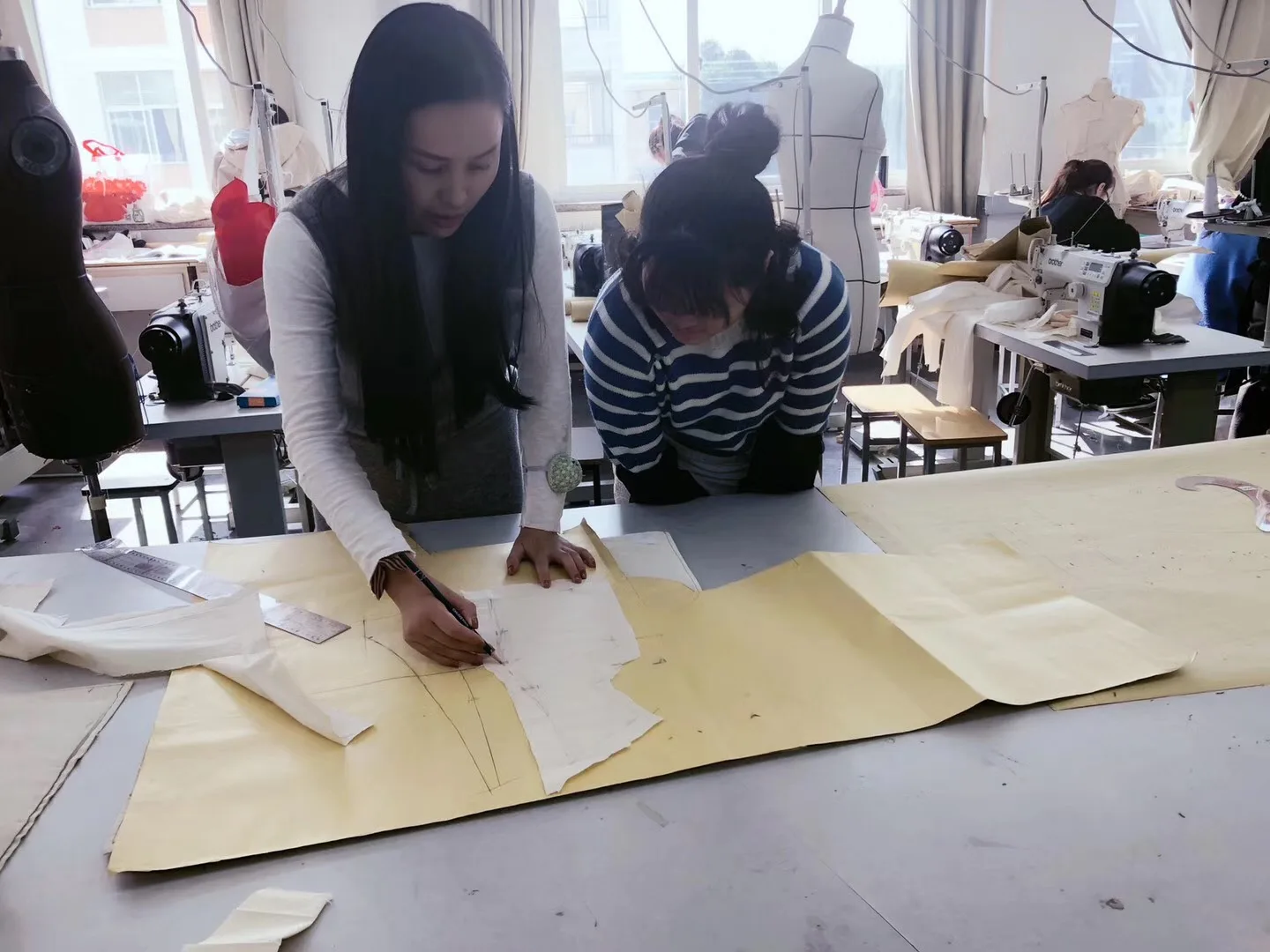
In-line quality control checks work while correction is still possible. The factory can review first pieces and production at defined stages for measurements, seam appearance, stitch security, skipped stitches, puckering, panel alignment, print or embroidery placement, closures, pockets, lining, elastic, labels, and other high-risk details. The exact check should follow the garment, not a generic list copied across every product category.
Set style-specific priorities. For a woven shirt, the buyer may focus on collar symmetry, placket, cuff, buttonholes, sleeve setting, body length, and pressing. A blouse may add drape, transparency, neckline stability, gathering, seam finish, and button colour. A dress can require checks on waist position, lining, zip, pocket, print placement, hem balance, and movement. A streetwear item may need attention to wash, graphics, rib, topstitching, hardware, pocket strength, and garment measurements.
Measurements need a current chart, named points of measure, a consistent method, and an agreed tolerance or decision rule. The buyer should identify which dimensions strongly affect fit or warehouse returns. The factory should explain how those points are checked during production and what happens when a result falls outside the agreed standard. A single total length measurement cannot prove that the shoulder, bust, waist, rise, sleeve, or pocket position is correct.
Do not separate measurement from material and construction. A soft fabric can relax. A rib can recover after handling. A washed garment can change. A lined dress may settle differently after pressing. Record when and how the measurement is taken, whether the garment has rested, and which approved condition applies. This reduces arguments caused by two teams measuring the same piece in different states.
In-line findings should create a closed record. Identify the issue, affected style or lot, proposed correction, responsible person, verification, and whether the approved sample or specification changes. Photographs can support the record, but they need a caption or note. An image of a seam without a style, location, scale, and decision is difficult to use later.
How should buyers review final garment appearance, function, and consistency?
Final garment review asks whether finished units match the approved product direction after sewing, finishing, and pressing. Look at the garment as a customer and as an operations team would see it. Confirm silhouette, colour, surface, drape, symmetry, measurements, seam appearance, loose threads, stains, marks, holes, pressing, closures, pockets, decoration, labels, and any product-specific function.
Appearance should be assessed under suitable light and in a consistent condition. A dark garment can hide lint, shine, shade variation, or pressing marks. A pale garment can reveal oil, dirt, transparency, or lining differences. Printed and washed products need an approved visual range. The quality plan should distinguish an acceptable product characteristic from an unintended defect instead of leaving the inspector to invent the boundary.
Function checks depend on the product. Open and close buttons, zippers, snaps, hooks, drawcords, and adjustable components where relevant. Check pocket entry and attachment. Review elastic recovery and attachment on garments that use it. Confirm that trims do not create an obvious comfort or safety concern within the buyer's specified product requirements. Do not imply laboratory performance from a visual inspection; if the buyer requires testing, define the method, sample, timing, responsible party, and documents separately.
Consistency matters across units, colours, and sizes. An inspector should not approve one attractive sample and ignore variation through the assortment. Compare units from relevant production and packing groups. Confirm that a correction made on one line, colour, or size was applied where intended. If a product has matching pieces, verify both the visual relationship and the SKU relationship.
Final quality control should not become a repair department for preventable production issues. Minor cleaning, thread trimming, pressing, or repacking may be possible before release, but repeated construction, shade, measurement, or identification problems usually point to an earlier control gap. Record the pattern and address the cause, not only the last visible symptom.
What should buyers check about make labels, barcodes, and SKU identity part of garment quality?
Private-label and wholesale orders carry product information through several layers. The garment may have a main label, size label, care label, country or responsible-party information where required, hangtag, barcode, price sticker, size sticker, individual bag label, and carton mark. The exact information depends on the product, buyer, retailer, destination market, and applicable requirements. The buyer should confirm the current content with its responsible compliance or retail owner.
Build an SKU master before packing. Each style-colour-size combination should have one identifier and one approved relationship between garment, sewn labels, hangtag, barcode, outer sticker, and carton data. Use controlled source files rather than retyping information at different stages. The master should show which items are supplied by the buyer, generated by a retailer, or prepared through the factory.
Scan barcodes against the buyer's product data where this is part of the order requirement. A readable barcode can still be wrong. Check that the scan result identifies the correct style, colour, and size. Verify placement and orientation against the packing instruction, and make sure the sticker does not hide required information or damage the presentation.
Care and fibre information must describe the actual product. If the material or construction changes, revisit the linked copy instead of assuming the previous label remains suitable. Language, origin, importer, responsible-party, claim, and retailer requirements can vary by market. Yinshan Fashion can coordinate approved files and application, while the buyer should confirm the exact current information with the appropriate owner.
The private-label development route helps organise labels, hangtags, barcodes, packing, and brand presentation alongside the garment. This is important because a label error is not only a design issue. It can affect warehouse receiving, product information, online listings, customer care, and the ability to repeat the order accurately.
How should buyers check finishing and packing against the receiving workflow?
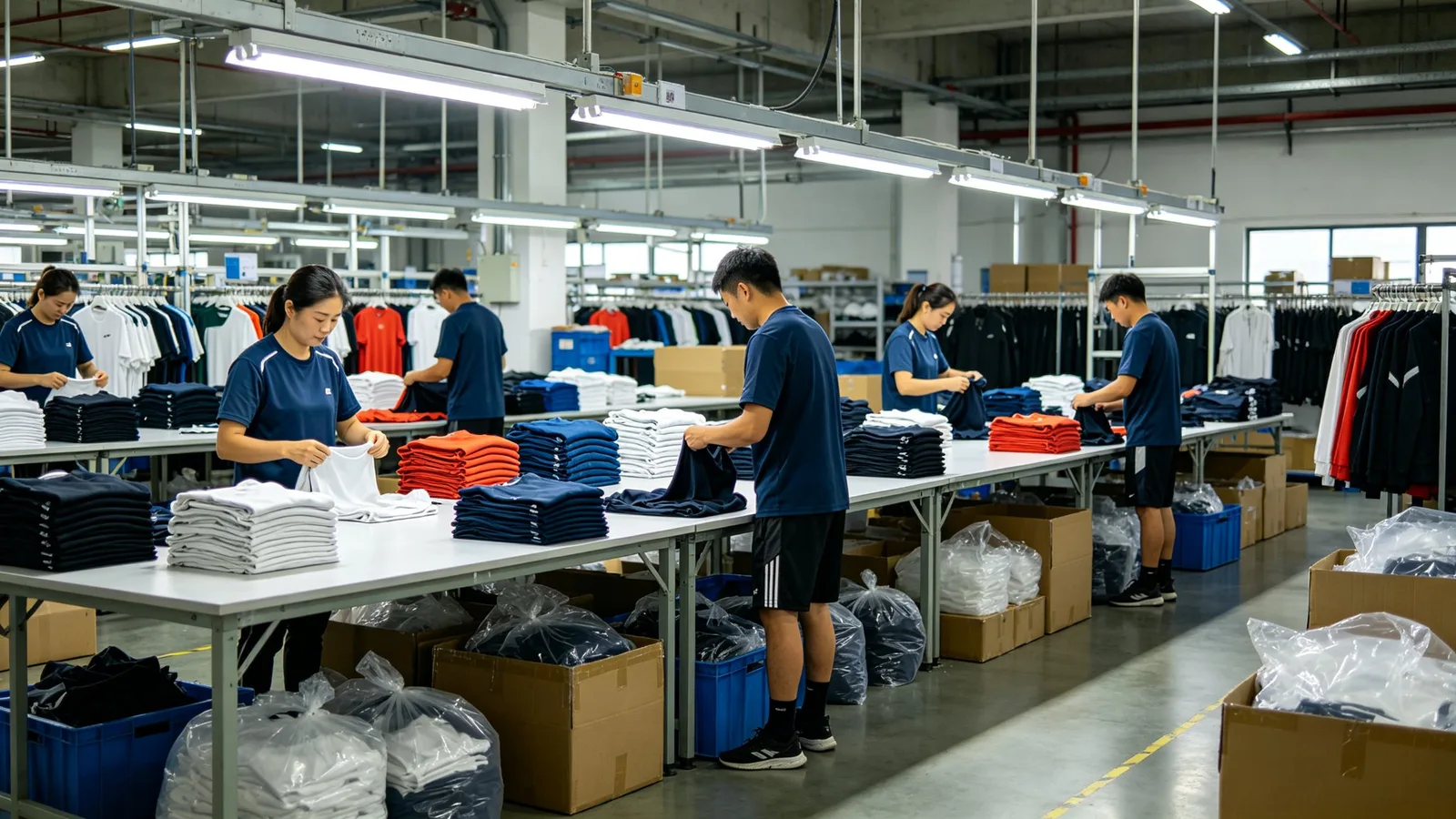
Finishing changes how the product arrives. Confirm thread trimming, cleaning, pressing, folding, shaping, tissue or inserts, hanger use where applicable, individual bags or boxes, seals, stickers, and presentation details. A garment can pass sewing inspection and still arrive creased, damp, crushed, mixed, or incorrectly identified if finishing and packing are treated as an afterthought.
The factory image above shows apparel being pressed during finishing preparation. It is evidence of a real production environment, not a promise that every garment uses the same operation. The relevant finishing route depends on the fabric, construction, product presentation, packing method, and buyer instruction.
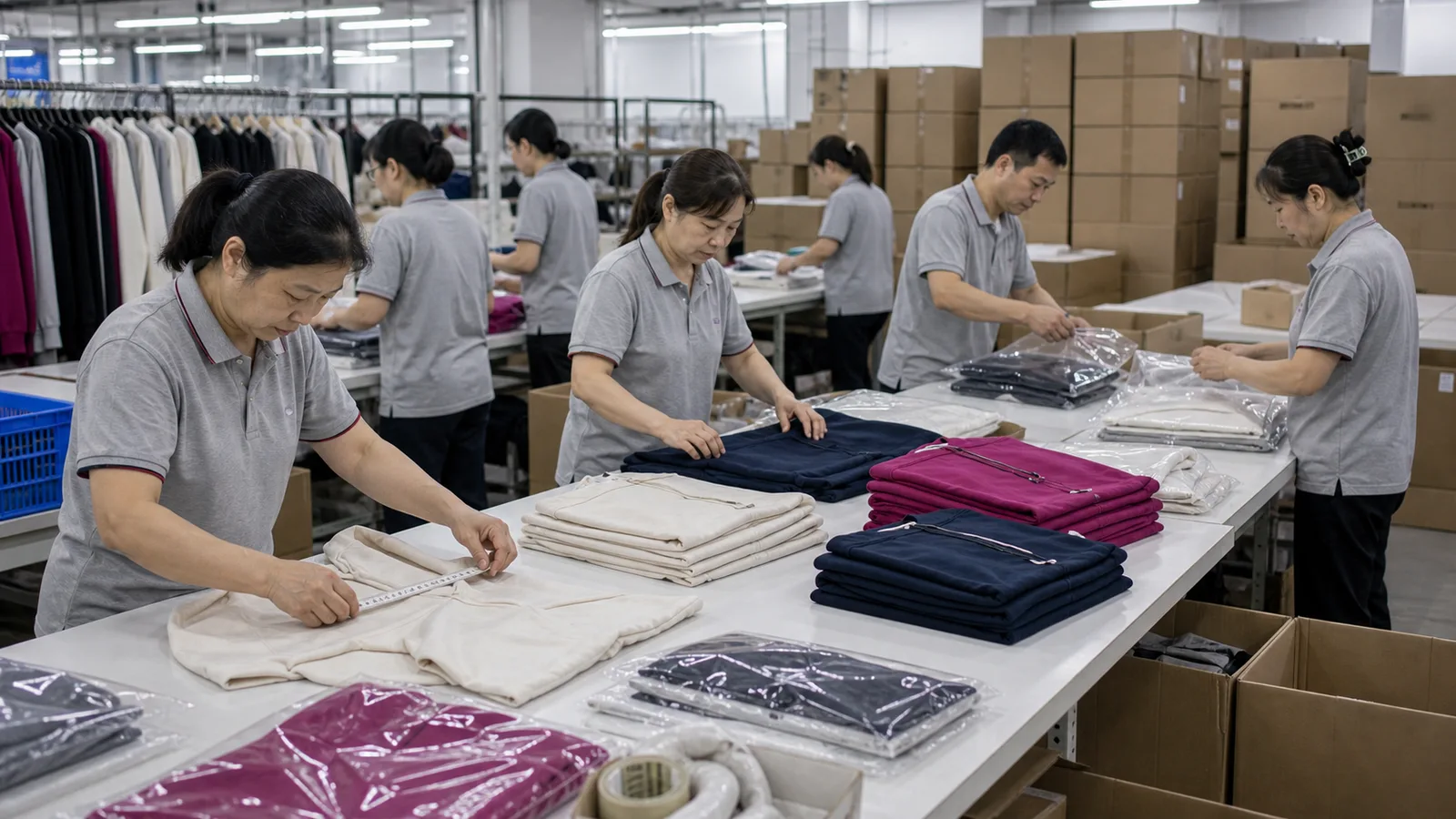
Approve a packing master that a packing operator and inspector can use. Show the garment fold, fastenings, tissue or insert, label and barcode position, size sticker, bag or box, warnings or approved market information where applicable, quantity per inner or carton, assortment method, and carton marks. Include photographs or diagrams when words alone could be interpreted differently.
The garment finishing and packing guide explains how thread trimming, pressing, labels, folding, individual packing, and cartons connect at the end of production. For a wholesale buyer, the key question is whether the finishing standard also protects the SKU and receiving record.
Test the receiving logic before all cartons are closed. Select a carton or packing group and trace its contents from packing list to carton mark, individual identification, and physical garment. Confirm style, colour, size, quantity, and presentation. This catches a data or assortment problem while repacking is still possible.
Packing protection should match the delivery route. A warehouse pallet, courier parcel, hanging garment, export carton, retailer distribution centre, and boutique back room can expose the product to different handling. The buyer should state the receiving and routing requirements. The factory can then review carton strength, dimensions, assortment, marks, internal protection, and practical packing sequence against the order.
What should buyers check about make the inspection sample represent the actual order?
An inspection result is only as useful as the sample it represents. The buyer and factory should agree how units are selected across styles, colours, sizes, production groups, and cartons. The plan should prevent a reviewer from seeing only the easiest style, the top layer of one carton, or units specially prepared for presentation. If the buyer uses a formal sampling standard, inspection level, defect classification, or acceptance rule, it should be written into the order or inspection protocol rather than assumed.
Classify findings in a way that supports decisions. The exact categories depend on the buyer's system, but the team should distinguish product-safety or regulatory concerns, serious failures against the approved product, and smaller workmanship or presentation issues. Define examples for the actual garment. A loose decorative thread, broken closure, wrong care label, major measurement error, shade mismatch, stain, and incorrect barcode do not carry the same warehouse or customer risk.
The plan should cover more than the garment. Include packing and carton verification where relevant: unit identity, assortment, quantity, labels, barcode, fold, individual protection, carton condition, carton marks, and packing-list relationship. A final report that ignores the receiving layer cannot show whether the order is warehouse ready.
Retain enough evidence to understand the result without reopening every carton. Evidence may include the order identity, inspection date, location, inspected quantity, selected cartons or lots, measurement record, finding descriptions, photographs, barcode results, packing checks, corrections, unresolved items, and release decision. Avoid unlabelled image galleries. Each image should connect to a style, colour, size, location, finding, and action.
Sampling does not turn an inspection into a guarantee that every unit is identical. It provides structured evidence about the inspected order under the agreed method. Quality still depends on the approved standard, production controls, representative selection, transparent records, and how findings are corrected.
What should buyers check about separate correction, concession, hold, and release decisions?
Not every finding leads to the same action. Some issues can be corrected and rechecked before packing or shipment. Some may be accepted by the buyer as a documented concession for a defined style, colour, size, or quantity. Others should place affected goods on hold while the cause and scope are reviewed. The final release should identify what was approved, what was corrected, what remains open, and who authorised the decision.
Avoid vague status words. “Fixed” should identify the correction and verification. “Accepted” should identify the approved deviation and affected goods. “Rechecked” should describe what was selected and what evidence supports the result. “Released” should connect to the purchase order, style range, quantity, packing status, documents, and delivery condition. This protects both buyer and factory when a later warehouse question refers back to the order.
When a problem appears, check scope before assuming it is isolated. A wrong label may affect one unit, one size, one colour, or every piece packed during a shift. A measurement issue may relate to one operator, one pattern version, or a material behaviour. A shade issue may follow a fabric lot. Use the order records to identify the population and design the correction or recheck accordingly.
The buyer should identify who can approve deviations. Merchandising, product, quality, operations, compliance, and warehouse teams may care about different risks. Consolidate their decision instead of sending conflicting messages to the factory. A garment should not be released because one contact accepted an appearance issue while another team still considers the label or barcode incorrect.
Commercial pressure does not remove the need for a record. If timing is tight, the team still needs a clear statement of the finding, scope, decision, and responsibility. Fast decisions become safer when the evidence is organised.
How should buyers build a warehouse handover pack and repeat-order record?
The warehouse handover should allow the receiving team to identify what is arriving. Confirm the purchase order, shipment or delivery reference, style-colour-size quantities, carton count, packing list, carton marks, dimensions or weights where required, and any receiving or routing instruction. The factory record and buyer record should use the same style and SKU language.
Include the final approved product and packing versions in the internal order archive. Retain the sample identity, measurement chart, material and colour references, trim codes, decoration files, label artwork, barcode data, packing master, carton marks, quality priorities, inspection evidence, concessions, corrections, and release note. This information supports claims review, warehouse troubleshooting, and a more controlled reorder.
When the warehouse receives the goods, capture useful feedback. Record shortages, overages, mixed SKUs, carton damage, moisture, crushing, label or barcode issues, garment defects, pressing problems, and other receiving observations. Separate transport or handling damage from product or packing nonconformity where the evidence allows. Send organised feedback rather than isolated photographs without carton or SKU identity.
The repeat-order file should show what remains the same and what must be reconfirmed. Fabric or trim availability can change. A new colour needs review. A changed size ratio affects cutting and packing. Updated artwork or market information requires new files. A repeat order is not simply “same as last time” unless the last approved standard can be identified.
Wholesale fashion quality control creates business value when it protects product consistency and inventory accuracy together. The aim is not to produce the longest inspection report. It is to give the buyer, factory, packer, shipper, and warehouse one traceable version of the order.
What should the buyer send, and what should the factory confirm?
The buyer should send a controlled input package before the final inspection window. Include the purchase order and assortment by style, colour, and size; current tech pack and measurements; approved sample identity; material and colour references; trims and decoration; labels, care information, hangtags, barcodes, size stickers, and packing files; carton marks and packing list requirements; destination market and warehouse routing information; quality priorities; inspection or sampling instructions; defect or decision rules where used; approval owners; and the delivery objective.
The factory should confirm the production and packing status, current reference documents, affected lots or cartons, readiness for inspection, available evidence, unresolved changes, correction status, and the contact who owns the final review. It should distinguish what has been checked from what remains an assumption. If the order is not ready, moving the inspection date is clearer than presenting selected finished pieces as though they represent all goods.
For a practical Yinshan Fashion review, send product references or a tech pack, style-colour-size quantities, materials, labels, barcodes, packing, carton and warehouse requirements, target market, quality priorities, inspection instructions, and the requested delivery window through the contact page. The team can then discuss which records and checks should connect the approved product with production, finishing, packing, and release. Final requirements remain subject to the actual order and buyer approval.

Warehouse-ready quality
Three controls that connect garment quality with accurate warehouse receiving
Wholesale fashion quality control should protect the approved garment and the SKU record at the same time. These checks help a buyer connect the product standard with labels, barcodes, packing, cartons, evidence, and a traceable release decision.
Control the product version
Identify the approved sample, measurement chart, fabric and colour reference, trims, decoration, and every authorised change before units are selected for inspection.
Control the SKU and pack
Match the physical style, colour, and size with sewn labels, hangtags, barcodes, individual packing, carton assortment, marks, and the buyer's packing list.
Control the release record
Separate correction, buyer-approved concession, hold, recheck, and release. The final record should state which order version and goods the decision covers.
Buyer action and factory confirmation before warehouse delivery
Use this checklist to keep product, data, packing, and release decisions aligned. The exact inspection method and acceptance rules remain project specific.
| Decision area | What the buyer should prepare | What to ask the factory |
|---|---|---|
| Order and approved reference | Send the purchase order, style-colour-size assortment, approved sample identity, current tech pack, measurements, and change log. | Which document and physical reference are production, quality, finishing, and packing teams using now? |
| Material, appearance, and workmanship | Define the critical points for fabric, shade, measurements, construction, decoration, closures, pressing, and visible appearance by style. | Which checks occurred before cutting, during sewing, and after finishing, and what evidence identifies the affected lots? |
| Labels, barcode, and SKU master | Provide approved label files, product information, hangtags, barcodes, size stickers, and one mapping for every style-colour-size SKU. | How will the packed garment, scan result, outer sticker, and carton data be checked against the same SKU record? |
| Packing and warehouse receiving | Confirm folding, individual protection, units per carton, assortment, carton marks, packing list, destination, and routing instructions. | Can a selected carton be traced from the packing list and carton mark to each physical unit before all cartons are closed? |
| Findings and order release | Name the approval owner and define how corrections, concessions, held goods, rechecks, and release decisions should be recorded. | Which goods were inspected, corrected, rechecked, held, or released, and which open conditions remain attached to the order? |
Continue the production conversation
Wholesale fashion quality-control plan before warehouse delivery
| Control area | Buyer-approved standard | Factory evidence | Warehouse risk if missed |
|---|---|---|---|
| Product identity | Current style, colour, size, sample, tech pack, and measurement version. | Order index, selected units, measurement record, and change log. | Wrong product, inconsistent fit, returns, or an untraceable deviation. |
| Materials and appearance | Fabric, shade, surface, print or wash range, trims, and finishing direction. | Bulk references, lot identity, final garment review, and labelled findings. | Mixed shade, visible variation, stains, surface damage, or customer complaints. |
| Labels and barcode | Approved main, size, care, hangtag, barcode, sticker, and product-data relationship. | SKU master, scan result, placement check, and approved file versions. | Receiving failure, misallocated inventory, inaccurate product information, or relabelling. |
| Individual packing | Fold, tissue or insert, bag or box, sticker, seal, and presentation master. | Packed-unit comparison, photos, and correction record. | Creasing, damage, wrong presentation, mixed sizes, or repacking work. |
| Cartons and assortment | Units per carton, style-colour-size ratio, carton marks, packing list, and routing needs. | Carton trace, count, assortment check, marks, and carton-condition review. | Warehouse delay, shortages, mixed SKUs, wrong distribution, or handling damage. |
| Release record | Inspection method, decision owner, correction, concession, hold, and release rules. | Final report, recheck evidence, unresolved-item list, and signed decision. | Shipment of unapproved goods or no reliable basis for a later claim or reorder. |
Buyer FAQs
What should wholesale fashion quality control check before warehouse delivery?
Check the current product identity, material and colour, measurements, construction, appearance, closures, decoration, labels, barcode, folding, individual pack, carton quantity, assortment, carton marks, packing-list relationship, corrections, and release evidence. The exact plan should follow the approved garment, purchase order, destination market, retailer or warehouse requirements, and written inspection method.
Is final inspection enough to control a wholesale fashion order?
No. Final inspection is one checkpoint. Material, colour, first-piece, construction, measurement, label, and packing risks are easier to control earlier. A useful plan combines approved product records, pre-production checks, in-line review, finishing and packing verification, representative final inspection, documented correction, and a clear release decision.
How should a buyer check barcodes and size labels on apparel?
Create an approved SKU master linking every style, colour, and size to its sewn labels, hangtag, barcode, outer sticker, and carton information. Scan barcodes where required and verify that the result identifies the physical garment. A readable barcode can still be wrong, so identity, placement, and approved file version all need review.
How are inspection findings handled before shipment?
Identify the finding, affected styles or lots, scope, proposed correction, owner, and verification. Separate corrected goods, buyer-approved concessions, held goods, and released goods. A final decision should name the purchase order, product range, quantity or cartons, unresolved conditions, evidence, and person authorised to release the order.
Does Yinshan Fashion guarantee a fixed wholesale inspection result?
No universal result can be guaranteed without the actual product and order conditions. Yinshan Fashion can discuss a project-specific quality route connecting approved samples, materials, measurements, construction, labels, packing, in-line checks, finishing, final review, and records. The buyer and factory should confirm the inspection method, acceptance decisions, market requirements, and release conditions for the specific order.