Article
What should buyers know first?
Short answer: Prepare a loungewear manufacturing brief covering fabric feel, relaxed fit, matching sets, care review, labels, packing and repeat-order decisions.
The practical goal is to translate a feeling into decisions that a development team can execute. Softness needs a physical reference. Relaxed fit needs a shape, size range and movement review. A coordinated set needs colour and component control. Retail readiness needs accurate identification and a packing method that protects the approved presentation. When those decisions are connected, a brand can evaluate a sample for the intended customer instead of judging it only by how it feels for a few seconds in the showroom.
How should buyers give the loungewear manufacturer a defined wearing scenario?
Start with the occasion and the customer. Explain whether the garment is intended mainly for home relaxation, sleeping, travel, casual outdoor use or a combination. Identify the layers a customer is expected to wear underneath and whether a top should work separately from its matching bottom. These details influence coverage, pockets, openings and the amount of ease needed. Avoid asking one product to satisfy every scenario without discussing the compromises in appearance and function.
Describe the brand's intended silhouette through drawings and a reference garment where available. A loose shoulder can be deliberate, but a sleeve that twists or limits reach is not automatically part of a relaxed look. Name the reference size, measurement method and size range. Explain whether the customer expects a close neckline, adjustable waist, open hem or fitted cuff. The factory can then review the proposed material and pattern as a complete garment rather than interpreting comfort as permission to make every dimension larger.
Use the loungewear category to identify the closest product family, then make a project-specific brief. If the range includes garments sold or promoted as sleepwear, flag that intended use early so the brand can identify relevant market requirements with its specialist advisers. This article does not establish a product's classification or legal compliance. A commercial name should not conceal a use that changes the information, evidence or review needed before sale.
How should buyers build the fabric choice around a retained physical reference?
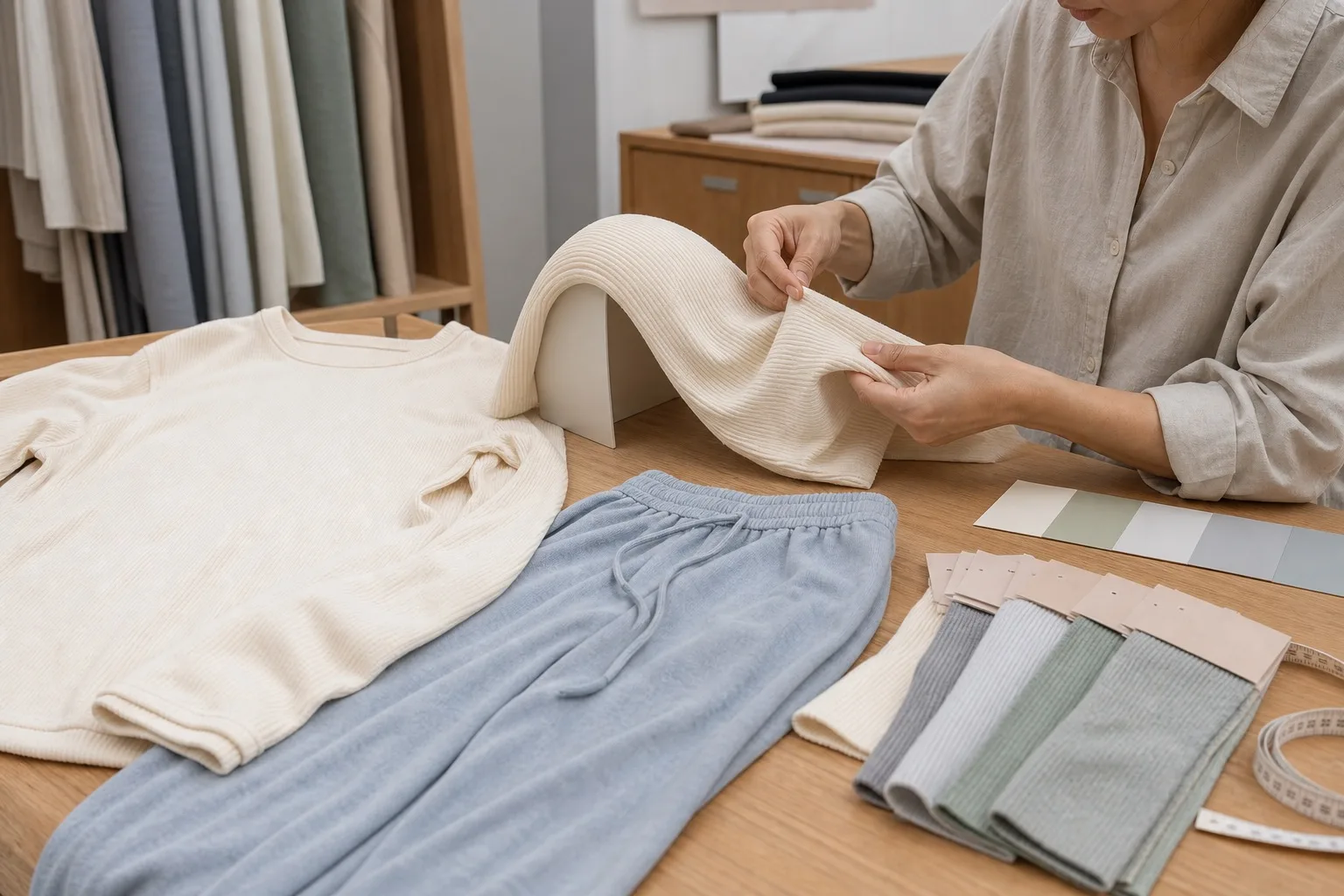
Words such as soft, smooth and cosy are useful starting points, but they are not precise approvals. Send or select a physical swatch and describe which qualities matter: surface feel, drape, weight, thickness, stretch, recovery or the sensation against skin. Distinguish the face from the reverse side. A brushed interior and a smooth exterior may create the desired experience, while a fabric that feels soft in one small area can behave differently when made into a complete garment.
Record the fabric supplier reference, composition, construction, finished width, weight and finish. Confirm whether the sample quality is representative of the intended bulk material. If an alternative is proposed, review the change explicitly instead of retaining the old fabric name in the technical pack. The casual fashion range can provide a comparison when a loungewear piece must also look appropriate outside the home, but a category image is not proof of handfeel or fibre composition.
Make tradeoffs visible. A denser fabric may support coverage while changing warmth and drape. A softer finish may change the surface after care. A stretch quality may require a different fit approach from a woven material. Ask the factory which uncertainties need sample review and which require appropriate material testing. Avoid promising breathability, moisture management, skin benefits or durability from a fibre label alone. The buyer should decide which claims matter and what evidence would support them for the actual finished product.
How should buyers separate relaxed fit from uncontrolled garment proportions?
A relaxed garment still needs an intentional relationship between shoulder, chest, sleeve, waist, rise and hem. Define the amount of volume the design needs and where that volume belongs. A wide torso does not necessarily require a very low armhole. A generous trouser leg does not resolve an uncomfortable waistband. Review the proportions on the intended body reference and inspect the garment in ordinary positions, including sitting, reaching and walking.
For bottoms, discuss rise, seat shape, crotch balance and waistband position together. A waist that feels comfortable while standing can become restrictive when seated, while an overly loose waist may slide and change the perceived length. For tops, check neckline security and the relationship between sleeve length and cuff. If the garment is supposed to accommodate a base layer, use that layer during review. Otherwise the team may approve a fit that changes noticeably when the customer wears it as intended.
Keep comments specific to the observed issue. State which sample and size were reviewed, identify the position that revealed the problem and attach photographs. Ask the pattern team to propose a correction when the cause is uncertain. Changing several measurements at once without a diagnosis can create a new imbalance. Compare the revised version with the previous one and record accepted areas as well as requested changes. This prevents a solved sleeve or rise issue from being reopened accidentally during another revision.
How should buyers approve waistbands, cuffs and necklines against use?
These areas often determine whether a loungewear garment feels comfortable over an extended period. Record the intended construction and inspect the assembled result. An elastic waistband should be reviewed for comfort, security, twisting and its relationship to the shell fabric. A drawcord may offer adjustment, but it also introduces questions about length, end treatment, attachment, access and customer use. Do not add it as a decorative afterthought without reviewing the complete design.
Cuffs and neckbands need their own material and measurement references. A rib that resembles the shell colour may still behave differently after care or repeated extension. Review the edge against the body and inspect whether it distorts the adjoining fabric. If a cuff must stay in place, confirm that outcome in the sample. If it is intended to sit loosely, do not allow the production team to tighten it simply because a different factory reference used a closer fit.
Keep the brand's customer promise realistic. The sample review can document what was observed, but it does not automatically support a universal comfort or performance claim. Where specialist testing or user evaluation is needed, agree its scope and owner. The active fashion category may help identify movement-oriented construction references when a crossover style is being developed. It should not be used to imply that ordinary loungewear has verified sports performance or that all existing materials meet the new brief.
How should buyers treat matching sets as two garments with one retail relationship?
A matching set needs coordination without losing control of the individual pieces. Give the top and bottom their own style or component identifiers, measurements and construction notes. Then define the relationship between them: shared material, colour, trim language and retail packaging. Decide whether the set will be sold only as a pair or whether customers can buy and combine separate sizes. That commercial decision changes labelling, stock identification and packing instructions.
Approve the finished pieces together under consistent viewing conditions. Compare the shell materials, ribs, thread and visible trims. If different constructions are used, discuss how close their appearance can reasonably be and retain the actual approved references. The same colour name across two supplier cards does not prove a visual match. Nor does a photograph establish how the materials look when they move, fold or catch light differently on the body.
Consider the size relationship as carefully as the shade. A customer may need a different top and bottom size, and the brand should decide how its selling model addresses that before the order is packed. If pairs are fixed, show the pairing matrix and retail identifier clearly. If separates are allowed, ensure the packing and product descriptions do not imply a fixed combination. The factory needs a precise instruction, because an otherwise correct shipment can become difficult to sell when set relationships are unclear.
How should buyers check coverage and surface appearance in representative conditions?
Loungewear can be photographed in soft studio light but worn in very different settings. Review coverage using the intended underlayer, relevant colours and normal movement. A light-coloured trouser may reveal pocket bags or underwear when the material is stretched across the seat. A loosely knitted top may look opaque on a hanger but become more open when worn. Record the conditions and the buyer's acceptance rather than describing the fabric as universally opaque.
Review surface behaviour on representative samples and decide which observations need a formal test. The brand may care about fuzzing, pilling, snagging, rubbing, colour transfer or the appearance of raised surfaces after care. Different constructions present different risks, so do not use a single generic checklist as proof that every issue has been assessed. If a named method or performance level is required, agree it with the appropriate testing party and retain the actual result.
Keep marketing language aligned with the evidence. A favourable handfeel review does not establish long-term durability. A garment that looks good after one development wash has not necessarily passed a defined repeated-care programme. This does not make practical sample review unhelpful; it makes accurate labelling of the evidence important. Buyers can use observations to refine the product while reserving stronger claims for properly supported results. The final product page should describe what the programme can demonstrate.
How should buyers review the complete garment after its proposed care route?
Choose a representative sample and record its identity before reviewing care effects. Measure the garment using the agreed method, photograph its appearance and identify the shell, trims, elastic, decoration and labels included. The care review concerns that complete assembly. A fabric supplier's information can inform the plan, but it does not settle every question created by sewing different materials together or adding decoration and functional components.
After the agreed care process, review dimensions, seam appearance, twisting, colour relationship, fastening operation and the feel of key areas. Check the top and bottom together if they are sold as a set. A change in one piece can disrupt the coordinated look even when the other remains acceptable. Record both the observation and the action: accept, revise, investigate or repeat a defined review. Avoid reducing the outcome to a green tick that loses the material and sample version.
If the factory changes the shell finish, elastic, rib or decoration after approval, identify which evidence may no longer apply. The buyer should know whether the change is merely administrative or affects the product. Do not reuse an old report because the new component has a similar colour. Maintain a controlled relationship between the approved care wording and the product it describes. That record supports clear handover to packaging, e-commerce and customer-service teams without turning a development observation into a blanket guarantee.
How should buyers use a sample sequence that answers different questions?
Explain what each requested sample is meant to resolve. An early prototype may test silhouette and construction using an interim fabric. A fit sample should allow a meaningful review of the actual material-pattern relationship. A later approval sample should identify the components and finishes intended for production. These names are used differently across businesses, so define the purpose and limitations rather than assuming the label alone creates agreement.
Do not request another round with an unchanged, vague instruction such as make it more premium. Identify what needs to improve and provide a reference or an observable criterion. If several alternatives are being considered, separate them so the review can compare cause and effect. For example, evaluate a new waistband construction without simultaneously changing every body measurement unless that combination is necessary. The resulting evidence will be easier to use when deciding which version to approve.
Keep an open-issue list beside the sample record. Name the person responsible for each decision and explain whether the issue blocks cutting, trims, packing or only final presentation. Some development tasks can proceed while another decision is pending, but the boundaries must be explicit. A buyer can approve a silhouette while holding the fabric decision open; the factory should not interpret that as authority to buy all bulk materials. Clear partial approvals reduce uncertainty without pretending the whole product is finished.
What should buyers consider about cost the collection with its actual set and colour structure?
Give the factory a quantity matrix by style, colour and size. Show whether the order consists of fixed sets or separate garments and identify any shared materials. Ask which minimums apply to shell fabric, ribs, elastics, labels, decoration and garment production. Material sharing may be helpful, but it does not automatically combine different colours or component requirements into one commercial minimum. Confirm the proposed arrangement for the specific order.
Compare quotations on a common specification. A price based on an unlined woven top cannot be compared directly with one using a brushed knit, custom rib and decorated packaging without identifying the differences. Record the fabric reference, construction, trims, care-review assumptions and packing included in each proposal. Separate development charges, material commitments and bulk pricing. If an estimate remains conditional on final material selection, keep that condition visible when discussing the collection budget.
Protect the product's essential decisions when exploring cost changes. The brand might simplify a pocket, reduce a trim variation or consolidate colours, but it should understand how each change affects the customer experience. Ask for options with the specification consequences stated plainly. Do not approve a cheaper substitution through an informal message while retaining the old reference in the technical pack. Yinshan Fashion should receive one current brief that reflects the version the buyer actually wants quoted and made.
How should buyers prepare labels and packaging around the way the range is sold?
Confirm the approved brand artwork, size identifiers, care information and other market-specific content with the people responsible for those decisions. Keep text approval separate from placement approval. A correctly printed label can still be uncomfortable or difficult to find when sewn in the wrong location. Review the assembled sample and consider whether the label interferes with the garment's intended feel against the body.
For fixed sets, define the retail unit and the component checks needed before packing. The factory should know which top, bottom, colour and size belong together, which identifiers appear on the garments and which appear on the outer package. For separates, make sure packing instructions preserve independent identification. If the brand uses barcodes, supply the verified data and approve a readable sample. Do not ask the production team to invent retail identifiers from a product title.
Review a packed sample rather than approving packaging only as artwork. Check folds, compression, protective material and the presentation on opening. Bulky garments and delicate surfaces can require different handling, and unnecessary packaging can add cost without improving the result. Agree carton allocation and packing-list detail for the intended destination. Keep customer-facing sustainability or recyclability statements subject to the relevant evidence; a choice of packaging material by itself does not justify every environmental claim a brand might wish to make.
How should buyers define production checks around the range's actual risks?
Translate the approved sample into checkpoints that help the factory detect meaningful differences. For a relaxed knit set, these may include key measurements, neckline and cuff appearance, waistband operation, seam balance and top-bottom shade relationship. For a woven robe, pocket placement, belt attachment and front overlap may be more relevant. The checklist should reflect the style rather than treating every loungewear item as an identical product.
Agree how the buyer will be informed when a problem appears. The record should identify the affected style, colour, material or quantity and the proposed response. A request for clarification is useful when it arrives before a change has been applied across the order. If the buyer accepts an exception, define its scope and whether it changes the production standard. A one-off concession should not silently become permission for future substitutions.
Retain enough evidence to explain the shipment's relationship to the approval file. This can include the approved reference, inspection observations, resolved issue records and packing confirmation appropriate to the programme. Avoid collecting documents without checking whether they concern the actual goods. A generic certificate or an attractive factory photograph does not replace order-specific product information. The useful question is whether the records allow the buyer and factory to trace a disputed detail back to a clear decision.
How should buyers plan repeat orders using the information from the first delivery?
The first delivery can reveal which assumptions deserve attention before the next order. Review customer feedback, returns, fit comments and retail handling observations by style and size where the information is available. Separate a product issue from a misleading description or an incorrect size recommendation. A loose fit may have been manufactured correctly but communicated poorly online. Changing the pattern without understanding that distinction can create another problem.
Confirm whether the approved materials and components remain available. Ask about changes to supplier references, finishes, colours, ribs, elastic or decoration. Compare proposed replacements with retained samples and identify which approvals need to be repeated. A repeat order can reuse useful records, but it should not inherit an unsupported assumption that every input is unchanged. Show the differences clearly so the buyer can focus its review on the parts that actually need attention.
Prepare the next quantity allocation using the brand's own demand evidence, not a generic claim about best-selling sizes or colours. If one component of a set sold more strongly as a separate, reconsider the selling and packing model. Send Yinshan Fashion the current specification, retained approval references, proposed quantities and the issues to resolve through the contact page. A clear brief allows the next discussion to concentrate on the collection's real decisions.
Keep the photography sample connected to that same product file. If the content team photographs a prototype with a different waistband, cuff or neckline, mark the differences before publishing the images. A customer should not have to discover the final design changes after delivery. When a change is intentional, update both the technical record and the product description so the factory, buyer and retail team are working from the same product.
If the range includes several fabric weights, keep them identifiable in the commercial file even when the colour and silhouette are similar. A lighter travel set and a heavier home set should not become interchangeable merely because they share a design name. Show the approved quality on the style record and packing instructions, and ask the receiving team to compare the shipment with the correct reference. This reduces the chance of an acceptable garment being assessed against the wrong material standard or a genuine substitution passing unnoticed.
Keep any customer trial feedback specific to the garment and conditions reviewed. Note the sample size, intended fit, duration and relevant activity without turning a small informal exercise into a general performance study. The observations can guide the next sample, while the brand remains clear about what has and has not been established.
How can buyers discuss next steps with Yinshan Fashion?
To connect the comfort brief with material and care questions, use the fabric sourcing guide.
Select the product family, assemble physical fabric references and define the set structure. Send a loungewear brief to Yinshan Fashion with drawings, quantities and the development decisions that need support.
Fabric Development buyer guide
Loungewear Manufacturer: How Brands Plan Fabric, Fit, and Retail-Ready Sets
Prepare a loungewear manufacturing brief covering fabric feel, relaxed fit, matching sets, care review, labels, packing and repeat-order decisions.
Define the customer experience
Name the wearing scenario, underlayers, silhouette and physical fabric reference. Identify the claims that would require evidence.
Review the set as a system
Compare the pieces together for shade, proportion and size relationship. Decide whether they will be sold as fixed pairs or separates.
Close the product file
Resolve temporary components, care wording and packing identifiers. Record the approval owner and version for every release decision.
Buyer and factory handover checklist for loungewear manufacturer
Use these prompts to make the current product decision reviewable. Confirm market requirements and commercial details for the specific programme.
| Decision area | What the buyer should prepare | What to ask the factory |
|---|---|---|
| Approval point 1 | provide style drawings, customer reference, size range and quantity matrix. | identify material references and explain sample substitutions. |
| Approval point 2 | approve fit, fabric feel, set relationships and customer-facing wording. | record construction questions, revisions and production exceptions. |
| Approval point 3 | supply verified artwork and retail identifiers. | Which proof or record should confirm this decision before the next stage? |
Continue the production conversation
Loungewear development decision table
| Buyer decision | Evidence needed | What should be clear before release |
|---|---|---|
| Wearing scenario | Customer and use brief | Intended product use and review responsibility |
| Fabric feel | Identified swatch and sample | Approved quality and acceptable variation |
| Relaxed fit | Measurements and movement observations | Intended ease without unresolved imbalance |
| Matching set | Finished top-bottom comparison | Colour, sizing and retail pairing |
| Care | Complete-garment review record | Approved instructions and remaining evidence needs |
| Packing | Label proof and packed sample | Correct retail unit and identifiers |
Buyer FAQs
What should a loungewear manufacturer know before quoting?
Provide the garment types, intended use, fabric direction, size range, quantities, set relationships and packing requirements. State which decisions remain open.
Is relaxed fit the same as using a larger size?
No. A relaxed silhouette needs intentional proportions. Review shoulder, sleeve, rise, waist and hem relationships on a representative sample.
Can a top and bottom be approved separately?
Their individual fit can be reviewed separately, but a matching set also needs a combined review of colour, proportion and retail pairing.
Does a soft fabric guarantee comfortable loungewear?
No. Construction, fit, labels, waistbands and care effects also influence the wearing experience. Review the complete garment against the intended use.
Can an approved sample be reordered without further checks?
Retain its records, then reconfirm material and component availability and identify changes. Repeat the approvals affected by those changes before committing to production.