
Article
What should buyers know first?
Short answer: A buyer guide to converting a fashion mood board into a clear product brief for fabric, silhouette, fit, construction, samples, private-label details, and bulk-production decisions.
What should a fashion mood board tell a manufacturer?
A fashion mood board is an effective starting point, but it is not yet a production brief. It can communicate atmosphere, colour, styling, silhouette, texture, target customer, and the point of view behind a collection. A factory, pattern team, fabric supplier, or sample room still needs to know what the buyer wants to make, which elements are essential, what can change for manufacturability, and what proof will support the next decision. Without that translation, a strong visual direction can become a sample that looks attractive but answers the wrong commercial question.
For a buyer, the useful question is not whether the board is beautiful. It is whether another team can use it to make consistent decisions about a dress, blouse, girls’ top, nightwear set, or other fashion product. The board should help identify the product role, target user, intended silhouette, material direction, colour or print position, construction exposure, components, private-label presentation, sample purpose, quantity assumptions, and decision owner. It should also show what is still open.
Yinshan Fashion works as a custom fashion supplier, manufacturer, and factory-coordination partner for bulk programmes rather than unrestricted ready-stock wholesale. Its team can help buyers turn references into a product-development route that joins design discussion, fabric and fit advice, sample coordination, private-label requirements, and production communication. Long-term cooperative factories supported by more than 30 years of production experience bring practical input to the route; material availability, quantities, commercial terms, testing, timing, and final production conditions are decided for the individual programme.
What should buyers check about separate visual inspiration from product instructions?
The first job of a fashion design manufacturer is to separate what a reference means from what it literally shows. A photograph may communicate an oversized shoulder, a polished surface, a relaxed day-to-night feeling, a contrast print, a dark romantic palette, or a close-to-body silhouette. It may also include styling, lighting, retouching, accessories, and a fabric that are not intended for the buyer’s product. Treating every visible element as a fixed instruction creates avoidable confusion.
Ask the buyer to label each reference with its purpose. Is it a silhouette reference, colour reference, print reference, fabric-surface reference, construction reference, styling direction, or a private-label presentation reference? Is the photograph showing the exact garment category, or only a feeling to carry into a different product? This simple annotation gives the development team a way to use the board without guessing.
For example, a buyer may like the energy and print scale of a colourful outfit but want a relaxed women’s blouse rather than a two-piece set. Another buyer may prefer the shoulder balance of one image, the drape of another, and the colour relationship of a third. The brief should record those choices separately. It is more reliable to say “use this image for print energy, this image for relaxed sleeve volume, and this image only for colour contrast” than to send a collage and assume that everyone sees the same hierarchy.
How should buyers start the production brief with the commercial product role?
Before choosing fabric or drafting a pattern, identify the commercial job of the garment. Is the product a key fashion statement, an accessible core item, a seasonal capsule, a coordinated colour story, a private-label repeat, an occasion piece, a casual dress, a nightwear programme, or a girls’ top? The answer affects the level of construction complexity, material focus, sample scope, size range, presentation, and the evidence required before bulk production.
State the target customer, price direction if the buyer is ready to discuss it, retail channel, target market, and wearing context. A fashion dress for occasion use may prioritise drape, lining, opacity, and a particular waist or neckline experience. A casual blouse may focus on handfeel, easy fit, print placement, wash impression, and repeatable colour. A girls’ top may need a different conversation about comfort, proportions, finishing, size range, and labels. These are not interchangeable development routes simply because the mood board uses a similar colour.
The fashion design brief should name the planned product categories and rank them. A buyer might have five reference images but only two initial styles to develop. Naming the priority styles allows the manufacturer to propose a sensible sample sequence instead of treating every image as an equal first-round request. It also keeps a collection mood board from turning into an unfocused request for many unrelated prototypes.
What should buyers check about turn a silhouette reference into fit decisions?
Silhouette is one of the most common places where mood boards need translation. Words such as relaxed, sculpted, cropped, fluid, body-skimming, oversized, feminine, minimal, playful, or tailored are useful directions, but they do not tell a pattern maker which measurements, ease, balance, construction, and wearer movement must be protected. The buyer should explain what a successful garment must look and feel like on the intended wearer.
Describe the critical view and the critical movement. A fitted dress may need a specific waist position, neckline stability, skirt movement, and back closure behaviour. A fashion blouse may need a dropped shoulder, controlled volume at the sleeve, a particular body length, and ease that remains intentional after washing. A nightwear set may need a soft drape without unwanted transparency or restriction. The team should state which features are non-negotiable, which are targets to test in a sample, and which can be adjusted based on fabric or construction reality.
Give the factory the sample size, intended size range, target customer profile, and any available measurement chart. The dress sample fit checklist provides a practical way to connect a visual silhouette with measurable review points. A mood board does not need to contain every specification at the beginning, but it should lead to a named fit question rather than a generic request to “make it similar.”
How should buyers use fabric references to define performance, not just colour?
Fabric images and swatches can express texture, shine, transparency, density, movement, or a particular colour effect. They cannot automatically confirm the exact fibre, construction, weight, finish, or production route. A fashion design manufacturer should help turn aesthetic language into testable material direction. “Soft and premium” might mean a dry matte surface, a fluid woven drape, a brushed knit handfeel, a crisp poplin structure, or a refined sheen. Each route can behave differently in a finished garment.
Start with the desired garment behaviour. Does the fabric need to hold volume, flow around the body, cover without heavy lining, recover after stretch, carry a print, take a wash, show a clean seam, or feel light against skin? Name the construction and fabric exposure that matter: a gathered skirt, a bias panel, a puff sleeve, a collar, a waistband, a hem, a lining, a rib, or a decorative trim. The fabrics and trims page can be used to organise that conversation before a sample route is confirmed.
If a board includes a fabric reference from another garment, record whether it is an exact material request or an inspiration for surface and behaviour. A heavy satin and a light fluid woven can both look glossy in a photograph but create very different silhouettes. A dense knit and a lightweight jersey can both look casual but carry different recovery, neckline, and seam considerations. The buyer does not need to solve the sourcing problem alone; the brief needs to explain what the material must achieve so that the manufacturer can make a relevant recommendation.
What should buyers check about make colour and print instructions specific enough to review?
Mood boards often carry colour more clearly than words, yet screen images are among the least reliable controls for bulk production. Lighting, editing, display settings, adjacent colours, fabric texture, sheen, and print scale can all change how a shade appears. The board should show the intended colour role and relationship, not pretend that a screenshot alone approves a bulk shade.
State whether each colour is a main body colour, contrast panel, print ground, trim, lining, stitch, label, or packing feature. Identify the relationship: warm versus cool, muted versus vivid, light versus dark, tonal versus high contrast. For prints, identify the scale, placement, repeat direction, exposed panels, matching expectations, and whether the reference is about motif, density, colour, or overall energy. A factory can then identify which proof is needed: swatch, lab-dip, strike-off, trim review, applied garment sample, or another project-specific check.
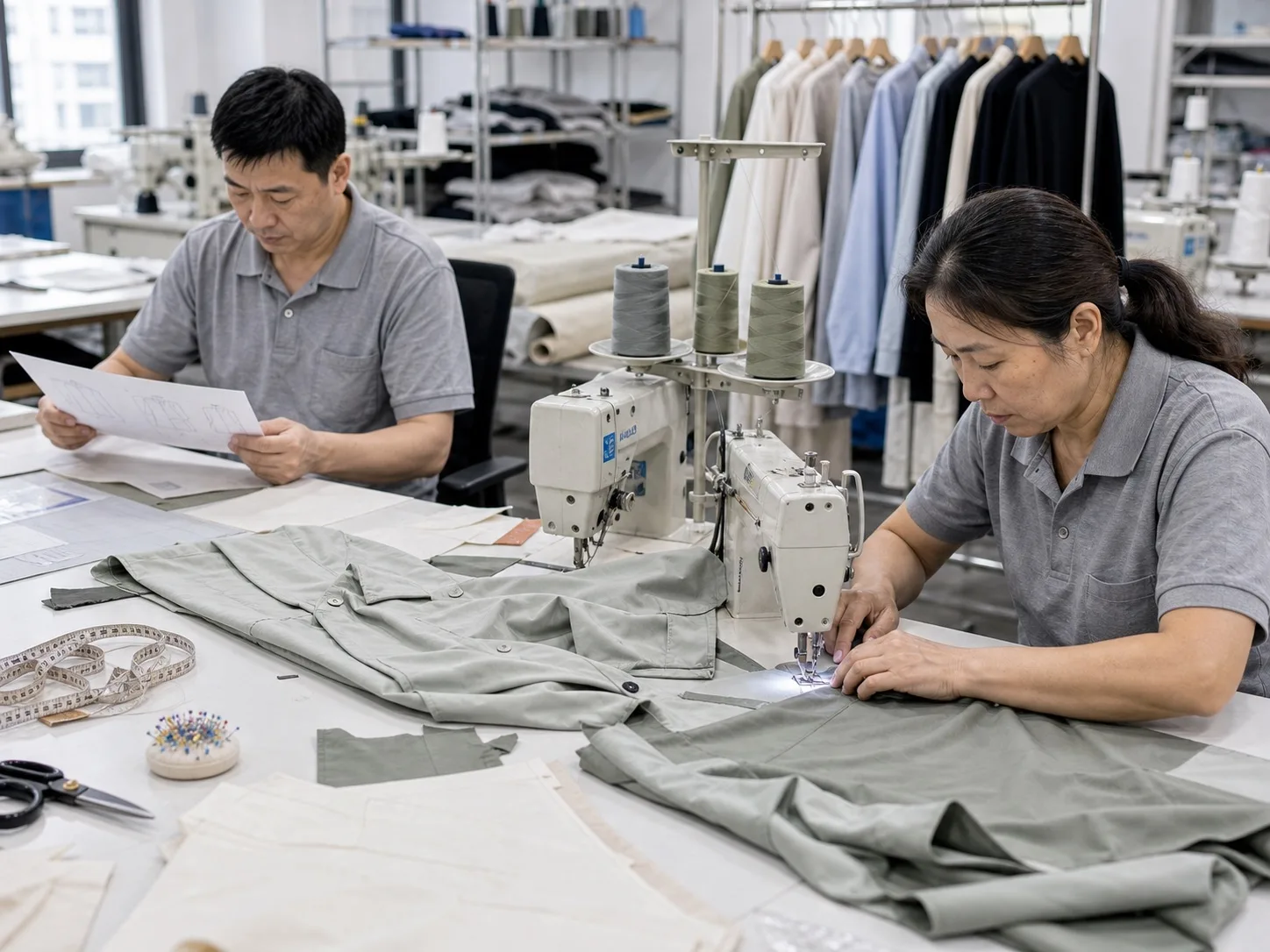
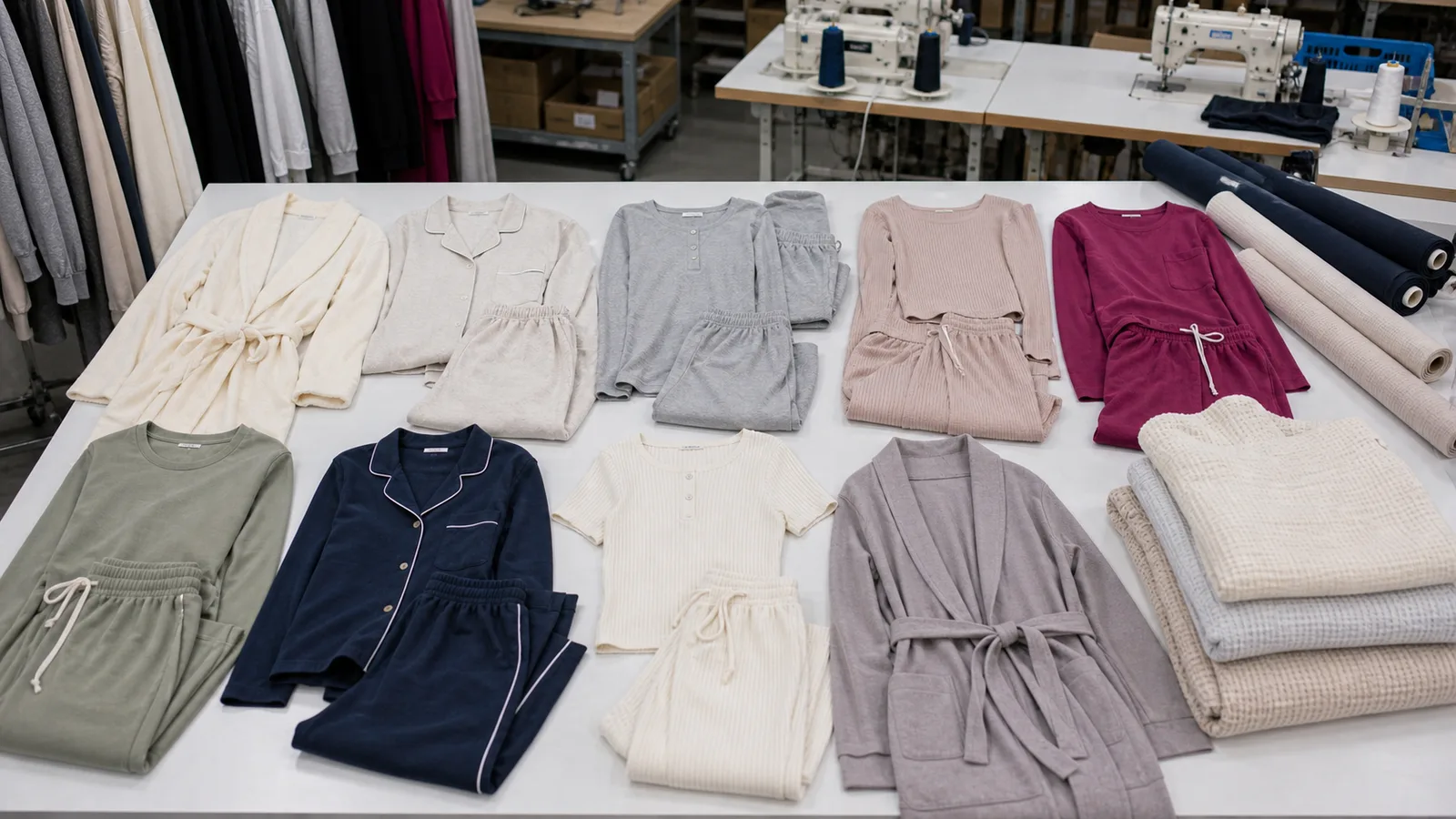
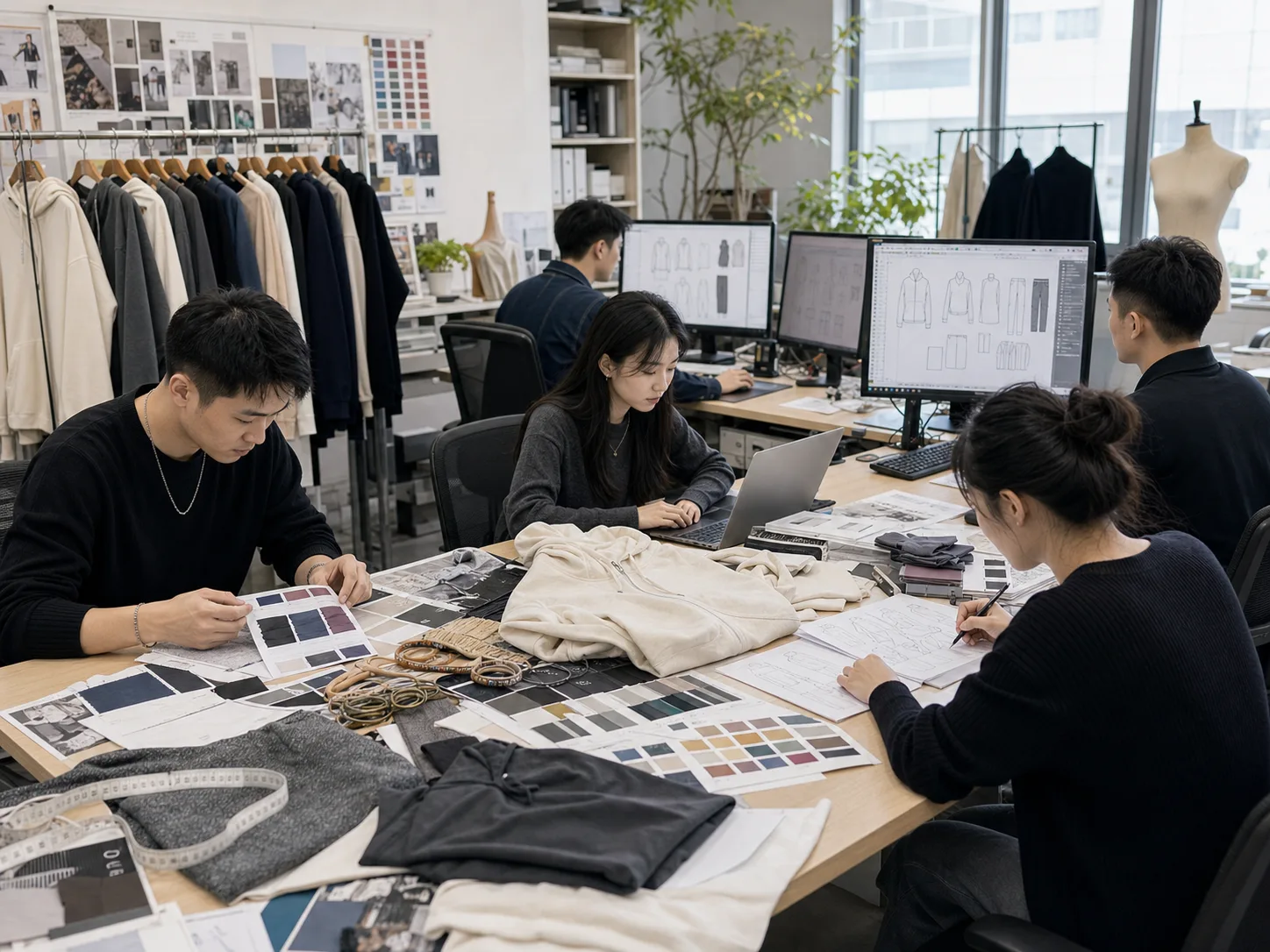
The supporting image in this article shows a design-development setting with swatches, garment references, and technical drawings. It illustrates a development conversation, not a customer order or a promise of a specific production capability. The hero image is a user-provided printed fashion reference with no visible watermark. It is used as inspiration for the buyer process, not as an approved material, print, or Yinshan Fashion production sample.
What should buyers check about translate construction details into visible priorities?
Construction is where a board’s impression becomes a garment. A gathered sleeve, exposed seam, corset-inspired bodice, wrap shape, collar, placket, pleat, ruffle, elastic, drawcord, button, zipper, contrast binding, or embroidered panel may look simple in an image while creating decisions about pattern, material, component choice, sewing route, support, movement, and finishing. A fashion design manufacturer should identify which of these details control the product’s perceived value and which can be altered without losing the original intent.
For each high-exposure feature, write a short description of the desired outcome. Instead of “same sleeve,” say “volume concentrated at the sleeve head, with a controlled cuff and enough room for natural arm movement.” Instead of “use a nice zipper,” state whether the closure must be invisible, decorative, firm, flexible, front-facing, back-facing, or hidden at a side seam. This gives a factory team something it can review in a sample.
Do not hide unresolved construction questions. A buyer may want a low visual neckline but still be deciding on coverage; a gathered skirt but still be deciding on lining; a slim blouse but still need enough sleeve movement; a lace-like surface but not yet know the backing or seam finish. Naming the open question lets the design and factory teams propose a sample objective rather than introducing an unrecorded compromise.
How should buyers build a product page for every first priority style?
Once the mood board has been interpreted, the collection needs a concise style-level brief. It does not need to be a finished technical package on day one, but each first-priority product should have its own page or section. Include style name or code, category, front and back visual references, silhouette, target customer, intended fit, size range, material direction, colour or print, construction features, components, branding, packing route, sample purpose, quantity assumption, and open decisions.
The reason is practical: one collection image may inspire multiple garments, but each garment has a different production path. A dress and a blouse can share a palette while requiring different fabric behaviour, pattern work, lining, closure, labels, and fit review. A girls’ top can share a print concept but need a different size and comfort discussion. Style-level pages keep a supplier, manufacturer, and factory team from applying one product’s solution to another by accident.
Use version labels from the start. A buyer can change a photo, colour, trim, or fit note without losing the earlier discussion if the current version is clear. Mark the date, reviewer, change, and question that the latest file is intended to answer. This is light-weight change control, not bureaucracy. It protects the buyer’s design intent while making it easier to compare sample feedback with the correct reference.
How should buyers choose a sample purpose before asking for a sample?
The word “sample” can describe very different work. An early development sample may test whether a visual concept is feasible. A fit sample may focus on silhouette, measurements, proportions, and wearer movement. A material sample may assess drape, opacity, print, colour, or surface. A pre-production sample may bring the approved pattern, material, components, labels, and packing together before the bulk release. Each has a different purpose and should not be assessed as though it proves everything.
Before a fashion manufacturer starts, the buyer should name the decision required from the sample. Is the question whether a fabric can achieve the desired shoulder shape? Whether a print has the right scale on a dress? Whether a sleeve has the intended volume without restricting movement? Whether the label package and folding route present the garment correctly? The next sample should answer the highest-risk unanswered question, not simply become more polished.
Yinshan Fashion can help sequence custom development through reference review, fabric and fit discussion, pattern work, sample coordination, and production communication with cooperative factories. This does not mean every idea needs the same number of samples. It means the team should identify which proof reduces the buyer’s real risk at each step, then record what the approved version does and does not control.
How should buyers keep private-label presentation in the same brief?
Private-label details belong in product development because they affect how the garment is experienced by a retailer, warehouse, and end customer. Main labels, size labels, care and composition information, hangtags, barcodes, individual protection, folding or hanging direction, cartons, and shipping marks should not be left as disconnected messages at the end of sampling. They need to match the product’s material, construction, channel, and presentation direction.
For example, a delicate fashion dress might need a hanging route that protects the hem or trim, while a soft blouse may need a folding method that avoids a visible crease. The buyer should supply approved artwork and required text when available, but can also identify which points are still being developed. The private-label page is a starting point for structuring these inputs, while the final label and packing requirements stay programme-specific.
Tie the label and packing record to the exact style version. A changed neckline, material, care route, colour, or size range can affect what needs to be checked. Keeping these decisions beside the product image, pattern comments, fabric reference, and sample notes reduces the chance that a bulk garment is correct in construction but inconsistent in presentation.
How should buyers ask the manufacturer for an informed response, not blind agreement?
An effective supplier relationship is not based on a factory saying yes to every image. Buyers should expect a useful fashion design manufacturer to ask focused questions: What does this reference control? Which product is first? Which fabric behaviour matters most? How should the garment fit? Which detail is fixed? Which material or component is still open? What must the sample prove? How will the buyer approve it? What happens if a change is made after approval?
Those questions are evidence that the team is connecting creativity with production. They give the buyer a chance to make an informed decision about trade-offs. A design can often be achieved by more than one fabric, pattern, construction, or component route, but the routes may differ in surface, fit, comfort, complexity, sample scope, cost direction, and bulk risk. The buyer’s decision should be based on the desired product outcome, not just the first visible approximation.
Yinshan Fashion’s role is to help make that exchange usable across design, sourcing, sampling, and its long-term cooperative factory network. It does not replace the buyer’s brand decision. It gives the buyer a clearer development record so that technical and production teams can execute the agreed direction consistently.
What should buyers check about put buyer feedback in an order the development team can act on?
After the first review, group comments by product decision rather than by the order in which people notice them. Begin with the commercial intent: is the product category, target user, silhouette, and brand direction still correct? Then move to fit and material behaviour, then high-exposure construction and components, and finally labels, packing, and presentation. This order helps prevent a team from perfecting a trim while the buyer is still reconsidering the core shape or fabric route.
Each comment should name the current sample or brief version, the observation, the requested outcome, the owner, and whether the point is approved, open, or replaced. For example, “retain the current relaxed body; review a slightly firmer cuff on the next material sample” is much clearer than “make it more premium.” If two reviewers disagree, record the decision that controls the next step instead of asking the factory to average contradictory messages. A clear feedback order preserves creative discussions while protecting the development schedule from informal changes.
What should buyers check about release one production brief before bulk production?
Before bulk, consolidate the controlling references. The release record should identify the approved style and version, pattern or measurement reference, material and colour route, print or trim references, construction points, components, sample evidence, labels, packing, quantity structure, quality priorities, accepted exceptions, decision owner, and authorised changes. It should also state what evidence controls a question if it occurs at cutting, sewing, finishing, inspection, or packing.
The manufacturing workflow shows why this handover matters. An approved mood board alone cannot resolve a question on a factory floor. A versioned product brief can. If the buyer changes fabric, colour, print, trim, label artwork, packing, size chart, or a high-exposure construction feature after approval, the team should decide whether the old sample still proves the current product or whether a targeted review is needed.
For repeat programmes, do not assume that the original brief is automatically current. Compare fabric availability, colour or print version, material finish, pattern revision, components, labels, packing, size mix, destination, and quality priorities. A clear difference list allows the manufacturer and buyer to protect what worked while reviewing only what genuinely changed.
What should buyers check about buyer checklist: turn the mood board into a usable request?
Before sending a mood board to a fashion design manufacturer, confirm that it includes the intended product categories, priority styles, target customer, wearing context, reference purpose, required silhouette, fit questions, fabric behaviour, colour or print role, high-exposure construction details, component direction, branding, packing, sample objective, quantities, target market, decision owner, and open questions. Mark what is fixed, what is preferred, and what needs advice.
Send the strongest references, not the largest unlabelled collection. Include front and back ideas if they matter, identify which images are only inspiration, and say what a successful first sample should prove. Yinshan Fashion can use that information to discuss a custom private-label development route involving relevant materials, pattern and fit advice, sample coordination, and factory communication. The aim is to preserve the buyer’s creative direction while producing a brief that a supplier, manufacturer, and factory can act on with confidence.
Mood board to brief kit
Three controls that turn fashion inspiration into a workable factory brief
A usable fashion mood board assigns every reference a product role, turns the buyer’s priorities into style-level questions, and keeps one versioned record for sample and bulk decisions.
Annotate the inspiration
State whether each image controls silhouette, product role, fabric surface, colour, print, construction, styling, or private-label presentation instead of relying on an unlabelled collage.
Brief every priority style
Connect category, target wearer, fit, fabric behaviour, colour, construction, components, labels, packing, sample purpose, and open questions on a versioned product page.
Release one controlled version
Carry approved references, samples, materials, components, private-label details, quality priorities, exceptions, and authorised changes into a factory-ready production brief.
Buyer actions and manufacturer questions from mood board to production brief
Use one record to connect the creative direction with fabrics, fit, construction, samples, components, private-label presentation, quantities, and bulk-release decisions. Material availability, commercial terms, testing, timing, and production routing remain programme-specific.
| Decision area | What the buyer should prepare | What to ask the factory |
|---|---|---|
| Reference purpose | Label every image as a silhouette, product, fabric, colour, print, construction, styling, or presentation reference; identify fixed elements and open questions. | What does each image actually control, and which visible features are only inspiration rather than a literal product instruction? |
| Product role and priority | State category, target customer, wearing context, retail role, priority styles, target market, quantity assumption, and decision owner. | Which styles should develop first, and which product questions carry the greatest commercial risk? |
| Fit and material direction | Describe the intended silhouette, key measurements or ease, movement, fabric behaviour, opacity, texture, sheen, print, wash, and lining relationship. | Which pattern, material, or applied-garment evidence is needed before the intended fit and surface can be approved? |
| Construction and components | Identify high-exposure seams, sleeves, closures, pleats, support, trims, labels, and visible finishing; distinguish fixed details from points requiring advice. | Which detail affects appearance, comfort, fit, sample scope, or bulk risk enough to need a named decision? |
| Sample objective | Name the current sample version, question it must answer, inputs in scope, reviewer, required evidence, approved points, remaining questions, and next action. | Does this proof test feasibility, fit, material behaviour, print, construction, components, or a complete bulk-ready route? |
| Bulk release and change control | Retain the approved style version, materials, components, labels, packing, quantities, quality priorities, exceptions, and authorised changes. | Where is the controlling production brief kept, and which later change requires a targeted new buyer review? |
Continue the production conversation
From fashion mood board to production-ready brief
| Stage | Buyer decision | What to define | Working record |
|---|---|---|---|
| Reference review | Assign a job to every image | Silhouette, product role, colour, print, material surface, construction, styling, or presentation | Annotated mood board with fixed elements and open questions |
| Style brief | Prioritise individual products | Category, target wearer, fit, fabric behaviour, colour, components, labels, packing, sample purpose, and quantity assumption | Dated style page with version and decision owner |
| Sample route | Test the highest-risk product question | Fit, drape, opacity, print scale, construction, component, or presentation question | Sample version, evidence, comments, decision, and next action |
| Bulk handover | Release the controlled production version | Approved pattern, materials, components, labels, packing, quality priorities, exceptions, and change triggers | Production brief with authorised changes and controlling references |
Buyer FAQs
What does a fashion design manufacturer need from a mood board?
A manufacturer needs the board’s intended product categories, target customer, reference purpose, priority styles, silhouette and fit direction, fabric behaviour, colour or print role, construction details, components, private-label requirements, sample objective, quantity assumptions, target market, decision owner, and open questions. Annotated references are more useful than a large unlabelled collage.
Can a mood board replace a fashion tech pack?
No. A mood board explains inspiration and product direction; a style-level brief or technical pack provides the controls a supplier and factory use for development and production. The mood board should be translated into product, material, fit, construction, sample, label, packing, and approval decisions.
How should buyers describe fabric from a fashion reference image?
Describe the garment behaviour required: drape, structure, opacity, stretch, recovery, handfeel, sheen, texture, print response, wash direction, lining relationship, and exposed construction points. An image can inspire the material route but does not by itself confirm the exact fabric or bulk result.
What is the first sample supposed to prove?
The first sample should answer the most important open question, such as feasibility, silhouette, fit, fabric behaviour, colour or print scale, construction, component, or presentation. Its purpose should be named before it is reviewed so that it is not mistakenly treated as a final bulk approval.
Can Yinshan Fashion help develop a custom private-label fashion collection?
Yes. Yinshan Fashion supports custom and private-label bulk programmes by helping buyers organise product references, fabric and fit discussions, samples, private-label details, and factory communication. The final route, materials, quantities, commercial terms, tests, timing, and production conditions are confirmed for the specific programme.