Article
What should buyers know first?
Short answer: A private label nightwear ecommerce guide for online brands: connect comfort, fit, size charts, product data, packing and repeat-order decisions to the current garment version.
A private label nightwear ecommerce programme needs a product record that connects a soft, customer-facing promise with the exact garment, information and packing route a buyer can actually control. Online shoppers cannot touch the fabric, compare the rise against their own body or see how a set arrives in a parcel. The brand therefore needs to define what the listing must communicate, what the sample must prove and which team owns each release decision. Yinshan Fashion supports custom and private-label bulk programmes rather than unrestricted ready-stock wholesale, so the useful starting point is a defined product route, not a request for any available pajama.
Direct answer: build a single style-colour-size record for each sleepwear route. Connect the intended wearer and use occasion to the selected silhouette, fit basis, fabric direction, measurement chart, care-information source, labels, packing, product-page fields and repeat-order decision. A factory can review the physical garment and production inputs. The brand retains responsibility for the customer proposition, price, channel, market requirements and final commercial approval.
What does a private label nightwear ecommerce brief need to answer?
An online-nightwear brief should begin with the product's role, not the word “comfortable.” Is the piece a button-front pajama set, a slip-inspired nightdress, a relaxed knit tee and short, a travel set, a giftable robe or a homewear layer? Is it intended for sleep, a slow morning, travel, a maternity-adjacent edit, lounge styling or a specific seasonal story? These distinctions change the fit questions, component choices, imagery and packing conversation.
Describe the intended wearer, the route to market, the proposed style family, current reference version, planned colourways, base size, size range and the sample question. State what must remain unchanged and what still needs factory input. A mood board can explain a visual direction, but it cannot substitute for a garment record. It may not disclose which neckline, closure, pocket, waistband, cuff, label or folded presentation the team intends to release.
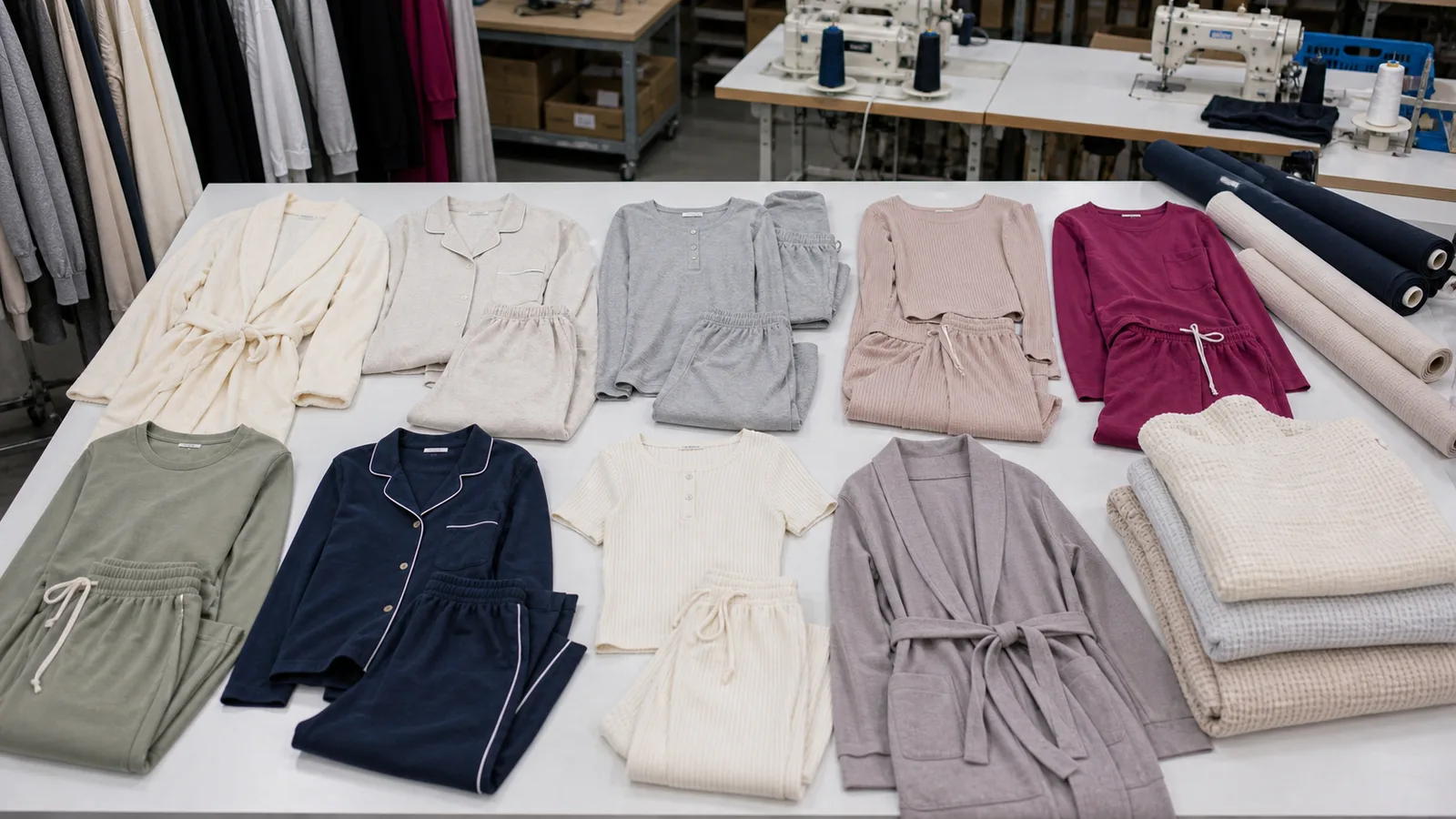
For a coordinated set, identify the selling unit. A top and bottom may share an illustration or fabric family, yet require different measurements, component records and quality observations. A robe with a belt may require a different packing instruction from a matching pajama even when both appear on one collection page. The pajamas collection is useful for discussing practical set shapes, openings and component relationships. It is a product reference, not a commitment that a pictured material, print or trim will be available for another programme.
Why is comfort a product-development question rather than a marketing claim?
Comfort is an outcome a shopper experiences through a combination of material hand, ease, seam placement, waistband tension, closure choice, label position, coverage and the setting in which the garment is worn. It is not established by a broad phrase such as “soft” or by a supplier's past sample. An ecommerce team needs language that accurately describes the current product without turning an early preference into a universal performance promise.
Write the desired physical experience as questions a sample can answer. Does the garment need a fluid or more structured drape? Is it intended to sit loosely at the body, or does the customer expect a closer fit? Does the waistband need a documented relaxed and stretched condition? Could a collar, placket, button, piping, label or inside seam create a point the team should observe on the sample? Name the wearer context and product decision instead of assuming that one fabric name proves the result.
The factory can discuss the selected material direction, construction and sample observations against the proposed garment. The brand decides how those observations become customer-facing copy. If the brand wishes to make a claim about breathability, thermal performance, durability or a particular care outcome, the claim needs evidence appropriate to the present product and the selling market. A soft-looking image and a supplier conversation do not establish it.
How should an ecommerce brand choose a pajama, robe or homewear route?
Separate the product architecture before requesting several samples. A first online launch may use one core pajama set to establish the size and construction language, a robe to test coverage and gifting presentation, and a lounge separate to learn how the material behaves in another silhouette. Treating all three as one generic “sleepwear” brief risks hiding the differences that affect fit, labels, product data and packing.
Use a named product record for every route. A pajama entry may identify its shirt, short or trouser, closure, pocket, waistband, sleeve, print direction and set pairing. A robe entry may identify lapel or collar construction, belt, loops, coverage, sleeve, fabric direction and fold. A homewear top may require a different review of neckline, hem, opacity, recovery or layering. The robe collection can help the team frame a wrap, belt and presentation question, while the current technical brief defines what the brand is actually considering.
Do not try to solve assortment breadth by copying every detail from one reference. A common colour story can still need separate component lists. A coordinated print can need a different scale or placement on a robe than on a short set. A prior launch photo may not match a new material, size range or channel. Record the connection between the styles, then preserve the decisions that remain product-specific.
How should fabric direction and fit be connected in a nightwear sample?
Give the factory a material direction, garment silhouette and sample purpose together. A fabric swatch can support a hand, surface or colour conversation. It does not by itself answer how a set will hang at the body, how a placket will sit, whether a waistband creates the intended relationship, or how a label feels against a particular construction. A constructed sample may be the useful proof for those questions.
Specify the desired feel and visible effect in clear but non-absolute terms. The team might be comparing a smooth surface, a relaxed drape, a light or more substantial direction, a degree of stretch, a matte or lustrous appearance, or a print ground. Then state which observations matter on the completed garment. A buyer can ask for an identified sample and record its material reference, colourway, measurement condition and open questions. If the material changes, the prior fit and product-page decisions should be reviewed rather than carried forward automatically.
Fit language needs the same discipline. “Relaxed” can refer to body ease, a dropped shoulder, a wider leg, a longer rise, a roomy sleeve or merely a styling image. Put the intended relationship in the measurement and sample record. Identify the base size, size range, critical points and how the garment should be laid out for measurement. The loungewear manufacturer solution provides a starting point for a product-specific factory conversation, not a blanket fit or material specification.
What should a sleepwear size chart explain to online shoppers?
The most useful size chart lets a shopper understand which garment measurements or body-reference information apply, which piece is being measured and how the product is intended to fit. It should be tied to the style-colour-size version being sold. A chart from a similar top, a previous fabric base or a different channel can create a misleading expectation even when the size labels look familiar.
For a two-piece pajama set, make it clear whether the chart covers both pieces and which points belong to the top and bottom. The shopper may need information about chest or body width, length, sleeve, waist, hip, rise or inseam depending on the product. The brand decides what it needs to communicate. The factory can review the supplied chart and sample relationship for the actual route. Avoid treating a generic grading rule or an early image as proof of every final measurement.
Explain the measurement condition where it matters. An elastic waist can look different when relaxed and when stretched. A wrap or tie front may need a different customer explanation from a button-front shirt. A garment measurement is not automatically a body measurement. If a brand uses a fit note, it should state the intended fitting relationship and be reviewed alongside the current product page, photography and sample rather than copied from an older listing.
The ecommerce size-chart handover guide offers a practical process for keeping product-page fields, measurement records and approval ownership connected. It does not replace the brand's decision about its customers, size communication or market requirements.
How do care, material and label details move into a product page?
The ecommerce owner needs a controlled source for product facts. Build a record for the current style-colour-size route that identifies the material description, care-information source, country or market information that requires review, label artwork, label placement, supplier-provided facts, product-page copy owner and approval status. A factory can confirm which supplied label and packing inputs relate to the present garment. The brand or responsible importer must verify final consumer-facing information and applicable obligations.
Do not fill unknown fields with an attractive generalisation. A care instruction copied from another garment may not apply to a different material, decoration, lining or construction. A product title may describe the collection role but not establish composition. A label file may be final artwork while its placement remains unreviewed. Keep these as separate fields so a marketing draft cannot quietly become a production instruction.
The ecommerce apparel product data pack is useful for mapping ownership across images, measurements, identifiers, labels and channel data. It gives a small team a way to distinguish an observed fact, an editable draft and a final approval. That distinction matters when a changed fabric, colour name or size range affects both the physical garment and the online listing.
What should product photography prove, and what should it not prove?
Photography helps a customer see silhouette, colour, garment pieces, visible details, proportions and styling. It can also reveal a product-page question: whether the back, cuff, hem, collar, print scale or belt arrangement needs another view. But a photoshoot sample does not automatically approve bulk fabric, fit, measurements, care information, labels or packing.
Before a shoot, state which version is being photographed and what each image is meant to show. A model image may communicate proportion. A flat or close view may clarify print, button route, texture or set pairing. If styling uses pins, hidden clips, underlayers, accessories or a tied belt that is not part of the garment specification, make sure the product team knows how the image may affect customer expectation. A visual result should not cause a shopper to infer an unconfirmed feature.
Link photography assets to the same product version as the measurements and product facts. When a later sample changes fabric, length, sleeve, colour, print placement or closure, identify which images and descriptions need review. This takes less time than trying to explain why a listing shows one version and the customer receives another. The buyer owns the final customer communication and launch decision.
How should labels, set identity and packaging be prepared?
Packing is part of the online product experience and a warehouse handover. Start with the sale unit. A pajama set can need a clear relationship between top, bottom, size identity, colourway, label, fold, bag, barcode and carton assortment. A robe can add a belt, hanger or different fold. A buyer should specify the selected channel, destination, recipient requirements and the source of any mandated data rather than assuming a prior instruction applies.
Create one packing record per applicable version. It can identify the garment pieces, labels, size or variant identifier, fold or hanger direction, protective materials, barcode or other data source, insert, bag, carton relationship, receiving condition and approval owner. The factory can review the defined instructions against the current product scope. Payment, fulfilment, marketplace and warehouse processes belong to the brand and named service providers, not to a generic factory assumption.
Run a practical cross-check before release. Can the warehouse team identify the same item that the product page calls a set? Does the size sticker correspond to the current chart? Does the packing reference match the displayed colourway? Has a changed belt, label or paper insert been recorded? The wholesale apparel packing requirements guide provides a broader handover framework, while the present route should retain only instructions confirmed for this nightwear programme.
Which customer-service and return signals merit a product review?
Returns, customer-service messages, ratings and warehouse observations can indicate a question worth investigating. They do not prove a factory cause or predict a fixed future rate. A comment about softness, size, colour, waistband, sleeve, transparency, a missing set component or a packaging issue may relate to the sold version, product-page wording, image styling, size guidance, fulfilment handling, channel policy or an observed physical defect. Start with the evidence and exact version.
Create a concise review record: style, colourway, size, channel, order or return context, customer wording, listing version, product image set, sample or bulk reference checked, owner and next decision. The action may be to clarify product copy, review a measurement field, check a returned unit against the current reference, investigate a named material or construction observation, contact a warehouse partner or leave the specification unchanged because the evidence is inconclusive.
This protects both the brand and factory. It keeps commercial feedback useful without turning it into an unsupported technical conclusion. The apparel return-reason analysis guide explains how a team can distinguish a signal from a verified cause before it changes the next sample or order.
How should a brand prepare a repeat order for ecommerce nightwear?
Begin with the exact version that was sold. Confirm the style code, colourway, size structure, material and trim references, approved sample or bulk reference, labels, packing instruction, product-page fields and any allowed exceptions. Then write every proposed change. A new colour, fabric base, print scale, sleeve, belt, size, label, fold, marketplace route or warehouse requirement can reopen a different decision.
Separate an approved repeat from a revised programme. A genuine repeat may need a current confirmation of the existing product record. A revised product may need a fabric review, new sample, updated size information, new imagery, label proof, packing review or commercial approval. Do not use “same as last time” to hide an unrecorded difference. Availability, quantity terms, timing, logistics and cost remain specific to the actual project and require a direct discussion.
The ecommerce fashion reorder-planning guide can help a team write a change list and decision gate. It is useful because it keeps factory and commercial questions separate. Yinshan Fashion can discuss the defined garment, fabric, sample, labels, packing and production-record questions. The brand's commercial owner decides whether the evidence supports a repeat, a revised launch or a hold.
How should ecommerce, product, customer-service and factory teams divide responsibilities?
Nightwear programmes often involve several evidence owners. Product development may own the current brief, sample comments and approved physical references. Ecommerce may own product-page fields, images, variant structure and channel rules. Merchandising may own assortment role and price position. Customer service, fulfilment or warehouse teams may hold the evidence behind a specific customer or receiving observation. The factory can review the defined garment, material, pattern, construction, labels, packing and production handover. A named commercial approver owns the final launch or reorder decision.
Use a decision log that distinguishes a fact, a proposal and an approval. A sample can show an observed neckline or waistband measurement. A brand may propose a new colourway. An ecommerce owner may need to approve its product-page description. A commercial owner may decide that the route is ready. These are different states. A shared document should not make an early suggestion look like a bulk release.
Consolidate factory questions around the product version and decision needed. Instead of forwarding a stream of unrelated comments, provide the style-colour-size record, source evidence, open question and intended next action. In return, a factory recommendation should identify the material, trim, construction or record it affects. The brand can then decide whether that difference also changes images, size guidance, labels, packing or customer communication.
What should a buyer send before asking Yinshan Fashion for a quote or sample route?
Send the strongest available brief: intended wearer and market, product category, reference images or retained sample, intended silhouette and fit, base size and range, material direction, colours or print, components, labels, packing direction, channel, quantity context, sample purpose and open questions. State whether the product is a pajama set, robe or homewear piece and whether any components belong to one sale unit.
Include product-page questions that may affect the physical route. For example, identify a feature that needs a clear measurement, a visible detail that needs a photo, a packing presentation needed for a particular channel or a customer-facing description that needs an approved source. Do not ask the factory to infer a brand's target price, promotion plan, platform rule or return-policy decision. Name the owner of those decisions.
Yinshan Fashion can use this information to discuss custom design, fabric options, pattern and sample questions, private-label details, labels, packing and production coordination. It cannot turn a partial mood board into a fixed MOQ, price, lead time, capacity commitment, test outcome or commercial result. Keeping open questions visible makes the next conversation more useful.
When is a nightwear ecommerce route ready, conditional or unsuitable for launch?
Use a named commercial approver and a written scope. “Ready” means the brand has the evidence it requires for the current style, colours, sizes, product information, images, labels, packing and channel route. “Conditional” means a specific proof, review or decision remains open. “Unsuitable” means the available information does not support the planned release. A completed spreadsheet, an attractive photoshoot or a factory message cannot make that commercial decision by itself.
Review the same current style-colour-size record across the sample, measurement information, product-page draft, images, labels and packing instruction. Mark proposed or unreviewed items clearly. If a material or design change affects any of those parts, name the owner and next proof rather than treating an earlier approval as universal.
This gate can be compact. Put the current product version at the top, list the evidence checked, show the unresolved condition and name the person who can make the next decision. For example, a route may be conditional because the team still needs to reconcile the waistband measurement and size-copy wording. That is a useful, bounded condition. It should not be concealed by a broad statement that the range is “almost ready.” Another route may be unsuitable for a planned marketplace launch because the selected sample, product images and packing file describe different colourways. The necessary action is to bring those records back to one controlled version, not to ask a warehouse or factory to infer which file is correct.
The same discipline helps a small team avoid duplicated work. When product, ecommerce and factory owners can see the exact evidence and condition, they can decide whether the next step is a focused sample review, a product-page revision, a packing confirmation or a commercial hold. It gives the supplier a clear question to answer while preserving the brand's ownership of the customer promise and launch decision.
When a brand is ready to move from concept to a controlled custom programme, contact Yinshan Fashion with the current brief, sample evidence, product-page questions and decision still required. The goal is a practical nightwear development route that preserves customer clarity and product control, not a generic promise that every sleepwear idea is ready for immediate production.
Nightwear ecommerce control kit
Three controls before a nightwear variant becomes customer-facing
Keep the current garment, customer information and packing handover connected to the same style-colour-size route.
Name the sale unit
Identify each garment piece, set relationship, colourway and intended customer role before building listing or packing instructions.
Release the current evidence
Connect the present sample, measurements, images, product facts, labels and packing record before a variant goes live.
Make changes visible
Use a change list for fabric, fit, print, label, fold, channel or size differences before calling a repeat the same product.
Buyer inputs and factory questions for online nightwear
Price, promotions, marketplace rules, fulfilment, customer communication and final commercial approval remain with the brand and its named service providers.
| Decision area | What the buyer should prepare | What to ask the factory |
|---|---|---|
| Product role | Provide the intended wearer, channel, sleepwear category, silhouette, sale unit, colour direction and current reference. | Which style record and sample purpose define the product route under discussion? |
| Fit and material | State the base size, range, measurement condition, fit objective, fabric direction and open comfort question. | Which swatch, fit sample or constructed proof can answer the stated question? |
| Listing and handover | Set product fields, images, size guidance, identifiers, labels, packing and receiving requirements for the selected route. | Which supplied label and packing files apply to this product version? |
| Repeat decision | Provide the sold version, change list, channel context, customer signals and named commercial owner. | Which approved record or proposed change needs review before the next route is discussed? |
Continue the production conversation
Private-label nightwear ecommerce: the record to review before a launch or repeat-order decision
| Decision area | Buyer or brand evidence | Factory input | Decision owner |
|---|---|---|---|
| Product role and comfort | Wearer, use occasion, silhouette, fabric direction, fit objective and current reference | Which material, construction and sample questions can the defined route answer? | Product owner confirms the intended product scope |
| Size and product data | Base size, range, measurement condition, listing fields, care-information source and asset version | Which supplied chart, sample and label files apply to the present garment version? | Ecommerce owner approves customer-facing data |
| Photography and packing | Image purpose, sale unit, variant identity, labels, fold, bag, barcode data source and receiving route | Which packaging instruction and product components belong to this version? | Brand and channel owners release the current handover |
| Returns and quality signals | Product version, channel, customer wording, order context, observed evidence and review record | What physical reference or identified observation can be checked before a production action is assigned? | Named reviewer distinguishes cause, action or no change |
| Repeat-order gate | Sold version, change list, commercial context, approvals still open and requested next step | Which product, sample, material, label or packing difference needs a fresh review? | Commercial approver decides repeat, revise, condition or hold |
Buyer FAQs
What should a private label nightwear ecommerce brief include?
Include the intended wearer, use occasion, style category, fit direction, fabric and colour direction, size range, components, product-page questions, labels, packing route, channel, quantity context, sample purpose, open decisions and named owners.
How should a private label nightwear ecommerce brand create a size chart?
Tie the chart to the current style-colour-size version, state what is measured and under which condition, identify set pieces separately, and review the chart with the approved sample and product-page fields before it goes live.
Can product photography approve nightwear for bulk production?
No. Photography can communicate the visible product, but it does not by itself approve fabric, fit, measurements, labels, packing, production scope or market-specific requirements.
Do sleepwear returns prove that the factory caused a problem?
No. Review the sold version, listing, size information, customer wording, channel and observed evidence before attributing a return to a factory cause or treating it as a fixed future rate.
What should an ecommerce brand provide for a nightwear repeat order?
Provide the sold style-colour-size record, material and component references, approved sample or bulk reference, labels, packing, product-page information, proposed changes and the commercial decision the brand needs to make.