Article
What should buyers know first?
Short answer: A practical buyer guide to linking fabric behaviour, finished measurements, sample evidence, and a pre-cut approval record before an apparel programme moves to bulk.
Editorial source: Yinshan Fashion’s product-development team. This is a buyer decision framework, not a substitute for a project-specific test method, care review, or market requirement.
A fabric does not need to “shrink a lot” to disrupt a garment programme; it only needs to change a measurement or placement that matters to the finished style. Clothing fabric shrinkage is the dimensional change seen after the relevant washing, drying, finishing, or relaxation route. Before bulk cutting, the buyer should make sure the material route, pattern, specification, sample, and care assumptions all describe the same finished garment.
Editorial source: Yinshan Fashion’s product-development team. This is a buyer decision framework, not a substitute for a project-specific test method, care review, or market requirement.
Why shrinkage is a product-development decision, not only a fabric issue?
Buyers sometimes hear “shrinkage” only after a wash test or a size complaint. That is too late in the process. A fabric’s dimensional behaviour can influence a style before the first bulk garment exists. A top may become shorter after a wash route; a trouser inseam may change; a collar can sit differently when the body fabric changes; a print can appear higher or lower if the finished panel dimensions change. The relevant outcome depends on the product, material construction, finishing route, intended care, fit expectation, and measurement point.
The useful question is therefore not “Will this fabric shrink?” in isolation. Ask: *What is the intended finished measurement, what process happens before that measurement is checked, and what material evidence supports the decision?* This shifts the discussion from a broad material promise to a production reference that a buyer, sample room, production team, and QC team can use.
Shrinkage can also interact with visual product decisions. A relaxed oversized sweatshirt may allow a different level of dimensional movement than a close-fitting jersey top. A washed streetwear style may deliberately rely on a garment treatment, while a clean woven blouse may need its balance checked after the intended finishing route. In all cases, the buyer should decide what is acceptable for the specific style before assuming that a generic fabric description resolves the risk.
How should buyers start with the intended finished garment, not an unprocessed fabric swatch?
A swatch is useful for colour, hand feel, surface texture, stretch direction, and early feasibility. It is not automatically evidence of the finished garment measurement. Before bulk, clarify whether the approved reference is raw fabric, fabric after a stated process, a sample garment, a pre-production sample, or a combination of those items. Each reference answers a different question.
The buyer’s measurement specification should describe the finished garment state that will be checked. If a garment is washed, brushed, garment dyed, heat set, or otherwise finished after sewing, the team needs to agree when the measurement is taken. If the product will be sold with a particular care direction, the buyer should identify whether that care assumption needs project-specific review before bulk. Do not rely on a message saying “same as sample” when the sample’s fabric or finishing route is not clearly identified.
A practical early action is to connect the fabric discussion to the intended product category. The needs of a stretch activewear piece, a heavyweight streetwear style, a soft lounge set, and a lightweight casual woven garment are not identical. Buyers can review Yinshan Fashion’s product directions while defining which fit, comfort, wash, or appearance priorities are fixed for their own programme.
How should buyers identify the material variables that can change dimensions?
Fabric behaviour comes from a combination of variables rather than a single fibre name. Construction, yarn or filament choice, knit or weave structure, weight, stretch, recovery, dyeing, finishing, cutting direction, and later garment processes can all matter. The correct conclusion for a specific programme must be confirmed from its actual material route; a generic statement about cotton, polyester, viscose, or a blend is not enough to approve bulk measurements.
For knit fabrics, a buyer may need to discuss course and wale direction, stretch, recovery, weight, and the way the fabric relaxes after handling. For woven fabrics, relevant questions can include construction, drape, finish, bias-cut panels, and the effect of any wash or softening process. For a bonded, coated, brushed, or special-surface material, the relevant evidence may be different again. The goal is not to ask every question on every project. It is to identify the variables that can change the finished style.
Trims and construction should not be ignored. Elastic, rib, tape, interfacing, linings, zippers, drawcords, embroidery backing, and seam direction can influence how a panel behaves or how a garment sits. If a body fabric changes but the trim reference remains the same, the buyer may need to review the combined result rather than only the fabric in isolation.
Buyers should also distinguish between a material observation and a commercial decision. A fabric team may note that a material needs relaxation before a particular check, while the product team still needs to decide the measurement state that represents the approved saleable garment. Both pieces of information are useful, but they are not interchangeable. The first helps establish a workable handling route; the second tells the brand, factory, and QC team what finished result they are trying to protect.
For this reason, a material reference should be traceable enough to avoid accidental substitution. A colour name alone is weak if several fabric qualities share that colour. A generic phrase such as “soft jersey” is also weak if the product depends on a particular weight, surface, stretch direction, or finish. Use the factory’s available reference system, then add buyer-facing notes about the characteristics that are commercially important. The record does not need to reveal confidential supplier information to be useful; it needs to let the project team distinguish the approved route from a lookalike alternative.
What should buyers check about turn a shrinkage concern into clear sample questions?
Vague questions create vague answers. Instead of asking a factory to “make sure it will not shrink,” give the product context and request the decision points that matter. State the style, intended customer, fit requirement, base size, key measurements, material direction, planned wash or finishing route, decoration, target market, and expected care direction if known. Then ask which points need a sample or material submission before bulk is released.
The buyer should identify the measurements that are commercially sensitive. For one style that may be body length and sleeve length; for another it may be inseam, rise, leg opening, chest width, waistband, collar opening, or a print’s distance from a seam. A measurement point needs a defined location, not only a label. “Chest width” is weaker than a clear instruction describing where and how the garment is laid and measured.
When a fabric or process changes, ask what else needs review. A revised material can affect pattern allowance, sewing settings, fit balance, decoration placement, label instructions, and the final sample route. This is not a reason to stop every change. It is a reason to give the factory and buyer one controlled decision instead of several unconnected messages.
What should buyers check about match the sample sequence to the material risk?
Not every product needs the same sample sequence. A straightforward style using a known material route may need a focused material and fit confirmation. A new fabric, a fitted silhouette, an active stretch construction, a garment wash, multiple panels, or a high-visibility retail programme can need a more deliberate route. The right sequence depends on the project and should be agreed before bulk planning, rather than inferred from a prior style.
A development sample can prove a concept, but it may use substitute fabric, temporary trims, an early pattern, or a different finish. A fit sample can resolve silhouette and measurement questions, but it may not yet represent the bulk material. A pre-production sample can become a stronger bulk reference once important material, trim, construction, decoration, and packing decisions are aligned. Buyers should ask which stage they are viewing and which conditions are still open.
When material behaviour could change the final garment, record the link between the approved sample and the intended bulk route. This may include the fabric reference, colour reference, process or finish assumption, pattern or specification version, key measurements, and a note of any remaining confirmation. That record helps avoid a development sample being treated as a full bulk standard by accident.
A buyer can ask for evidence at the moment it will influence a decision. Early in development, a swatch and product brief may be enough to choose a direction. Before a revised fit sample, the key question may be whether the fabric and process are close enough to assess balance and measurements. Before bulk cutting, the question becomes whether the final material route, specification, and production reference are aligned. Asking for the same document at every stage can create delay; asking for no evidence until final inspection creates a different risk. Match the request to the decision that must be made next.
For styles with several colours, fabrics, or components, clarify whether one approval applies across the programme. A sample in one colourway may not automatically resolve a different fabric colour, print base, contrast panel, or trim combination. The buyer should identify where a shared rule is reasonable and where a separate check is needed. This is especially helpful when a collection combines related silhouettes: the fabric direction may be shared, while the fit and finished-measurement risk is unique to each style.
How should buyers build a pre-cut approval record that production can actually use?
The purpose of the approval record is not paperwork for its own sake. It is to make the latest decision usable at the point when material is cut, garments are sewn, and QC reviews the finished style. A scattered trail of messages, marked-up photographs, and partial attachments makes it hard to know which instruction controls the order.
Use one versioned pack for each style. At a minimum, identify the style name or code, base size, approved sample or reference, measurement specification, fabric reference, colour reference, key trim details, planned process, decoration files, packing direction, open items, and the person who can resolve a difference. If an item remains conditional, write that condition clearly rather than presenting the entire style as unqualifiedly approved.
The decision table below can be entered in the site’s dedicated article table field when this draft is published. It is designed to help a buyer ask for evidence, not to impose a universal testing method or tolerance.
How should buyers check shrinkage alongside fit, grading, and decoration placement?
Dimensions matter because the garment has to fit and present as intended, not because a fabric number is interesting by itself. Once the team knows the finished material route, compare the sample’s balance and key points with the approved measurement specification. Consider body length, width, sleeve, rise, inseam, opening, pocket position, collar shape, hem behaviour, and other points that define the style.
If the programme includes a size range, confirm how the approved base-size decision connects to grading. A pattern adjustment made only to one measurement point can affect another area of the garment. The exact grade rules depend on the product and buyer requirement, so they should be reviewed by the people responsible for the pattern and specification rather than copied from an unrelated style.
Decoration needs its own check. A print, embroidery, patch, label, or pocket position may be specified from a seam, neckline, hem, or another defined point. If the finished panel dimensions change, the buyer should confirm whether the location is still correct in the approved finished garment. A digital artwork file alone cannot answer that question.
How should buyers keep bulk fabric, cutting, QC, and packing in one conversation?
Shrinkage management does not end when a sample is approved. Before cutting, the production team should know the material reference, the current pattern or measurement version, any finishing sequence, and the key checkpoints. During production, the relevant checks should reflect the style’s actual risks. At finishing, the team should review the garment in the finished state that the buyer approved. At packing, the presentation should still match the approved label, fold, hangtag, and protective-packing direction.
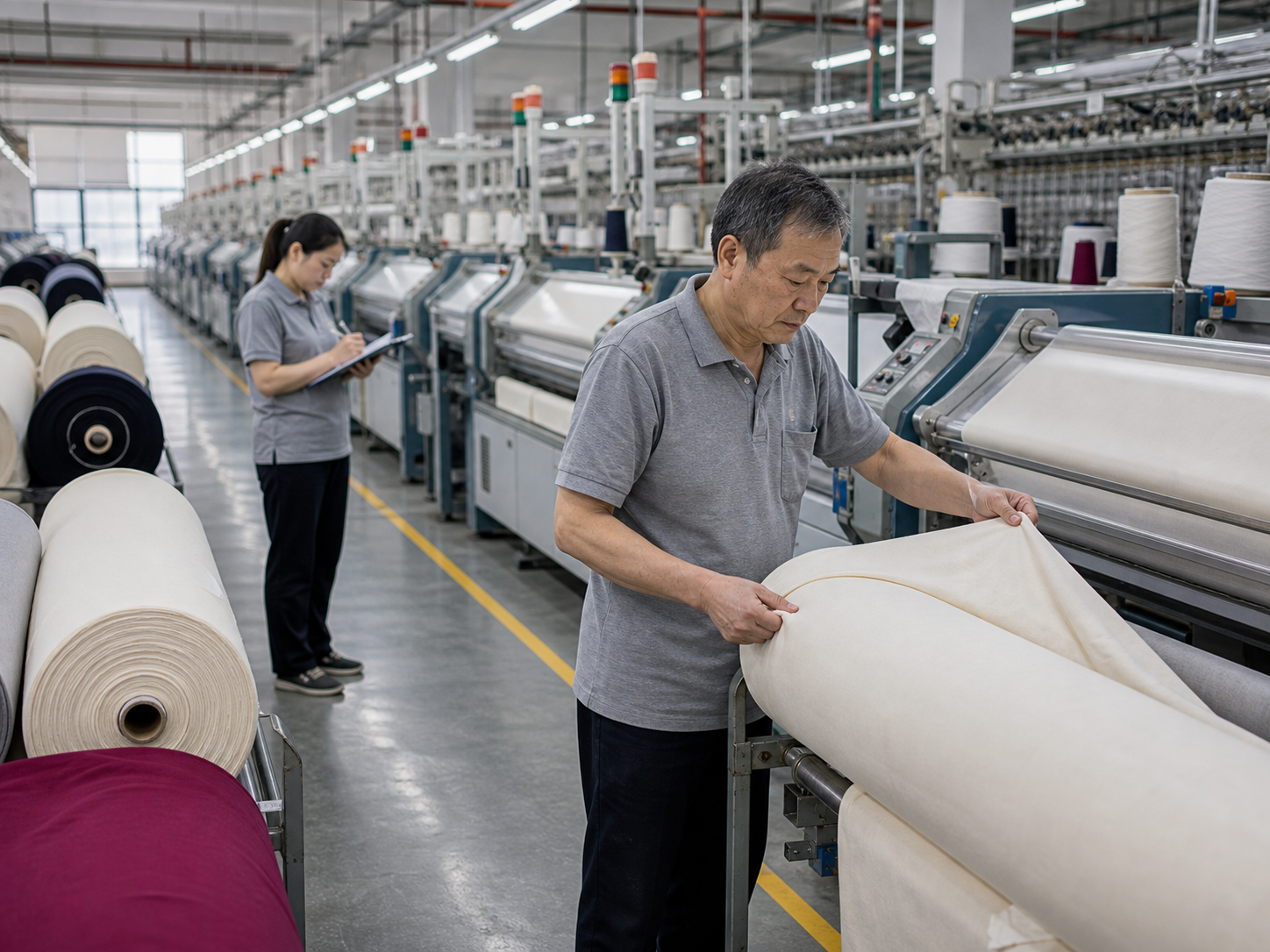
An organised process helps only when the instructions are complete. Buyers can use Yinshan Fashion’s fabric manufacture and sourcing support to frame the material conversation, then review the wider fashion production process to see how development, QC, packing, and export coordination connect.
For the buyer, the useful evidence is a clear chain: the material reference explains the intended fabric; the sample and specification explain the finished garment; the production record explains which version was released; and the QC or packing record explains what was checked. The exact documents vary by project, but the chain should not break between sample approval and bulk production.
The sequence should also identify where the buyer needs to make a decision and where the factory needs to report an observation. For example, a factory may flag that a material submission does not match the sample route closely enough to release cutting. The buyer then needs enough context to approve a correction, accept a stated exception, or request another review. A useful record says what was observed, which version it relates to, what options are available, and which person owns the final decision. It does not bury a production-critical point in a broad progress update.
When the product is intended for a retailer, marketplace, or buyer with its own specification, add those requirements to the same conversation early. The factory can discuss the project route, but the buyer remains responsible for confirming its own commercial, testing, care-label, and destination-market requirements. Treat them as inputs to the product approval pack, not as assumptions that can be reconstructed after garments are complete.
What should buyers check about control late changes before they become measurement surprises?
Late changes can happen for legitimate reasons. A buyer may revise a colourway, a trim may need an alternative, a material may need a different route, or a decoration file may be updated. The risk is not simply that something changes. The risk is that the change is treated as independent when it affects material behaviour, fit, finished dimensions, or presentation.
When a change is proposed, identify its scope. Does it apply to every colourway, only one size, the first order, or a future repeat? Does it change the fabric reference, wash or finish, pattern, measurement specification, grading, decoration placement, labels, packing, or cost assumptions? Record the answer and decide what evidence needs approval before production proceeds.
Do not treat an accepted exception as a hidden instruction. If the buyer accepts a particular material difference or sample condition, record what was accepted and why. This protects both sides from a later assumption that the exception represented the normal bulk standard.
Version control is important when the project moves quickly. Give the decision record a date and revision name, and make clear whether it replaces an earlier approval or adds a narrowly defined exception. If comments arrive from several buyer-side colleagues, consolidate them before sending the final instruction. A factory cannot reasonably follow two competing sleeve-length comments, two artwork versions, or a packing note that conflicts with the stated measurement reference. One current decision is safer than a large volume of messages.
The same discipline helps with factory-side substitutions. If a requested material, trim, or process cannot proceed as planned, the most useful response is not a broad assurance that it will be “similar.” The response should identify what differs, which garment attributes may be affected, and what sample, swatch, photo, measurement, or other evidence would allow the buyer to make a project-specific decision. This preserves the buyer’s control without making promises that have not been verified.
How should buyers prepare a repeat order by comparing records, not memory?
A repeat order is easiest when the first order leaves a clear record. Retain the final measurement specification, approved sample reference, material and colour direction, trim records, artwork, label and packing files, QC notes, and any change decisions. At the start of a repeat, compare the new request with those records rather than assuming that the old route automatically applies.
Even a repeat with the same style name may need review if colourways, fabric availability, finishing, labels, market, size range, quantity split, or target delivery window have changed. The buyer should be able to say which elements are unchanged and which need reconfirmation. That makes the repeat-order conversation faster and more accurate without claiming that any previous result can be reproduced automatically.
It is useful to begin a repeat-order review with a short comparison sheet. List the previous approved material route, the new requested material route, current colourways, trims, artwork, label files, packing standard, size range, and requested changes. Mark each line as unchanged, changed, or still to be confirmed. This gives the buyer and factory a practical way to focus on the differences instead of rereading an entire historical message trail.
Retained records also help a buyer decide when a new sample is sensible. If the fabric reference, finish, or fit-critical construction changes, the previous approval may no longer answer the current question. If the relevant inputs are unchanged, the buyer can still check that the retained record is complete and suitable for the new production plan. The right route depends on the style and current material availability, so it should be confirmed before the repeat is released.
The retained record should be easy for a new colleague to understand without relying on oral history. Include the date of the last substantive approval, the exact sample or material reference, the current specification version, and the unresolved items, if any. If a prior order involved an accepted exception, identify it separately from the normal standard. A later team should not have to guess whether a variation was deliberate, temporary, or simply never reviewed.
This approach also helps protect collection calendars. A buyer can see early whether a new request is a straightforward repeat, a material reconfirmation, a revised fit programme, or a new development route. That clarity makes it easier to allocate attention to the styles that genuinely need another approval instead of applying the same process to every garment regardless of risk.
What should buyers check about next step: start the material discussion before bulk is released?
Before asking a factory to cut bulk fabric, prepare a product brief or tech pack, reference sample or images, intended material direction, colourways, key measurements, decoration and trim details, planned finishing route, quantity plan, packing needs, target market, and target timing. To discuss a specific programme, share your fashion product brief so the material, sample, and bulk route can be reviewed against the actual style.

Finished-measurement control
Three checks that keep fabric behaviour connected to the finished garment
A shrinkage discussion is useful only when the buyer and factory are talking about the same finished state. The material, process, measurement points, pattern, and sample need to describe one product rather than separate assumptions.
Define the finished state
State whether measurements are assessed before or after washing, drying, relaxation, pressing, garment dyeing, or another relevant process.
Review material in the garment
A fabric swatch cannot show every effect on finished length, width, drape, recovery, decoration placement, or construction. Use an appropriate sample route.
Keep one release record
Connect the approved material reference, specification, pattern-related decisions, sample result, and open changes before bulk fabric is cut.
Fabric shrinkage: buyer action and factory confirmation
Use this list to make the finished garment state visible before bulk. It is conditional guidance; the actual test, care route, and market requirements belong to the project.
| Decision area | What the buyer should prepare | What to ask the factory |
|---|---|---|
| Style and finished state | Provide the garment type, intended fit, base size, key measurement points, and the process completed before those points are assessed. | What exact finished state will the sample and bulk measurement reference represent? |
| Material reference | Identify the fabric, colour, construction, hand feel, finish direction, and any wash, dye, brushing, or heat-setting assumption. | Which material evidence belongs to this style, and which variable could change the finished dimensions or appearance? |
| Sample and specification | Confirm the sample purpose, final measurements, grading discussion, construction, decoration, trims, and unresolved questions. | Does the current sample use the relevant material and process route, and what needs review before it becomes the bulk reference? |
| Bulk release | Record the approval owner, material and colour evidence, current specification, and any point that remains conditional before cutting. | Which item must be closed before fabric is cut, and how will the final decision reach production and QC? |
| Repeat-order record | Retain the approved material, sample, measurements, pattern-related version, labels, packing, and accepted changes. | Which change in material, colour, finish, size range, or packing would require the previous approval to be revisited? |
Continue the production conversation
Clothing fabric shrinkage: buyer approval points
| Control area | What the buyer should confirm | Risk if it stays unclear | Useful evidence |
|---|---|---|---|
| Finished garment state | The process completed before measurement is assessed | Raw or early-stage material is compared with a finished garment | Written process assumption and approved sample reference |
| Material reference | Fabric, colour, construction, hand feel, and relevant finish direction | A later material is treated as interchangeable without review | Swatch, bulk material reference, and versioned notes |
| Key measurements | Base size, defined measurement points, and current specification version | Fit questions emerge after cutting | Final measurement specification and comment closure |
| Pattern and grading | Whether material or process changes require a pattern or grade review | One adjustment causes an unreviewed change elsewhere | Current pattern or specification record |
| Decoration and trims | Placement, components, and combined finished appearance | Print, patch, label, or trim sits differently on the finished garment | Annotated approval photos and trim or artwork records |
| Release to bulk | Open points, decision owner, and production-release status | Conditional points are mistaken for approved instructions | Versioned pre-cut approval pack |
Buyer FAQs
Does every clothing fabric need the same shrinkage review?
No. The appropriate review depends on the material, construction, finishing route, product category, fit expectation, intended care, and buyer requirement. The buyer should identify the variables that could change the final garment, then agree on the evidence needed before bulk production.
Can a development sample be used as the bulk measurement reference?
Sometimes it can support the decision, but a development sample may use substitute material, temporary trims, an early pattern, or a different finish. Confirm exactly what the sample represents and whether its material and process route match the intended bulk garment before treating it as the production reference.
Which garment measurements should a buyer prioritise?
Prioritise the measurement points that define the style’s commercial fit and appearance. Depending on the product, that can include body length, width, sleeve, inseam, rise, waistband, opening, collar, or placement relative to a seam. Define each point clearly in the measurement specification.
Does a fabric change require a new approval?
It may. Review whether the change affects the finished dimensions, hand feel, fit, sewing route, decoration placement, care direction, labels, or packing. The appropriate evidence depends on the project; do not assume a fabric substitution is interchangeable because its composition sounds similar.
What should be kept for a repeat order?
Keep the final sample or reference record, material and colour notes, specification, pattern-related version information, trims, artwork, labels, packing direction, QC notes, and a record of any accepted changes. Begin the repeat by comparing those records with the new request.