Article
What should buyers know first?
Short answer: Plan in-line quality control for garments with stage-specific checkpoints, traceable findings, containment, verified corrections, and useful factory reporting.
A photograph of someone inspecting a garment does not explain the scope of the check. Nor does a short message saying quality is good identify which styles, operations, or production groups were assessed. This guide focuses on the questions that make progress reports useful, particularly for brands managing an order remotely and trying to distinguish a controlled correction from an unresolved production problem.
How should buyers connect in-line quality control for garments to the approved product?
Start with the current product reference. Identify the technical pack, approved sample, measurement chart, material references, artwork, and any authorized changes. The checking plan should point to these documents so the production team knows what outcome is required. If the factory is working from a different revision than the buyer, even a carefully completed inspection record can describe the wrong specification.
Convert the features that matter into observable checks. A statement such as elegant appearance may express the design goal, but the checker needs a more specific reference for neckline presentation, seam appearance, alignment, or finishing. Agree which sample or illustration demonstrates the requirement and how uncertain observations will be reviewed. The buyer should not expect an inspector to infer a complete design standard from a mood board.
Review known development concerns before deciding the checks. A feature revised several times during sampling deserves a clear production reference and an appropriate verification point. The published guide to fashion factory sampling and production standards provides related context for that handover. Carry the resolved decisions into the production plan instead of allowing the checking team to rediscover the same questions.
What should buyers consider about place checks where the relevant feature is accessible?
Map the production route at a level that explains where important characteristics can be assessed. The buyer does not need a minute-by-minute account of every operation. The plan should show the stages at which materials, cut components, assembled sections, completed garments, finishing, and packing are reviewed as appropriate to the style. Ask why each selected checkpoint belongs at that point in the route.
Consider what later work changes or conceals. If a construction detail becomes difficult to see after another component is attached, discuss an earlier check with the factory. If the final appearance depends on a later finishing step, make sure the plan also includes assessment after that step. One convenient inspection station may not provide useful evidence for every characteristic of the garment.
For a dress collection project, the buyer may want separate attention to an internal construction detail and the finished neckline presentation. Those checks need different views of the product. Ask the factory to propose the appropriate sequence using the actual style, then record the agreed reference and response at each point. This makes the plan specific without prescribing an unsupported universal factory layout.
How should buyers review the first production output with a clear scope?
An early production review can test whether the approved instruction has transferred into the working process. Identify the styles, variants, operations, and product stage covered by that review. The first pieces should be compared with the current production requirements, and any differences should be recorded before they are treated as a new normal. Define who reviews the findings and who authorizes the next step.
Do not assume that one reviewed piece represents every colour, size, material group, or construction variation in the order. Ask the factory which differences require their own verification and why. A style using two materials may need a different discussion from a style with only a label variation. The review scope should follow the actual changes that could affect the result, not the convenience of selecting one attractive sample.
Keep the evidence concise but identifiable. Include the production reference, date, relevant variant, observations, and decision. If a correction is requested, retain a record of the corrected result and its approval. A photograph without product identity may be hard to connect to the order later; a short annotated record can be more valuable than a large gallery of unlabelled images.
How should buyers ask how material identity follows the work?
Quality discussions should include the identity of the materials being used. CottonWorks' garment quality control overview identifies fabric characteristics, fit, seam integrity, and product performance as distinct aspects of garment quality. For an order review, this supports asking which material and construction references the factory is checking rather than looking only at the finished garment's surface appearance.
Ask how the production team distinguishes approved fabrics and components from alternatives, pending items, or materials assigned to another order. The records may be simple, but they should make the actual material choice traceable. If production uses several identified groups, discuss whether any additional separation or verification is required for the project. The buyer should be able to understand the arrangement from a brief explanation and relevant evidence.
When a material question arises, record the affected work and stop the uncertainty from spreading through the order. The factory should identify what has been used, where the related work is located, and what remains unused. The buyer can then review the issue with the appropriate references. A proposed substitution should follow an approval process rather than being introduced as an undocumented correction during production.
How should buyers define the check and its recorded result?
For each checkpoint, identify the characteristic, reference, method, scope, responsible role, and reporting requirement. The method should be clear enough that two people can understand what was assessed. A visual comparison, a measurement, a functional observation, and a laboratory test are different activities. Use accurate names and avoid allowing a general inspection label to imply work that was not performed.
A leggings programme might require production checks linked to the approved seam presentation, waistband construction, dimensions, and branding position. These are examples of topics to define, not a complete specification for every legging. The actual checklist should reflect the style's approved requirements and any separate performance assessment arranged for the product.
Decide how a satisfactory result and an uncertain result will be recorded. A blank field should not mean both not checked and checked with no issue. Use distinct statuses, and provide a short explanation when a check cannot be completed. That distinction helps the buyer interpret the report honestly and directs attention toward evidence still needed before the order advances.
How should buyers choose checking frequency with the factory's process in view?
Ask the factory to explain how often each check occurs and what prompts an additional review. Relevant triggers can include the start of a style, a material or component change, an adjustment, a restart, or a repeated finding. The appropriate arrangement depends on the product and process. This article does not prescribe a universal interval or claim that a particular percentage is sufficient for every order.
Record the agreed approach in terms the team can follow. If the plan calls for a review at defined production events, name those events. If it uses a documented selection or sampling procedure, identify that procedure and the responsible person. Avoid a vague promise of frequent checks, because it offers no basis for understanding the observations or investigating a gap later.
The buyer should also ask what happens when findings increase or a new concern appears. The factory may propose additional checking or a change to the control point, but the action and reason should be visible. A stable routine is useful; a routine that cannot respond to evidence is less useful. Keep the checking plan connected to what the production team is actually learning.
How should buyers keep measurement records comparable?
Measurement records need a shared method as well as a target value. Identify the garment condition, points of measure, units, measuring approach, nominal dimensions, and tolerances. Where production-stage measurements differ from finished-garment measurements, explain the relationship in the approved instructions. The buyer should not compare unlike readings simply because both appear under the same familiar dimension name.
For an oversized hoodie project, the intended shape may depend on several dimensions working together. A checker should use the specified reference points rather than choosing whichever seam or fold is easiest to locate. If a reading is disputed, review the method and product condition before deciding whether the garment or the record needs correction.
Preserve actual readings when the plan requires them. A pass-only summary may be sufficient for some checks, but it can hide information needed to understand a developing concern. Agree the level of detail with the factory and keep it proportionate. The objective is a record that supports a decision, not a large volume of numbers collected without a clear purpose or review owner.
How should buyers describe findings so another person can recognize them?
An actionable finding identifies the product, operation or stage, location on the garment, observed condition, and relevant requirement. Add a photograph when it clarifies the issue, with enough context to show where the close-up belongs. Avoid descriptions such as bad sewing or wrong shape when a more specific observation can be made. Those broad labels create unnecessary interpretation work for the person expected to correct the problem.
Separate observation from suspected cause. A checker may observe a visible irregularity without knowing which process condition produced it. Record the finding first, then ask the responsible technical team to investigate. If a proposed cause is later confirmed, add the evidence to the issue record. This preserves the difference between what was seen and what the team concluded after review.
Use an agreed defect vocabulary, but do not let classification replace description. The same category can contain several different product issues, each requiring a different response. The buyer needs enough detail to assess the consequence and confirm whether a proposed correction restores the approved requirement. A severity label by itself rarely provides that information.
What should buyers consider about contain affected work before deciding the correction?
When a finding suggests that other work may be affected, ask how the factory identifies and controls that population. The response should distinguish units known to have the issue, work requiring assessment, and work shown to be unaffected. The appropriate boundary depends on the evidence. Avoid assuming either that only the observed garment is affected or that the whole order necessarily has the same problem.
Record where the affected work is located and what status it carries. Items awaiting a decision should not be indistinguishable from approved work moving to the next stage. The factory can propose a practical identification and separation method suited to its workflow. The buyer needs confirmation that the arrangement is understood by the people handling the garments, not simply written in an email.
Keep containment and cause investigation connected but separate. The team may need to control the affected work while the exact cause is still being examined. Waiting for a complete explanation before identifying the potentially affected goods can make later decisions harder. Ask for an initial containment record, followed by the investigation and proposed correction when the relevant evidence is available.
How should buyers verify the correction against the original requirement?
A correction should specify what will be changed, which goods it covers, and how the result will be checked. Ask whether the proposed work restores the approved specification or creates a different product condition that requires buyer approval. The distinction matters: a repair that resolves one visible issue may introduce another difference in appearance, dimensions, or construction that needs review.
Review a suitable corrected example before extending the action when the project requires that evidence. Identify the garment and original finding, show the proposed result, and document the decision. The factory should then apply the authorized instruction to the defined population and retain the agreed verification record. Do not describe a proposed repair as completed merely because a demonstration has been approved.
Check the outcome at the relevant later stage as well when the correction could be affected by subsequent work. This is a planning question for the technical and quality teams, not a reason to invent a universal retesting schedule. The buyer should understand what evidence closes the issue and what remains pending. Closure needs an accepted result for the affected work, not only a statement that the team has been reminded.
How should buyers define who can pause and restart affected work?
The control plan should identify the authority to hold affected work, request a technical review, approve a correction, and authorize a restart. These responsibilities may sit with different people. Make the distinction explicit so an operator or checker can escalate a concern promptly without being expected to make a commercial or design decision outside their role.
A restart record should identify the issue, action taken, evidence reviewed, and scope of the authorization. If only one operation or variant is affected, the record can be correspondingly specific. If the concern has wider implications, the responsible team should evaluate them before continuing. The buyer should not have to infer the restart condition from a general progress update.
Use the first output after the change to confirm the intended result under the agreed plan. A correction to an instruction or process is not complete merely because the change was communicated. Record the verification and any follow-up monitoring that the factory proposes. This gives the buyer a clearer view of whether the issue is controlled and helps the production team avoid repeating the same unresolved adjustment.
What should buyers consider about read production figures with their denominator and context?
A useful report explains the population behind each count. Units checked, units with findings, individual findings, repaired units, and units awaiting a decision are different measures. Define them before comparing reports. If the same garment is checked twice, the record should make that visible where it affects interpretation. Otherwise, an apparent improvement or increase may reflect a reporting change rather than a production change.
Consider a purely hypothetical example: a checkpoint record lists forty garments checked and six garments needing attention. A later record lists eighty garments checked and eight needing attention. The second count is higher, while the observed share is lower. Neither comparison alone establishes the cause, the condition of the whole order, or whether the checks covered comparable work. The buyer needs the operation, variants, selection approach, and issue descriptions as well.
Use figures to direct questions rather than to manufacture certainty. A repeated finding at one stage may justify investigation even when a summary percentage appears small. A change in checked product mix may explain a different pattern. Ask the factory to connect the data with actual observations and actions, and avoid presenting in-process counts as an estimate of the final shipment's exact defect rate.
What should buyers consider about request remote evidence that answers a specific question?
Before asking for more photographs, define what the buyer needs to decide. A full-garment view may show overall presentation, while a close view may show the location of a seam concern. A measurement image may need the reference points and garment condition to be understandable. Give a focused evidence request so the factory can produce a useful record without guessing what the buyer is trying to assess.
Ask for identity and context beside the visual evidence. Style, variant, stage, date, and issue reference are often more useful than a large file size. If the evidence cannot establish the required point remotely, say so and agree the appropriate next step. A buyer should not record a full approval from images that only show a narrow feature or conceal the relevant part of the garment.
Respect the boundary between communication and verification. A video call can clarify a production question, but it does not automatically provide independent confirmation of every statement made during the call. Record what was demonstrated and what was reported, then identify any additional evidence needed. This keeps remote collaboration practical while preserving an accurate account of how the decision was reached.
How should buyers carry unresolved issues into final inspection readiness?
Before the order moves to final inspection, review the in-process issue register. Identify which findings have been closed, which corrections require later verification, and which decisions remain open. The final inspection team should receive the relevant history and current product references. It should not have to reconstruct a series of changes from disconnected messages or assume that silence means all earlier concerns were resolved.
Keep the final acceptance procedure distinct from the production checking routine. In-process checks help the team respond during manufacture; the final inspection has its own defined scope and decision criteria. A reassuring production report does not authorize the buyer to skip an agreed final requirement without an explicit, informed decision. Likewise, a final result should not erase the history of issues that were corrected during production.
Use the handover to verify product identity and quantity as well as quality status. Corrected or replacement work can change allocation and packing records. Confirm that the identified goods presented for final assessment correspond to the current order and release plan. This closes the gap between resolving an issue on the production floor and ensuring the right goods are included in the eventual shipment.
What should buyers consider about turn repeated findings into a better next-order brief?
After the order, review the findings that required the most clarification or repeated work. Ask whether the original requirement was clear, whether the checkpoint was well placed, and whether the evidence arrived in time to support a decision. The purpose is to improve the next handover, not to assign blame from an incomplete report. Separate confirmed lessons from assumptions that still need investigation.
Update the relevant technical documents when the buyer has authorized a lasting change. A successful correction may restore the existing requirement, or it may lead to an approved revision. Record which occurred. Future production teams need a clear current instruction, while the development history should explain the reason for important changes. Do not let an order-specific concession become an undocumented standard.
For a repeat programme, agree which lessons alter the checking plan. A revised illustration, a clearer measurement method, or a different evidence request may make the next order easier to manage. Retain only the controls that serve a defined purpose and add new ones where the evidence supports them. The best report is the one that helps the team recognize a deviation and make the correct next decision.
Keep an example of the agreed report format with the next order brief. A completed example shows how much detail the buyer expects and how findings connect to decisions. Remove information that belongs only to the previous order, then confirm the new style and process requirements. This makes the reporting request concrete while leaving room for the factory to propose a more suitable control point or record when the product changes.
What should buyers consider about three actions for a clearer production report?
Action 1: Agree the evidence fields
Define product identity, stage, check method, findings, responsible role, and result status. Keep unchecked and satisfactory results distinct.
Action 2: Trace one issue to closure
Ask the factory to show the observation, affected-work boundary, correction, verification, and authorization for a resolved issue. Use the example to clarify the reporting format.
Action 3: Review the final handover
Carry remaining issues and controlled changes into the final inspection pack. Confirm that corrected goods and quantity records remain aligned.
How can buyers discuss next steps with Yinshan Fashion?
Send your style specification, approved sample references, development concerns, and proposed quality reporting requirements through Yinshan Fashion's project contact page. The custom or private-label discussion can then connect the garment's actual requirements with a practical production checking and handover plan.
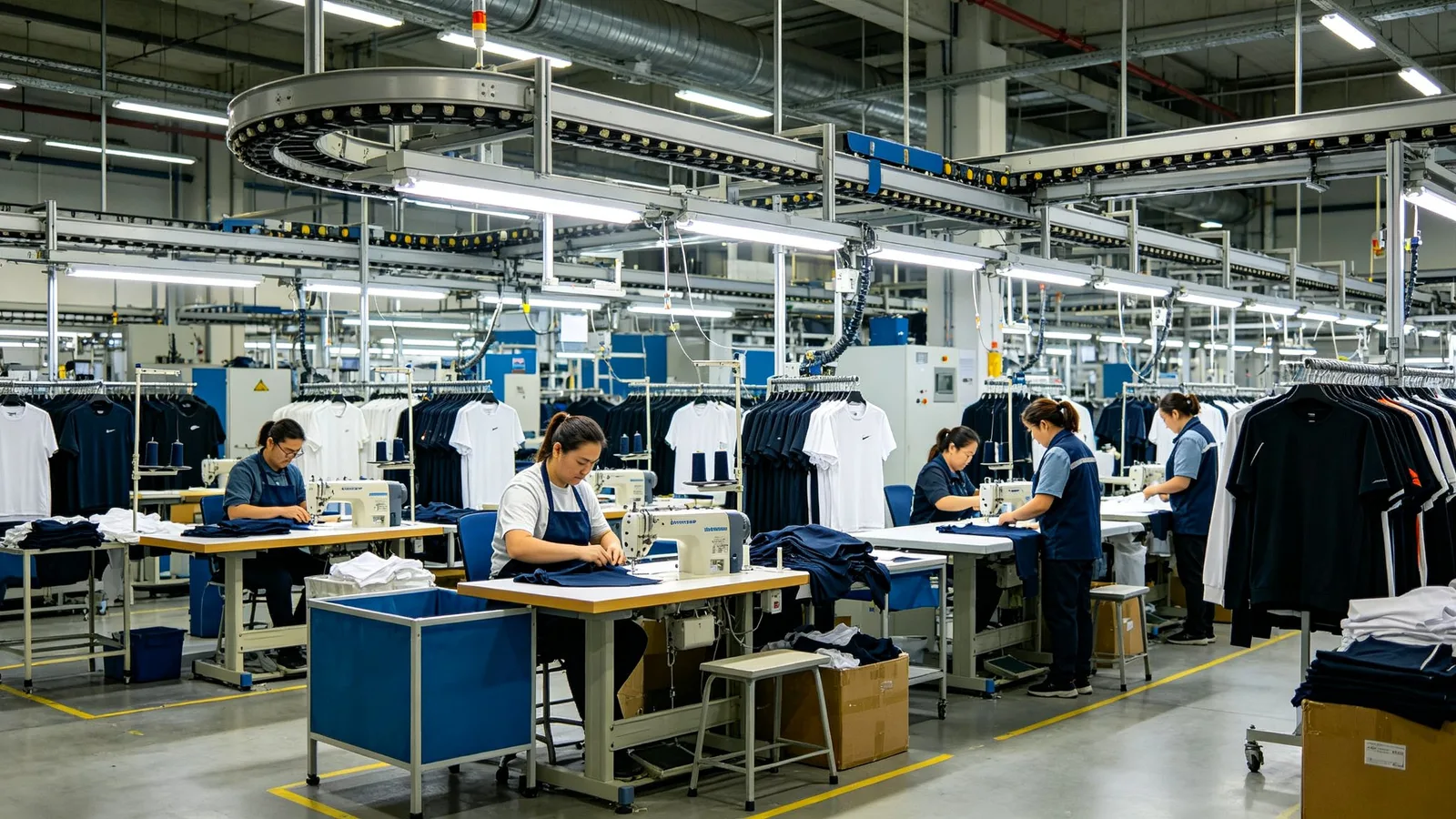
Factory Production buyer guide
In-Line Quality Control for Garments: What Buyers Should Ask to See
Plan in-line quality control for garments with stage-specific checkpoints, traceable findings, containment, verified corrections, and useful factory reporting.
Confirm the product brief
Connect in-line quality control for garments, intended use, materials, fit, quantities and approvals in one current product record.
Review the next proof
Use the next sample, material swatch or applied component to answer a named buyer question.
Record release decisions
Keep approved scope, open conditions and changes connected to the current product version.
Buyer and factory handover checklist for in-line quality control for garments
Use these prompts to make the current product decision reviewable. Confirm market requirements and commercial details for the specific programme.
| Decision area | What the buyer should prepare | What to ask the factory |
|---|---|---|
| Approval point 1 | supply approved product references, clear requirements, and the authority for specification changes. | propose checkpoints, checking frequency, responsible roles, and escalation triggers. |
| Approval point 2 | define the evidence needed for remote decisions and final release conditions. | record findings, control affected work, and verify authorized corrections. |
| Release and repeat | Record the current requirement, reference and approval owner for this product decision. | Which proof or record should confirm the decision before the next stage? |
Continue the production conversation
Decision table: useful evidence at each control point
| Buyer question | Evidence to request | What it helps decide |
|---|---|---|
| Is the current specification being used? | Reference list and revision identity | Whether checks address the approved product |
| Has the instruction transferred into production? | Identified early-output review | Whether the next stage is ready |
| What exactly was found? | Observation, location, image, requirement | The scope and significance of the issue |
| Which work may be affected? | Traceable containment record | What needs review or correction |
| Did the correction work? | Defined action and verification evidence | Whether the issue can close |
| Can affected work restart? | Authorized restart record | The scope of permitted continuation |
| What remains before final inspection? | Open-issue register and current references | Final assessment readiness |
Buyer FAQs
Is in-line quality control for garments the same as final inspection?
No. It supports decisions during production. Final inspection has a separate scope and acceptance procedure agreed for the goods presented.
How often should production checks happen?
Agree the approach with the factory based on the product, operations, changes, and observed concerns. A universal interval cannot be assumed to suit every order.
What should a useful finding record contain?
Identify the product, stage, location, observed condition, relevant requirement, and action status. Add visual evidence when it helps another person understand the issue.
Does a corrected sample close an issue for the whole order?
It demonstrates the reviewed example. Closure for the affected work requires the agreed correction and verification records covering that work.
Can remote photographs replace every other check?
No. They support specific observations. If the required decision needs measurement, testing, physical review, or independent verification, arrange the appropriate evidence.